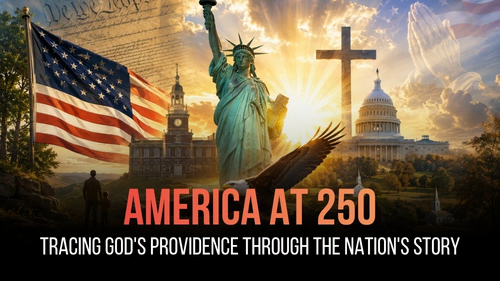
America at 250: Tracing God’s Providence Through the Nation’s Story

On July 4, 2026, fireworks will burst across American skies. Children will wave flags. Families will gather. But beneath the celebration lingers a question: How has this improbable experiment in self-governance survived for two and a half centuries?
The odds were never in America’s favor. A ragtag collection of colonies declared independence from the world’s most powerful empire. They survived civil war, depression, world conflict, and social upheaval that toppled other nations. Yet here we stand, 250 years later, still enduring.
Many Americans throughout history have offered the same answer: providence, the belief that a sovereign God guides the affairs of nations through human choices and historical circumstance. It’s an old-fashioned word, but it was the vocabulary the Founders used. Tracing that thread through 250 years of American history reveals something profound about who we’ve been and who we might yet become.
The Founders and Providence
The men in Philadelphia in 1776 knew exactly what they risked. The Declaration of Independence closes with a remarkable phrase: “with a firm reliance on the protection of divine Providence.” Not ceremonial but fundamental.
George Washington reflected on his army’s survival with wonder. He had watched them nearly starve at Valley Forge, cross the Delaware on Christmas night when surrender seemed rational, and win battles that defied military logic. He attributed their survival to “interposition of Providence.”
Benjamin Franklin, the least conventionally religious Founder, nevertheless told the Constitutional Convention: “The longer I live, the more convincing proofs I see of this truth—that God governs in the affairs of men.”
These weren’t naive men. Yet across theological differences, they shared conviction that their success depended on more than strategy and muskets.
Against All Odds
The Revolutionary War should have ended in defeat. Britain possessed the world’s most powerful navy and professional army. Yet history turned on moments that felt like grace.
In August 1776, Washington’s army was trapped on Brooklyn Heights, surrounded and seemingly doomed. Then a dense fog rolled in, thick enough to hide 9,000 men as they evacuated across the East River. By morning, all had escaped. The fog lifted as the last boat departed.
Valley Forge tested faith further. Men wrapped feet in rags and left bloody footprints in snow. Yet from that crucible emerged a professional army, forged by shared suffering into something cohesive.
Looking Forward
What does providence mean for America at 250?
It means gratitude. For all our flaws, Americans have enjoyed freedoms and opportunities that billions have never known. That’s not because we deserve it more than others. It’s a gift, one we should steward carefully.
It means responsibility. Future generations will inherit what we leave them. Will we fracture further into tribal enclaves? Or will we recover the language of shared purpose, common citizenship, and mutual obligation?
Most importantly, it means prayer. Not the kind that assumes God is on our political side, but the kind that acknowledges our need for wisdom we don’t possess, for unity we can’t manufacture, for grace we don’t deserve.
Providence, understood correctly, is not about God blessing America unconditionally. It’s about God working through America, toward purposes we can only dimly perceive. It’s about the belief that even our worst moments can be transformed.
A Legacy Worth Leaving
What would it mean to approach America’s next chapter with that kind of conviction?
It would mean recovering the language of providence. Not as a claim that God blesses our politics, but as a confession that we need wisdom beyond ourselves, that we’re accountable to something larger than our preferences, and that redemption is always possible for those willing to seek it.
The answer to the questions we face will determine not whether America survives the next 250 years, but what kind of nation survives them and what legacy we leave to those who will celebrate America’s tercentennial.
As fireworks light the sky on July 4, 2026, may we remember: we are part of a story far larger than ourselves. What we do with that story, in this moment, matters more than we know.
Thank you for your support.
If you appreciate the work we do to spread the good news of Jesus Christ, please consider giving a gift to help us continue this work. Maranatha!
Click an icon below to share this post.
All articles, including blogs and guest articles, published on Revival Nation News are owned by Revival Nation and Revival Nation News. The use of any content created and published by Revival Nation News may be quoted but attribution is required.
Portions of Revival Nation News articles may be used for reprint and republish purposes, but Revival Nation News MUST BE CREDITED.
All reprinted or republished articles must:
(1) Identify the author of the article.
(2) Contain the Revival Nation News byline at the beginning of the article and a hyperlink “Revival Nation News” to the respective article on the Revival Nation News website.
(3) Contain, at maximum, three paragraphs and then link back to the original article.