Australia’s Proposed “Spare Bedroom Tax”: A Gross Overreach and Assault on Property Rights

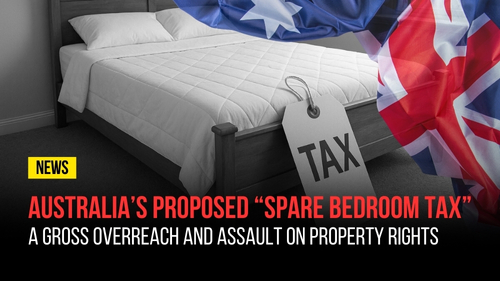
An Australian think-tank believes it would be a good idea to impose a “spare bedroom tax” on the nation’s citizens to address the nation’s housing crisis.
Cotality, a property research group, has championed its head of research, Eliza Owen who suggests taxing homeowners for unused bedrooms in their homes—a policy that reeks of government overreach and undermines the fundamental principles of property ownership, individual liberty, and the Australian dream.
The idea, framed as a solution to a supposed mismatch between household sizes and housing stock, would penalize Australians for having extra space in their homes, space often used for offices, guest rooms, or future family planning.
With over 60% of Australian households consisting of two people and most homes having three or more bedrooms, Cotality argues this “inefficiency” justifies state intervention. But this proposal isn’t just impractical, it’s a direct attack on personal freedom and property rights, raising serious concerns about human rights violations and the erosion of social values.
A Violation of Property Rights
At its core, the “spare bedroom tax” is an affront to the sacred principle of property ownership. Australians work hard, often for decades, to afford a home; a symbol of security, stability, and personal achievement. The idea that the government could penalize citizens for how they choose to use their private property is nothing short of authoritarian.
As The Spectator Australia aptly noted, “The curious nose of the government must stop at the closed and locked front door of our homes.”
This policy echoes the disastrous “bedroom tax” implemented in the UK, which slashed housing benefits for social housing tenants with spare rooms. The UK experience revealed a chilling reality: such policies disproportionately harm vulnerable groups, including the elderly and disabled, who may need extra space for medical equipment, caregivers, or family visits.
In 2019, the UK Supreme Court ruled that failing to provide a bedroom for the partner of a severely disabled tenant violated their human right to a home. Australia risks repeating this mistake, potentially breaching Article 14 of the European Convention on Human Rights (adopted in Australia’s human rights framework) by discriminating against those with unique housing needs.
Punishing the Elderly and Families
The proposal unfairly targets older Australians, many of whom are “asset-rich but cash-poor,” living in family-sized homes after their children have moved out.
Cotality’s Owen callously suggested that younger households shouldn’t bear the burden of higher prices for housing “utilised by older households.” This rhetoric pits generations against each other, ignoring the emotional and practical reasons why seniors stay in their homes; stability, memories, or the hope of hosting grandchildren. Forcing pensioners to downsize or pay a punitive tax could push them into poverty or social isolation, a clear violation of their dignity and right to live free from undue financial coercion.
Young families, too, would suffer. Many purchase larger homes with plans to grow their families, only to face the prospect of being taxed for “unused” bedrooms before they have children. Not only does would this policy undermine family planning but it would also fuel resentment against government policies that appear to be prioritizing mass migration over the needs of Australian citizens.
A Broader Social and Cultural Assault
A “spare bedroom tax” also threatens the cultural fabric of Australia, and if they implement one, nations who follow in their footsteps.
The Australian dream of a home with a “picket fence, pool, and quarter-acre block” is under siege, replaced by a dystopian vision where citizens are herded into smaller, government-approved living spaces. Creepily, this idea looks like a first step into accepting the World Economic Forum’s agenda to ensure people “own nothing and be happy.”
Interestingly, these policies are emerging at a time when there is growing influence of private equity firms buying up homes worldwide. In Australia, this tax could accelerate the transfer of wealth from hardworking families to corporate elites, further eroding the middle class.
Moreover, the policy ignores practical realities. Many Australians use spare rooms for home offices, especially as remote work becomes a “right” in places like Victoria, or for hobbies, guests, or storage. Taxing these spaces dismisses their legitimate utility and assumes the government knows better than individuals how their homes should be used.
In Conclusion…
The “spare bedroom tax” is a dangerous precedent that threatens the very foundation of Australian values: freedom, property rights, and family. Such insidious proposals, not only violate human rights, but also seek to reshape society into a collectivist nightmare.
People deserve to live in homes they’ve earned without the government peering into their bedrooms and demanding a cut. This isn’t solely about having extra space, but ever increasing government overreach.
If this proposal gains traction, it could set a chilling precedent for further government intrusion into private lives. The time to resist is now, before the taxman knocks on your door, counting your bedrooms.
Thank you for your support.
If you appreciate the work we do to spread the good news of Jesus Christ, please consider giving a gift to help us continue this work. Maranatha!
Click an icon below to share this post.
All articles, including blogs and guest articles, published on Revival Nation News are owned by Revival Nation and Revival Nation News. The use of any content created and published by Revival Nation News may be quoted but attribution is required.
Portions of Revival Nation News articles may be used for reprint and republish purposes, but Revival Nation News MUST BE CREDITED.
All reprinted or republished articles must:
(1) Identify the author of the article.
(2) Contain the Revival Nation News byline at the beginning of the article and a hyperlink “Revival Nation News” to the respective article on the Revival Nation News website.
(3) Contain, at maximum, three paragraphs and then link back to the original article.