Texas Restores Biblical Literature to Public School Curricula

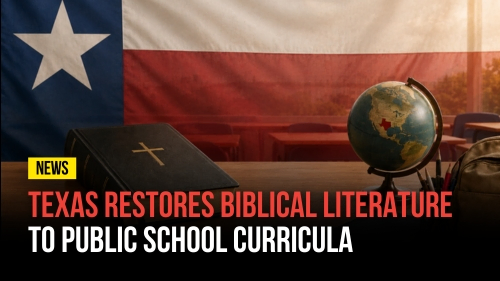
The Texas State Board of Education has approved a reading list that reintroduces Bible passages into public school classrooms, a curriculum that marks the return to educational traditions that shaped American learning for generations.
The approved state book list will ensure that approximately five million Texas students encounter biblical passages as part of their regular coursework, beginning in fourth grade. This restoration of what was once a cornerstone of American education includes carefully selected passages such as Luke 14’s “The Necessity of Humility,” Ecclesiastes 3’s “To Everything There is a Season,” and excerpts from Job.
Elementary students will encounter picture-book adaptations of the David and Goliath narrative and Adam and Eve accounts, while older students engage with increasingly sophisticated biblical texts.
It’s important to recognize that the inclusion of Bible passages in public education is hardly revolutionary as critics of this new policy seek to project. For in reality, it represents a return to standard practice. For much of American educational history, biblical literacy was considered essential to a well-rounded education, particularly given the Bible’s profound influence on Western literature, philosophy, and governance.
The curriculum thoughtfully pairs biblical passages with classic literature, allowing students to see these connections firsthand. Senior high school students, for instance, will study 1 Corinthians’ “Definition of Love” alongside Jane Austen’s “Pride and Prejudice,” a pairing that illuminates how biblical concepts have shaped literary traditions.
The expanded reading list will also include timeless classics such as E.B. White’s “Charlotte’s Web,” Charles Dickens’s “Great Expectations,” Shakespeare’s “The Tragedy of Julius Caesar,” and other foundational works of Western civilization.
As David Closson, director of the Center for Biblical Worldview at the Family Research Council, noted in The Washington Stand: “This recognizes a simple historical reality, which is that it is nearly impossible to understand American history and western civilization or really, even the English language without some familiarity with the Bible. The speeches of our founders, Abraham Lincoln, and the sermons and writings of Martin Luther King Jr. are saturated with biblical language and concepts.”
He further explains that this approach mirrors how educators have long treated other foundational texts: “We routinely teach students the works of Homer and Shakespeare and other foundational texts because they have enduring cultural significance. The Bible is undoubtedly the most influential book in western history and it should not be excluded from that conversation.”
Importantly, Closson clarifies that this curriculum represents academic study rather than religious indoctrination: “This curriculum is not about requiring students to practice Christianity, or even treating the Bible as a devotional book. This reflects a growing recognition that public education has too often neglected Christianity’s formative role in the development of our civilization. Teaching selective biblical passages in their proper historical literary context is not religious indoctrination—it’s a rather good education. This curriculum is both constitutionally permissible and educationally responsible.”
The decision has garnered support from many throughout the state, as well as educators who view it as essential to comprehensive literary and historical education.
The new curriculum will take effect in 2030, following Texas’s earlier decision to require the display of the Ten Commandments in public school classrooms, another step toward reinstating long-established educational traditions.
Thank you for your support.
If you appreciate the work we do to spread the good news of Jesus Christ, please consider giving a gift to help us continue this work. Maranatha!
Click an icon below to share this post.
All articles, including blogs and guest articles, published on Revival Nation News are owned by Revival Nation and Revival Nation News. The use of any content created and published by Revival Nation News may be quoted but attribution is required.
Portions of Revival Nation News articles may be used for reprint and republish purposes, but Revival Nation News MUST BE CREDITED.
All reprinted or republished articles must:
(1) Identify the author of the article.
(2) Contain the Revival Nation News byline at the beginning of the article and a hyperlink “Revival Nation News” to the respective article on the Revival Nation News website.
(3) Contain, at maximum, three paragraphs and then link back to the original article.