SCOTUS Ends Abuse of ‘Temporary’ Immigration System

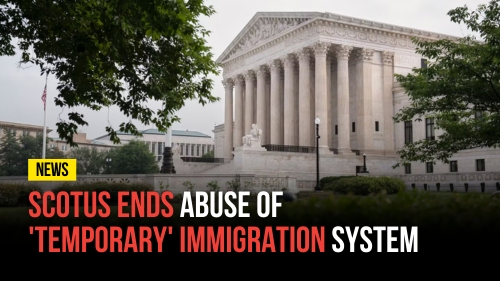
The U.S. Supreme Court has delivered a clear victory to President Donald Trump and his team, confirming that Temporary Protected Status (TPS) for foreign nationals must remain just that, temporary.
In its Thursday ruling in Mullin v. Doe, the Court upheld the authority of Homeland Security Secretary Markwayne Mullin to end TPS designations before they expire and shielded those decisions from most judicial second-guessing.
TPS is a humanitarian program created by Congress in the 1990 Immigration Act. It lets the executive branch, originally the Attorney General, now the Secretary of Homeland Security, grant temporary relief from deportation to nationals of countries facing armed conflict, natural disasters, or other extraordinary conditions. Beneficiaries already in the United States at the time of designation can stay legally, receive work permits, and gain other benefits while the status is active.
By law, TPS designations were designed to last between six and 18 months. Once the period ends, recipients are expected to return home unless conditions genuinely warrant an extension. In practice, however, the program has often become a backdoor for long-term or even near-permanent residence through repeated renewals across administrations, even after the original crises subside.
The Trump administration moved quickly in its second term to terminate several TPS designations that had stretched on for years. Lower courts, particularly those with judges appointed by previous Democratic administrations, repeatedly blocked those efforts.
Some claimed the Secretary could only grant TPS but lacked power to end it. Others attempted to review the underlying reasoning despite clear statutory language in the Immigration and Nationality Act stating there is “no judicial review” of the Secretary’s determinations regarding the designation, extension, or termination of TPS.
Justice Samuel Alito, writing for the majority (joined fully by Chief Justice John Roberts and Justices Clarence Thomas and Brett Kavanaugh, and in part by Justices Neil Gorsuch and Amy Coney Barrett), reaffirmed the plain text of the law. The statute bars judicial review of these determinations, including the full decision-making process, Alito explained. The Democrat-appointed justices dissented.
The Court also cast doubt on equal protection challenges alleging racial motivation in decisions involving countries like Haiti, noting strong race-neutral policy reasons: the current administration has taken a consistent, restrictive approach to TPS renewals across the board.
This ruling removes a major obstacle but the concern remains that activist lower courts may still attempt to slow-walk enforcement. Nevertheless, the decision restores the “temporary” in Temporary Protected Status and gives the administration the green light to act.
Government data shows how dramatically TPS grew under the previous Biden administration where in 2017, roughly 440,000 foreign nationals held TPS. By the end of President Trump’s first term, however, that figure dropped below 310,000. Under President Biden and Secretary Alejandro Mayorkas, the number surged past 530,000 by late 2022 and exceeded 1.29 million by 2025, covering nationals from more than a dozen countries.
Long-running designations include El Salvador (since 2001), Haiti (since 2010), and others from Honduras and Nicaragua dating back to the late 1990s. Venezuela also received a large-scale TPS grant in 2021. These extensions turned a short-term relief tool into a de facto permanent program in many cases.
The human and social costs have been significant. For example, in Springfield, Ohio, the rapid influx of thousands of Haitian TPS holders have placed a strain on local resources, housing, and public services. Continuous reports have come out documenting an increase in traffic incidents, competition for jobs and apartments, and cultural tensions that have burdened this small American city.
Other incidents involving TPS recipients have included serious crimes: a Honduran national charged in a fatal DUI crash, a Haitian man convicted in a brutal killing in Florida, and cases of sexual assault. These tragedies have proven that lax enforcement and endless extensions undermine both the rule of law and public safety.
With the Supreme Court’s decision, the Trump administration can now move forward with terminating designations that have outlived their original purpose, and for millions of Americans who have watched immigration programs stretched far beyond their statutory intent, this ruling represents a long-overdue correction because its one that prioritizes the temporary nature of TPS and puts American workers and communities first.
The “T” in TPS finally stands for temporary again.
Thank you for your support.
If you appreciate the work we do to spread the good news of Jesus Christ, please consider giving a gift to help us continue this work. Maranatha!
Click an icon below to share this post.
All articles, including blogs and guest articles, published on Revival Nation News are owned by Revival Nation and Revival Nation News. The use of any content created and published by Revival Nation News may be quoted but attribution is required.
Portions of Revival Nation News articles may be used for reprint and republish purposes, but Revival Nation News MUST BE CREDITED.
All reprinted or republished articles must:
(1) Identify the author of the article.
(2) Contain the Revival Nation News byline at the beginning of the article and a hyperlink “Revival Nation News” to the respective article on the Revival Nation News website.
(3) Contain, at maximum, three paragraphs and then link back to the original article.