
Only Two Kinds Of Churches Are Growing and They Share Spiritual DNA

Something is shifting in American Christianity: younger generations are showing up to church, campus ministries are reporting waves of students coming to faith, baptismal waters are busy and after years of headline-grabbing decline, the story of faith in America is getting more complicated, and more interesting.
But the real story isn’t the comeback itself, but rather, who’s leading it.
Two types of churches have driven consistent growth since the pandemic, and at first glance they might seem unrelated: nondenominational congregations and Pentecostal churches. But take a closer look, and a clear pattern emerges: these aren’t two separate movements but two branches of the same tree.
Nondenominational Christianity didn’t appear overnight, its rise has been slow, steady, and quite staggering in scale.
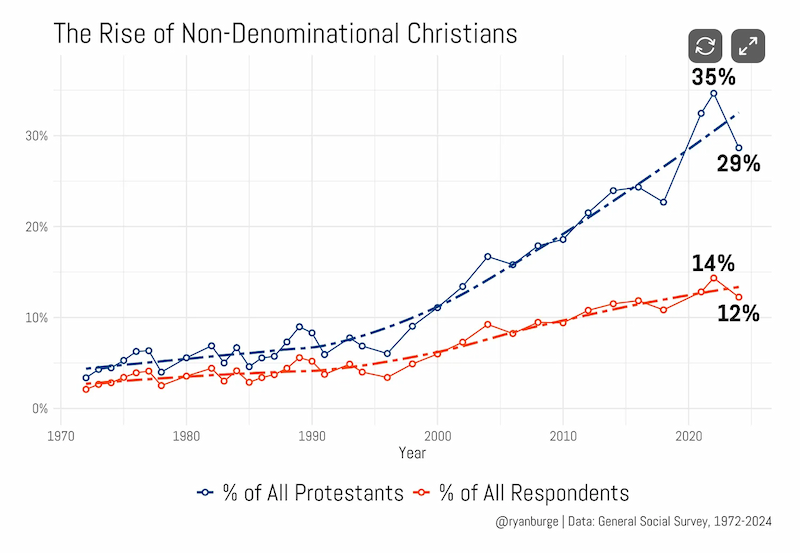
In 1972, Christians who identified with no particular denomination represented about 5% of American Protestants, per Ryan Burge’s analysis of General Social Survey data. That figure has since climbed to roughly 30%, one of the most consequential shifts in the history of American religion.
Pew Research’s 2025 Religious Landscape Study lands at a more conservative 18%, reflecting differences in methodology, but the direction is the same regardless of which number you use. Nondenominational Christianity is no longer a niche category but a dominant one.
Pentecostalism tells a parallel story.
The Assemblies of God, among the largest Christian denominations in the country, posted growth across virtually every metric in its latest annual report. Worship attendance rose 6.2% over 2023, and more than 529,000 people recorded conversions. Over 168,000 were baptized in water and there were new churches planted.
Lifeway Research’s 2025 survey of congregations confirmed the broader trend, identifying Holiness and Pentecostal churches as among the Protestant traditions most reliably reporting meaningful growth.
The connection between these two movements becomes obvious when you look past the labels.
A large number of the fastest-growing nondenominational churches are, theologically speaking, charismatic and strongly continuationist. They may not carry a Pentecostal affiliation or use Pentecostal vocabulary, but their DNA is unmistakable: a hunger for the Holy Spirit, worship that doesn’t apologize for being expressive, a belief that the gifts described in Scripture are still active today, and a culture that expects believers to actually encounter God.
What looks like two separate trends in the data is arguably one movement expressing itself through different structures.
The demographics add another layer to this story. Young nondenominational churchgoers are considerably more racially diverse than the membership rolls of most historic Protestant bodies; only 59% identify as white, compared to 85% among United Methodists and 78% among Southern Baptists.
One of the most peculiar insights is that churches are drawing heavily from two specific pools: people leaving Catholicism and evangelicals who’ve drifted away from their childhood denominations.
The Southern Baptist Convention, by contrast, is a study in institutional gravity. Membership fell another 3% to 12.3 million, the lowest since 1973, making this the denomination’s 19th straight year of decline. There were bright spots, too, however: weekly attendance and baptism numbers both improved, but the SBC remains the largest Protestant denomination in America largely on the strength of its history, not its momentum.
The pattern across all of this isn’t hard to read. People aren’t leaving Christianity so much as they’re leaving a particular version of it: one built around denominational loyalty, institutional structures, and a faith that stays comfortably in the head. What they’re moving toward is something more immediate: churches where there is an expectation of the Holy Spirit showing up because He is welcomed in, where worship is alive and full of freedom, and where faith is something you experience by way of active participation rather than something you simply hold.
The combination of less institution and more encounter is proving to be exactly what a searching generation is looking for.
Thank you for your support.
If you appreciate the work we do to spread the good news of Jesus Christ, please consider giving a gift to help us continue this work. Maranatha!
Click an icon below to share this post.



All articles, including blogs and guest articles, published on Revival Nation News are owned by Revival Nation and Revival Nation News. The use of any content created and published by Revival Nation News may be quoted but attribution is required.
Portions of Revival Nation News articles may be used for reprint and republish purposes, but Revival Nation News MUST BE CREDITED.
All reprinted or republished articles must:
(1) Identify the author of the article.
(2) Contain the Revival Nation News byline at the beginning of the article and a hyperlink “Revival Nation News” to the respective article on the Revival Nation News website.
(3) Contain, at maximum, three paragraphs and then link back to the original article.

You might also like




Explore Categories