Religious Freedom’s Erosion: The Impact of Canada’s Bill C-9

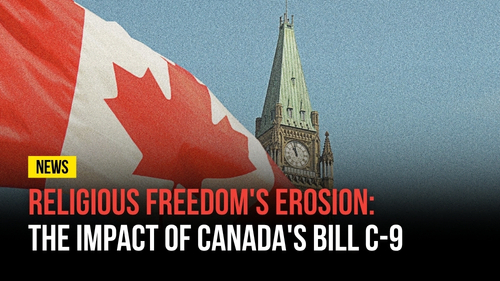
Canada has long prided itself on being a nation of rights and freedoms, enshrined in its Charter of Rights and Freedoms. Yet a growing body of evidence suggests that religious freedom — one of the Charter’s foundational protections — is facing a sustained and accelerating assault, both from legislative chambers in Ottawa and in the form of physical attacks on houses of worship across the country. At the center of the current debate is Bill C-9, the so-called “Combating Hate Act,” which critics across faiths and political persuasions warn represents one of the most serious threats to religious liberty in the nation’s modern history.
What Is Bill C-9?
Formally titled An Act to amend the Criminal Code (hate propaganda, hate crime and access to religious or cultural places), Bill C-9 was introduced by the Liberal government under Prime Minister Mark Carney and passed the House of Commons on March 25, 2026. It now awaits Senate consideration.
On its face, the bill carries several provisions that enjoy wide support. It makes it a criminal offence, punishable by up to ten years in prison, to obstruct someone from accessing a place of worship or other sites used primarily by an identifiable group. It also criminalizes the willful public display of hate and terror symbols, including those associated with the Holocaust or designated terrorist organizations such as Hamas and the Islamic Revolutionary Guard Corps.
However, the bill’s most contentious element has nothing to do with those provisions. A late-stage amendment, introduced by the Bloc Québécois and supported by the Liberal government as part of a political deal to secure Bloc votes, proposes to permanently remove a religious defence from Canada’s Criminal Code — one that has existed for 56 years.
Section 319(3)(b) of the Criminal Code currently states that no person can be convicted of wilfully promoting hatred “if, in good faith, the person expressed or attempted to establish by an argument an opinion on a religious subject or an opinion based on a belief in a religious text.” This narrow but critical provision protects sincere religious expression — the reading of scripture, the teaching of doctrine, and the articulation of moral convictions — from criminal prosecution, even when others may find it offensive or disagreeable.
Bill C-9, as amended, would erase that protection entirely.
The Loss of the Religious Defence: A Critical Blow to Faith Communities
The Canadian Conference of Catholic Bishops (CCCB), in a formal letter to Prime Minister Carney, described the elimination of the good-faith religious-text defence as raising “significant concerns.” The Bishops wrote that the exemption has served “for many years as an essential safeguard to ensure that Canadians are not criminally prosecuted for their sincere, truth-seeking expression of beliefs made without animus and grounded in long-standing religious traditions.”
The Canadian Constitution Foundation went further, warning that Bill C-9 would “remove safeguards against politically motivated charges, remove political accountability for charges, would create a risk of overcharging to force plea bargains, expand the availability of hate offences beyond the criminal law, and risks limiting constitutionally protected protest activity.”
Further compounding the threat is Bill C-9’s proposal to eliminate the requirement that Canada’s Attorney General must approve hate-propaganda charges before they proceed — a consent mechanism that has historically served as a check against frivolous, ideologically driven, or politically motivated prosecutions. The Canadian Centre for Christian Charities (CCCC) has described the bill as being “subject to broad interpretation and unclear standards,” warning that under its expanded provisions, some faith-based teachings could be interpreted as “hate,” potentially criminalizing religious speech for the first time in Canadian history.
Adding to the alarm, Bill C-9 redefines “hatred” itself. Where the Supreme Court of Canada ruled in the 1990 Keegstra decision that the term “hatred” must connote “emotion of an intense and extreme nature that is clearly associated with vilification and detestation,” Bill C-9 proposes a notably weaker standard: “the emotion that involves detestation or vilification and that is stronger than disdain or dislike.”
Critics note that this loosened definition lacks the Supreme Court’s critical qualifier that the speech be “intense and extreme,” — opening the door to prosecution of speech that falls well short of what the Court originally intended to address.
Opposition to Bill C-9 has been fierce within Parliament, particularly from the Conservative benches, where multiple MPs sounded the alarm that the legislation is an existential threat to religious liberty.
Conservative Member of Parliament Andrew Lawton has been one of the most outspoken critics, at one point single-handedly filibustering an entire meeting of the House justice committee to slow the bill’s advance.
In a statement delivered during committee hearings, Lawton drew a stark line:
“[The Liberals] are prepared to mount, with the support of the Bloc Québécois, a full-scale assault on religious freedom.”
Lawton has explained his concern, stating: “Bill C-9 was already dangerous as far as freedom of expression and civil liberties are concerned, but if the proposed amendment is adopted, it will amount to an all-out assault on religious freedom as well. The state will be able to jail people who express religious beliefs or quote religious texts the government finds offensive for up to two years.”
Thankfully, Lawton wasn’t alone. Conservative MP Jamil Jivani, upon the bill’s passage through the House of Commons, was equally unambiguous. Speaking on the House floor in December 2025, Jivani framed the Liberal effort to remove the religious exemption as an act of cultural coercion:
“I proudly voted NO on Bill C-9 — the most serious attack on religious freedoms I’ve seen in the House of Commons since becoming an MP.”
In his floor speech, Jivani accused the Liberal government of attempting “cultural imperialism” against Christians, Muslims, and Jews. “The government should not make its way into churches, mosques and synagogues in an effort to bring Liberal values,” he declared, “nor use the criminal justice system to enforce Liberal values on the private religious lives of Canadian citizens.”
The opposition to Bill C-9 hasn’t been limited to one faith tradition. Conservative justice critic Larry Brock noted that millions of Canadians, including Jews, Christians, Muslims, Sikhs, and Hindus, have expressed concern about the removal of the religious exemption.
The Canadian Conference of Catholic Bishops, the Christian Legal Fellowship, the Evangelical Fellowship of Canada, and numerous faith-based and civil liberties organizations have all formally opposed the amendment.
A Nation of Burning Churches
While the legislative battle over Bill C-9 has been determined, a separate and deeply troubling physical assault on Canada’s Christian communities has been unfolding across the country, one that has received comparatively little national attention or government urgency.
Beginning in May 2021, following the announcement of what came out to be a farce, potentially unmarked gravesites were allegedly discovered at the site of the former Kamloops Indian Residential School. What followed was one wave after another of church burnings across the nation.
According to reporting by the New York Post in November of 2024, over 160 Canadian churches had been set ablaze, desecrated or vandalized. Sadly, a married couple living above one of the church lost their lives due to an attack on a church. Shockingly, as of January 2024, only 12 people had been charged in relation to this acts of arson and just one person had been convicted.
These waves of majority arson attacks represent a dramatic acceleration from the preceding period: between January 2019 and May 2021 when 14 churches had been destroyed by fire. Alberta RCMP data showed an even starker rise in church arson within their jurisdiction: eight fires between May 2019 and May 2021, compared to 29 fires between June 2021 and September 2023.
The broader picture is even more alarming. Since 2021, there has been no formal national inquiry to investigate the crisis.
MP Jamil Jivani has specifically cited the attacks on houses of worship, including churches, Hindu temples, mosques, and synagogues in a July 2025 motion to the Standing Committee on Canadian Heritage, urging formal recognition that “protecting the freedom to worship without fear of violence or criminal intimidation is a fundamental part of Canadian heritage.”
COVID-Era Crackdowns on Churches: A Documented Pattern
The church burnings weren’t the only form of assault on religious freedom in Canada in recent years.
During the COVID-19 pandemic, Canadian provincial governments implemented some of the most restrictive worship regulations in the Western world, regulations that resulted in the arrest and jailing of multiple Christian pastors.
Pastor Artur Pawlowski of the Cave of Adullam Church in Calgary, Alberta, was arrested five times by Canadian authorities over the course of roughly two years. His offences? They ranged from holding church worship services in alleged violation of public health orders to delivering a sermon to truckers at the Coutts border blockade during the Freedom Convoy protest of February 2022.
For his 17-minute sermon to those at the Freedom Convoy, Pawlowski was convicted of mischief and violating his release conditions. He was held in solitary confinement for 23 hours a day for 78 days before his trial and was ultimately sentenced to 60 days, which was considered served.
Pastor Tim Stephens of Fairview Baptist Church in Calgary was arrested twice for holding worship services. His second arrest became particularly notable: Alberta authorities deployed a police helicopter to track the location of his outdoor church gathering, after which officers arrived at Stephens’ home and arrested him in front of his children.
Stephens spent 18 days in jail and was later acquitted of all public health-related charges, with his legal representatives from the Justice Centre for Constitutional Freedoms declaring that he “was illegally arrested and imprisoned.”
Pastor James Coates of GraceLife Church in Edmonton was also arrested and jailed for continuing to hold church services in excess of provincial capacity limits. His case drew the concern of the U.S. Commission on International Religious Freedom (USCIRF), with Senator Josh Hawley urging the commission to consider adding Canada to its watch list.
Alberta eventually acknowledged that aspects of its COVID public health orders had gone too far.
Premier Doug Ford of Ontario publicly apologized for lockdown measures, stating “we got it wrong.” Nonetheless, the precedent set during the pandemic of provincial governments treating religious assembly as a citable, arrestable, and jail-worthy offense.
These actions marked a significant and documented rupture in Canada’s relationship with religious liberty.
Conclusion: A Pattern That Demands Scrutiny
Taken together, these three developments; the legislative threat posed by Bill C-9, the burning of more than one hundred churches without a national inquiry, and the pandemic-era prosecution and jailing of pastors for acts of religious worship describe more than a series of isolated incidents, this is an ongoing pattern that warrants serious examination.
Religious freedom should never be a conservative or liberal value for it is the foundational freedom from which all others flow; the recognition that there exists a dimension of human life that the state may not enter, regulate, or punish. Canada’s Charter of Rights and Freedoms was written with that understanding in mind.
Thank you for your support.
If you appreciate the work we do to spread the good news of Jesus Christ, please consider giving a gift to help us continue this work. Maranatha!
Click an icon below to share this post.
All articles, including blogs and guest articles, published on Revival Nation News are owned by Revival Nation and Revival Nation News. The use of any content created and published by Revival Nation News may be quoted but attribution is required.
Portions of Revival Nation News articles may be used for reprint and republish purposes, but Revival Nation News MUST BE CREDITED.
All reprinted or republished articles must:
(1) Identify the author of the article.
(2) Contain the Revival Nation News byline at the beginning of the article and a hyperlink “Revival Nation News” to the respective article on the Revival Nation News website.
(3) Contain, at maximum, three paragraphs and then link back to the original article.