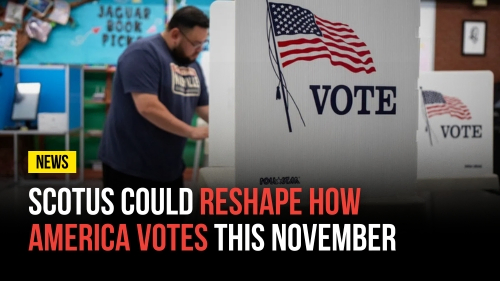
SCOTUS Could Reshape How America Votes THIS November

A. What the Case Is About
On March 23, 2026, the U.S. Supreme Court heard Watson v. Republican National Committee, a case that would determine whether states can continue to decide for themselves whether to count absentee ballots that were casted but received within a window of time after Election Day.
The case centers on a Mississippi law born out of the COVID era after the state passed a law in 2020, allowing mail-in ballots to be counted as long as they were postmarked by Election Day and received within five business days afterward.
Tom Fitton of Judicial Watch remarked on the case saying, “This is the most important Supreme Court election integrity case in a generation. The pandemic spread of states counting late ballots received after Election Day is a flagrant violation of long-standing federal law that not only encourages voter fraud but also severely undermines public confidence in our elections.”
He continued, “The Supreme Court now has a critical opportunity to restore a fundamental guardrail to the election process.”
The core issue before the justices is whether federal law requires that ballots be received, not just mailed, by Election Day.
To this issue, the RNC says, yes. Mississippi, however, says states have the constitutional authority to set their own rules. The plaintiffs argued that federal statutes enacted in the 1800s, which set a uniform day for the election of president and Congress, require ballots to be received by Election Day, and that Mississippi’s grace period conflicts with those laws.
A federal district court upheld Mississippi’s law, but a three-judge panel of the 5th Circuit Court of Appeals struck it down, ruling that federal law requires all ballots to be received by Election Day. Mississippi appealed this ruling, and the Supreme Court agreed to take it up.
B. Where Things Stand Now
Whilst the ruling hasn’t come down yet, the court’s decision is expected by late June or early July, but the direction the court is leaning was unmistakable during oral arguments.
After just over two hours of argument, a majority of justices appeared to agree with the challengers. This included the Republican Party of Mississippi and the Libertarian Party of Mississippi. They agreed that Mississippi’s law conflicts with federal statutes setting a uniform Election Day.
Justice Samuel Alito pointed to concerns that “confidence in election outcomes can be seriously undermined” when results are delayed, an observation echoed by Justice Brett Kavanaugh, who warned: “If the apparent winner the morning after the election ends up losing due to late-arriving ballots, charges of a rigged election could explode.”
The Trump administration’s Solicitor General, D. John Sauer, argued on the side of the RNC, telling the court that Mississippi’s law would authorize practices Congress couldn’t have approved in the 19th century, back when the federal Election Day statute was originally written.
C. What the Impact Could Be on the Midterms and Beyond
The stakes extend far beyond Mississippi. Thirteen other states and the District of Columbia set mail ballot receipt deadlines after Election Day, and 29 states plus D.C. count ballots that arrive after Election Day if they were postmarked on time.
A final ruling will almost certainly come by late June which would be early enough to govern the counting of ballots in the 2026 midterm congressional elections. That timeline is already alarming local election officials.
Washington State faces some of the most dramatic potential consequences. While Mississippi’s challenged law allows ballots to arrive up to five days after Election Day, Washington’s grace period runs a full 21 days, making it the longest in the country. The state certifies its general elections at that same 21-day mark. If the court rules against the grace periods, Washington faces a total overhaul of how its all-mail election system works on a very short clock, before November’s midterms.
Election integrity requires finality on Election Day, and this case represents a long-awaited reckoning.
SCOTUS’s conservative majority may scrap state grace periods for federal elections just weeks or months before states hold their primary races or general midterm elections. That could reshape turnout patterns, ballot strategies, and ultimately the balance of power in Congress, all before a single vote is cast in November.
The ruling is expected by late June or early July 2026.
Thank you for your support.
If you appreciate the work we do to spread the good news of Jesus Christ, please consider giving a gift to help us continue this work. Maranatha!
Click an icon below to share this post.
All articles, including blogs and guest articles, published on Revival Nation News are owned by Revival Nation and Revival Nation News. The use of any content created and published by Revival Nation News may be quoted but attribution is required.
Portions of Revival Nation News articles may be used for reprint and republish purposes, but Revival Nation News MUST BE CREDITED.
All reprinted or republished articles must:
(1) Identify the author of the article.
(2) Contain the Revival Nation News byline at the beginning of the article and a hyperlink “Revival Nation News” to the respective article on the Revival Nation News website.
(3) Contain, at maximum, three paragraphs and then link back to the original article.