Global Leaders Weigh Impact of Democratic Sweep in U.S. Midterms

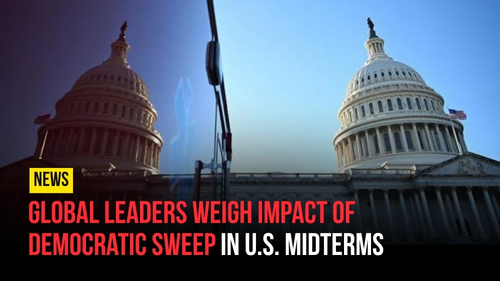
President Donald Trump’s Republican Party suffered sweeping losses in the U.S. midterm elections, triggering reactions from governments around the world as Democrats took control of both the House and Senate.
Iranian officials quickly portrayed the results as a public rejection of the war launched by the United States and Israel more than eight months ago. Iranian negotiator Mohammad Bagher Ghalibaf said Americans had voted “no to war,” suggesting that rising living costs and moral concerns contributed to the Republican defeat.
A statement attributed to Supreme Leader Ayatollah Mojtaba Khamenei, however, warned Iranians against expecting any fundamental change in Washington’s approach. He argued that hostility toward Iran extends beyond America’s partisan divisions.
Russia offered a cautious response. Kremlin spokesman Dmitry Peskov expressed hope that Trump could continue his peace initiatives despite the election setback. Deputy Foreign Minister Sergei Ryabkov acknowledged that Democratic control of Congress could complicate U.S.-Russia relations but insisted Moscow would not alter its foreign policy or position on Ukraine.
The political shift comes as another round of U.S.-brokered talks between Russia and Ukraine is scheduled for Nov. 10-11 in Abu Dhabi. Previous negotiations have produced prisoner exchanges and limited ceasefires but no comprehensive agreement.
Across Europe, several leaders welcomed the Democratic victories. Spanish Prime Minister Pedro Sanchez described the outcome as another indication that a global wave of right-wing populism is weakening. Facing his own election on Nov. 29, Sanchez predicted that Spanish voters would deliver a similar verdict.
European Union foreign policy chief Kaja Kallas voiced hope that the incoming Congress would expand military and political support for Ukraine while increasing pressure on Moscow. Officials from Germany, France, and Norway also suggested that the results could strengthen transatlantic cooperation on Ukraine, climate policy, development aid, and economic concerns.
British Prime Minister Andy Burnham emphasized the cost-of-living crisis, arguing that global prices would remain difficult to control until the war with Iran is resolved.
South African President Cyril Ramaphosa, whose government has endured strained relations with the Trump administration, said American voters had opened the door to “a new era in world relations.”
While foreign leaders interpreted the outcome through their own national interests, the global response underscored one reality: America’s elections continue to reshape diplomatic calculations far beyond its borders.
Thank you for your support.
If you appreciate the work we do to spread the good news of Jesus Christ, please consider giving a gift to help us continue this work. Maranatha!
Click an icon below to share this post.
All articles, including blogs and guest articles, published on Revival Nation News are owned by Revival Nation and Revival Nation News. The use of any content created and published by Revival Nation News may be quoted but attribution is required.
Portions of Revival Nation News articles may be used for reprint and republish purposes, but Revival Nation News MUST BE CREDITED.
All reprinted or republished articles must:
(1) Identify the author of the article.
(2) Contain the Revival Nation News byline at the beginning of the article and a hyperlink “Revival Nation News” to the respective article on the Revival Nation News website.
(3) Contain, at maximum, three paragraphs and then link back to the original article.