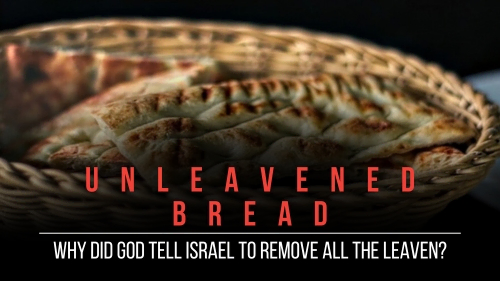
Unleavened Bread: Why Did God Tell Israel to Remove All the Leaven?

Imagine being told to search your entire house for something as ordinary as bread.
Not just to stop eating it, but to remove every trace of it.
That was God’s command to Israel during the Feast of Unleavened Bread. For seven days, the Israelites were to remove leaven from their homes and eat unleavened bread. What might seem like a strange household rule was actually a lasting reminder of God’s deliverance, and a picture that would eventually point to Christ.
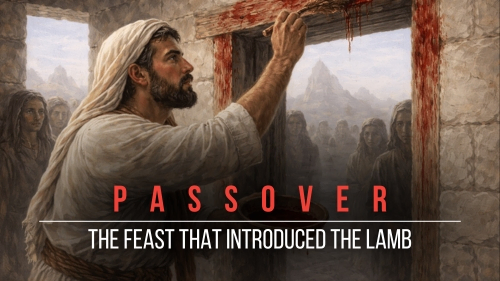
The Feast of Unleavened Bread was closely connected to Passover. In Exodus 12, God commanded the Israelites to eat the Passover meal with unleavened bread because they would leave Egypt in haste. Exodus 12:39 explains that they baked unleavened cakes because they were driven out of Egypt and could not delay.
There was no time to wait for dough to rise.
But God wanted this moment remembered. The Feast of Unleavened Bread became an annual reminder that Israel had been rescued from slavery and brought out of Egypt by the power of God. Every year, the people would remove leaven from their homes and remember the night when God delivered them.
Yet there was more to the story.
Throughout Scripture, leaven is sometimes used as a picture of something that spreads. Jesus warned His disciples about “the leaven of the Pharisees,” referring to their teaching and hypocrisy (Matthew 16:6, 12). Paul similarly used leaven as an illustration when warning the church about sin’s influence within the Christian community.
But it is important to remember that leaven does not always symbolize sin in Scripture. Its meaning depends on the context. In the Feast of Unleavened Bread, however, the removal of leaven provides a powerful picture of leaving behind the old life and walking in holiness.
Paul captures this connection beautifully when he writes, “Let us therefore celebrate the festival, not with the old leaven, the leaven of malice and evil, but with the unleavened bread of sincerity and truth” (1 Corinthians 5:8).
And then comes the most beautiful part of the story.
The Feast of Unleavened Bread points us toward Jesus.
Jesus was completely without sin. Peter writes that Christ “committed no sin, neither was deceit found in his mouth” (1 Peter 2:22). Paul says that God made Christ, “who knew no sin,” to be sin for us so that we might become the righteousness of God in Him (2 Corinthians 5:21).
The Passover lamb had to be without blemish. Jesus, the true Lamb of God, was perfectly holy.
He was not merely another sacrifice.
He was the sinless Savior who gave Himself for sinners.
There is also a striking connection in the timing of Jesus’ death and burial. Jesus was crucified during Passover and buried as the Feast of Unleavened Bread began. The One who was without sin entered the tomb, having offered Himself as the perfect sacrifice for His people.
But the story did not end there.
The Feast of Unleavened Bread reminds us that God’s salvation is not only about being rescued from something. Israel was rescued from slavery so that they could belong to God and live as His people. In the same way, Christ does not save us merely from the penalty of sin; He calls us to a new life.
Paul’s words in 1 Corinthians bring Passover and Unleavened Bread together: “For Christ, our Passover lamb, has been sacrificed. Let us therefore celebrate the festival…” (1 Corinthians 5:7–8).
The order is beautiful.
Christ has accomplished the work of salvation. Now His people are called to live in the reality of that salvation.
We do not remove sin from our lives in order to earn Christ’s salvation. We pursue holiness because Christ has already saved us.
The ancient Israelites removed leaven from their homes as they remembered their deliverance from Egypt. Christians are called to put away the old ways of sin and live in the freedom Christ has purchased for us.
The Feast of Unleavened Bread began as a reminder of a hurried departure from Egypt. But as we look through the lens of the gospel, it points us to something greater: the sinless Christ who gave Himself for us and calls His people to walk in sincerity and truth.
Passover showed us the Lamb.
Unleavened Bread shows us His holiness and calls us to a new way of life.
And then comes the next feast.
The story does not end with the cross or the tomb. After Passover and Unleavened Bread comes Firstfruits, the feast that points us to the greatest victory over death the world has ever seen.
This article is part of our series, Jesus in the Feasts, exploring the seven biblical feasts of Leviticus 23 and how each one points to God’s redemptive plan through Christ.
Next in the series: Firstfruits: The Feast That Predicted the Resurrection.
Thank you for your support.
If you appreciate the work we do to spread the good news of Jesus Christ, please consider giving a gift to help us continue this work. Maranatha!
Click an icon below to share this post.
All articles, including blogs and guest articles, published on Revival Nation News are owned by Revival Nation and Revival Nation News. The use of any content created and published by Revival Nation News may be quoted but attribution is required.
Portions of Revival Nation News articles may be used for reprint and republish purposes, but Revival Nation News MUST BE CREDITED.
All reprinted or republished articles must:
(1) Identify the author of the article.
(2) Contain the Revival Nation News byline at the beginning of the article and a hyperlink “Revival Nation News” to the respective article on the Revival Nation News website.
(3) Contain, at maximum, three paragraphs and then link back to the original article.