
Ten Commandments in Texas Public Schools: Supreme Court Asked to Uphold Displays

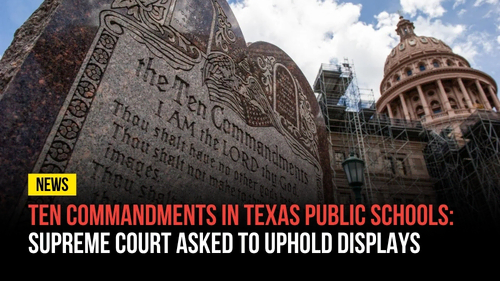
A legal battle over displaying the Ten Commandments in Texas public schools is raising a fundamental question about the First Amendment: Does acknowledging America’s religious and legal heritage amount to government coercion?
Supporters of the displays are urging the U.S. Supreme Court to uphold their constitutionality, arguing that the Ten Commandments have played a significant role in shaping Western law, public morality, and the nation’s understanding of justice. They contend that displaying the historic text does not force students to accept a religious belief or participate in worship.
The dispute follows a Fifth Circuit ruling addressing the constitutional boundaries of religious expression in public education. Advocates maintain that the appeals court correctly recognized the difference between acknowledging religion’s historical influence and establishing an official faith.
That distinction has become increasingly important since the Supreme Court moved away from the so-called “Lemon test,” a legal framework once used to evaluate potential Establishment Clause violations. In Kennedy v. Bremerton School District, the Court emphasized an approach rooted in historical practices and understandings rather than treating nearly every religious reference on public property with suspicion.
Under that standard, supporters argue, the Ten Commandments cannot automatically be classified as unconstitutional simply because they come from Scripture. Their influence extends beyond churches and synagogues into legal history, civic institutions, and longstanding debates about personal responsibility and public conduct.
Opponents claim that classroom displays could make students feel pressured to accept a religious message, particularly because attendance at school is compulsory. But defenders answer that exposure is not the same as indoctrination. Students routinely encounter religious ideas while studying history, literature, art, and the development of law.
The Supreme Court’s eventual response could determine whether public institutions may openly recognize the religious foundations that helped shape American society or whether those foundations must be removed from view.
At stake is more than a classroom display. The case could clarify whether the Constitution requires neutrality toward religion or demands its exclusion from public life. Supporters of the Texas displays insist the First Amendment was written to prevent government-compelled religion, not to erase the nation’s religious heritage.
Thank you for your support.
If you appreciate the work we do to spread the good news of Jesus Christ, please consider giving a gift to help us continue this work. Maranatha!
Click an icon below to share this post.
All articles, including blogs and guest articles, published on Revival Nation News are owned by Revival Nation and Revival Nation News. The use of any content created and published by Revival Nation News may be quoted but attribution is required.
Portions of Revival Nation News articles may be used for reprint and republish purposes, but Revival Nation News MUST BE CREDITED.
All reprinted or republished articles must:
(1) Identify the author of the article.
(2) Contain the Revival Nation News byline at the beginning of the article and a hyperlink “Revival Nation News” to the respective article on the Revival Nation News website.
(3) Contain, at maximum, three paragraphs and then link back to the original article.