Trump Orders Vaccine Policy Review: Balancing Parental Authority with Medical Safety

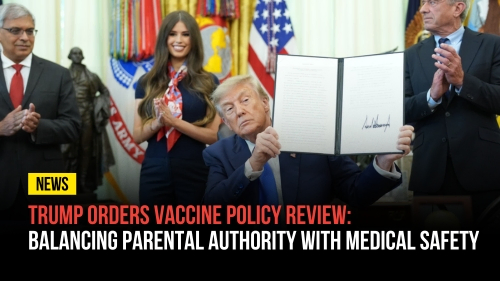
President Trump signed an executive order Monday directing a restructuring of childhood vaccination recommendations. The order recommends limiting the total number of vaccines given to children, splitting some vaccines into separate shots, and spacing vaccine visits over extended periods rather than clustering them together. It also directs the Department of Health and Human Services to reassess vaccine sequencing and timing within 90 days.
The move has sparked significant debate between the Trump administration, the medical establishment, and parents seeking to make informed decisions about their children’s health.
Trump cited concerns about current vaccine schedules during the signing, mentioning autism rates and claiming children in previous decades were healthier. HHS Secretary Robert F. Kennedy Jr. announced a separate initiative to investigate “foundational causes and biology of autism,” saying the administration will “examine every biologically plausible hypothesis and leave no legitimate, scientific question unexplored.”
The American Academy of Pediatrics responded swiftly, calling the order “disheartening” and “dangerous.” The organization emphasized that “there is no new evidence to justify significant changes to childhood immunization guidance” and pointed to extensive research showing no link between vaccines and autism. The group warned that delaying or skipping shots is risky, particularly as measles cases have reached their highest levels in 35 years.
The scientific record is clear on one point: multiple large-scale studies, including a 2019 Danish study of 657,461 children and a 2015 American study of 95,727 children, found no connection between vaccines and autism. Research indicates genetics play a significant role in autism diagnoses, with possible risk factors including prenatal pesticide exposure, prematurity, and maternal health conditions.
However, questions about vaccine spacing and parental authority are not inherently unreasonable. Some parents express concerns about vaccine timing and load—legitimate parental questions worthy of discussion. The medical community’s response is that while spacing vaccines creates no safety benefit, it does create compliance problems as parents miss follow-up appointments.
History offers a cautionary tale: when Japan split its MMR vaccine in the 1990s, vaccination rates dropped dramatically, mumps cases surged, and doctors documented hundreds of children who lost their hearing.
Republican Senator Bill Cassidy, a physician, opposed the order, stating, “Vaccines are overwhelmingly safe. Vaccines are effective. Vaccines DO NOT cause autism. Breaking up vaccines will mean children have to get more shots to get the same protection, not fewer shots.”
Parents deserve accurate information. They have the right to make informed decisions about their children’s health in consultation with trustworthy pediatricians. But those decisions must be grounded in evidence, not fear. As Proverbs 14:15 reminds us, “The simple believe anything, but the prudent give thought to their steps.”
Seek wisdom; consult your child’s doctor. Base decisions on evidence, not speculation.
Thank you for your support.
If you appreciate the work we do to spread the good news of Jesus Christ, please consider giving a gift to help us continue this work. Maranatha!
Click an icon below to share this post.
All articles, including blogs and guest articles, published on Revival Nation News are owned by Revival Nation and Revival Nation News. The use of any content created and published by Revival Nation News may be quoted but attribution is required.
Portions of Revival Nation News articles may be used for reprint and republish purposes, but Revival Nation News MUST BE CREDITED.
All reprinted or republished articles must:
(1) Identify the author of the article.
(2) Contain the Revival Nation News byline at the beginning of the article and a hyperlink “Revival Nation News” to the respective article on the Revival Nation News website.
(3) Contain, at maximum, three paragraphs and then link back to the original article.