Democrats No Longer Love America: This Is An Opportunity for the Church

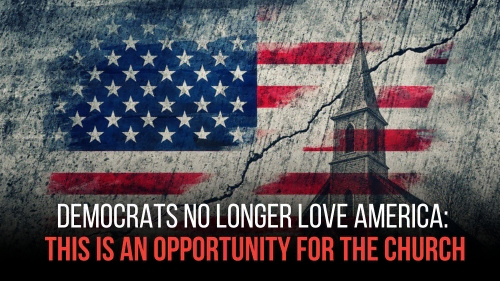
A new Gallup poll lays bare what many have perceived for years: Republicans and Democrats no longer share the same relationship with America.
According to a 2026 Gallup poll, 90% of Republicans say they are “extremely” or “very” proud to be American. Among Democrats, that number has collapsed to just 29%, the lowest ever recorded in the poll’s 25-year history. That isn’t a gap; it’s a chasm, and it tells us something profound about where we are as a nation: we are not the same.
NEW polling shows Democrats HATE America
— DeVory Darkins (@devorydarkins) June 17, 2026
The Anti-Christian and anti-American sentiments have risen along with TDS among leftist
"The Democratic percentage absolutely plummets to just 29% of Democrats say they're extremely or very proud to be an American." pic.twitter.com/rtNYq4nRCM
Back in 2001, Democrats and Republicans were only three percentage points apart in national pride, both hovering near 90%. Something has fundamentally changed since then, and it isn’t America. What has changed is the foundation of Democratic identity.
Republican pride has remained remarkably steady across administrations: high under Obama, high under Biden, high under Trump. It dips slightly when Democrats hold power, but it has never cratered.
For most conservatives, pride in America is rooted in something that transcends election cycles: founding ideals, national history, human dignity, the flag, and a belief that this nation represents the greatest experiment in human freedom the world has ever seen.
Democratic pride, by contrast, swings dramatically with the political climate. It jumped to 62% the moment Biden took office and held above 50% throughout his term, only to crater after Trump’s return, plunging 26 points in a single year. This isn’t pride in a country but pride in a political outcome. When the outcome goes the wrong way, the love evaporates.
But there’s something even more telling beneath the surface…
A significant portion of the Democratic coalition has built its political identity not around what it loves, but around what it opposes; contempt for institutions, contempt for the founding, contempt for the other side. When identity is constructed around opposition and grievance, genuine love becomes structurally impossible. Pride in one’s country requires wanting that country to flourish and you cannot be proud of something you believe to be irredeemable.
This didn’t happen by accident, there’s clear generational patterns in American pride, with each successive generation significantly less likely than the previous one to describe themselves as extremely or very proud to be American. Among Gen Z Democrats, more say they have little or no pride in being American (32%) than say they are extremely or very proud (24%).
A generation was handed a curriculum, and for decades, the dominant cultural and educational narrative has framed America almost exclusively through the lens of its sins: slavery, inequality, racism. These injustices were real, and they aren’t to be minimized. However, they were also not unique to America; they were practiced across the globe throughout history. That broader perspective is one young people are rarely given. Instead, many have been taught that America is the singular epicenter of these wrongs, when in truth, those wrongs were endemic to the human condition worldwide.
When the national narrative is consumed by failures, it leaves little room for the ideals, the sacrifices, and the unlikely miracle of a nation that became, in the words of John Winthrop and Ronald Reagan alike, a “city upon a hill,” an exceptional beacon to the world.
When young people are taught that their country is fundamentally broken and morally bankrupt, pride doesn’t merely become unlikely, it becomes shameful. To love America, within that framework, is to be either ignorant or complicit.
The result is a generation that knows, in great detail, everything America has done wrong, and almost nothing about why it has been worth fighting for, and there is much worth fighting for!
What we are witnessing isn’t merely a political disagreement but a divergence in identity so deep that the two sides barely recognize each other’s version of America.
One side sees a flawed but extraordinary nation; a nation worth defending, worth improving, and worth passing on to the next generation.
The other side, or at least a significant portion of it, sees a nation whose sins disqualify it from love, whose institutions exist primarily to oppress, and which must therefore be dismantled and rebuilt upon the unstable foundation of a coercive and ill-defined “equity.”
No policy debate bridges that divide. No bipartisan commission closes it. The collapse in national pride mirrors the broader disintegration of every shared space where Americans once encountered one another as human beings rather than ideological adversaries. And this is precisely where the church must enter the room.
The American church remains one of the few institutions in this country that possesses both the theological resources and the relational infrastructure to address a wound this deep. The question is, however, will it step into that space with the clarity our society so desperately needs.
THE BLUEPRINT:
First, the church must preach a theology of healthy patriotism.
Scripture is clear: believers are to honor governing authorities (Romans 13), pray for their leaders (1 Timothy 2), and to seek the peace (prosperity) of the city where God has placed them (Jeremiah 29). Scripture is equally clear that our ultimate citizenship is in heaven (Philippians 3:20).
This gives the church a unique lane where it can look conservatives in the eye and say: America is not your savior. The flag is not a cross. Meanwhile, it can also look progressives in the eye and say: Contempt is not a virtue. Gratitude is not naivety. You cannot love your neighbor while despising the nation you share with them. A biblically grounded church can model what it looks like to love your country without worshipping it, and to critique your country without hating it.
Second, the church must become the community where the divide is actually crossed, and that requires courage, not compromise.
The early church was the most diverse institution in the ancient world. Jews and Gentiles. Slaves and free. Romans and revolutionaries. They weren’t unified by ideology, dialogue, or carefully managed listening sessions. They were unified by the gospel, a shared truth that transcended every political loyalty and cultural identity. That unity produced a community the Roman Empire couldn’t explain, because it was built on nothing the Empire understood.
The contemporary church has drifted from that model. Many congregations have sorted themselves into comfortable ideological enclaves, reflecting their zip code more than their theology. That is a pastoral failure, not merely a cultural one.
The solution isn’t to platform every political perspective equally in the name of balance. The solution is for the church to unapologetically preach the absolute truth about human dignity, civic responsibility, sin, redemption, and the authority of Scripture, and to trust that truth, faithfully proclaimed, cuts across political lines on its own terms.
A church that preaches the full counsel of God inoculates its congregants against the deceiving talking points of culture.
So what can churches do to resist the enormous pressure to become ideological monocultures? Pastors must preach the whole counsel of God which speaks to everything under the sun, from morality and politics to marriage, human sexuality, work ethic, and fiscal stewardship. And this responsibility doesn’t rest on pastors alone, congregations bear a corresponding duty: to prioritize unity in Christ over the perceived comfort of ideological echo chambers.
The data from Gallup isn’t merely a polling curiosity but a window into two entirely different emotional realities about the same country. That gap cannot be closed by a better candidate, a sharper platform, or a more effective political strategy.
What closes the gap is when people are given something worth fighting for: a vision of human dignity, shared sacrifice, and redemptive possibility that transcends the news cycle.
The church holds that vision. The only remaining question is whether it has the courage to offer it.
SUPPORT MATTEA’S WORK
- Tune into The Mattea Merta Podcast
- Follow her on Twitter and Instagram
- Fund the mission through CashApp or PayPal: @matteamerta
CLICK HERE for more posts by Mattea Merta.
Thank you for your support.
If you appreciate the work we do to spread the good news of Jesus Christ, please consider giving a gift to help us continue this work. Maranatha!
Click an icon below to share this post.



All articles, including blogs and guest articles, published on Revival Nation News are owned by Revival Nation and Revival Nation News. The use of any content created and published by Revival Nation News may be quoted but attribution is required.
Portions of Revival Nation News articles may be used for reprint and republish purposes, but Revival Nation News MUST BE CREDITED.
All reprinted or republished articles must:
(1) Identify the author of the article.
(2) Contain the Revival Nation News byline at the beginning of the article and a hyperlink “Revival Nation News” to the respective article on the Revival Nation News website.
(3) Contain, at maximum, three paragraphs and then link back to the original article.

You might also like



Explore Categories