Why Catholic Integralism and the U.S. Constitution Are Fundamentally Incompatible

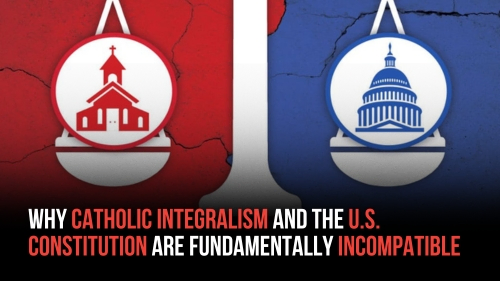
Most Americans have never heard the word “integralism,” but the idea behind it is older than the United States itself and it’s making a quiet comeback in certain intellectual, religious and political circles. Before you dismiss this topic, we encourage you to learn about it because it is predominately gaining traction with our young people because of those they listen to.
So, what is integralism, what it would mean in practice, and why it’s worth paying attention to?
Let’s start with something familiar. You probably know that America has a separation of church and state. It’s right there in the First Amendment: the government cannot establish an official religion, and it cannot stop you from practicing yours. Your faith is your business. The government runs on votes, laws, and courts and not bishops.
Integralism, however, says the American arrangement is fundamentally wrong.
Not wrong in the way a bad policy is wrong, but wrong in the deepest possible sense: philosophically, spiritually, and morally wrong. Integralism argues that separating religious authority from political authority isn’t a clever solution to a hard problem but that it’s a catastrophic mistake that has been unfolding for centuries.
The Core Idea: What Integralism Actually Believes
Integralism is a Catholic political philosophy rooted specifically in the Catholic tradition, drawing on medieval thinkers like Thomas Aquinas. Its central claim is simple, even if its implications are enormous:
Human beings have an ultimate purpose, to know God and reach eternal salvation. That purpose is higher than any earthly goal. Therefore, any institution that helps people reach that purpose, namely, the Catholic Church, has a higher authority than any institution that merely manages earthly life, like the government.
Within integralism, the state isn’t abolished as it still does real things: maintaining order, building roads, running courts, collecting taxes, but it exists within a larger framework. So when the state’s decisions touch on matters of morality, faith, or humanity’s ultimate purpose, the Church has the authority to direct, correct, or override it.
In an integralist order, the bishop outranks the mayor, not just on Sunday, not just in matters of worship, but on any question where the moral and spiritual stakes are high enough.
To integralists, this isn’t radical but honest. Every society is ordered toward some vision of the good life. America is ordered toward individual freedom, free markets, and the idea that you get to decide what’s true for you. Integralists say that’s also a belief system, it’s just one that pretends to be neutral while it quietly dismantles religious life, traditional family structures, and any sense of shared moral purpose.
So why not, they ask, be honest about it and order society toward what is actually, objectively true?
The Town Square: What This Looks Like in Real Life
Imagine a town under integralist governance.
The town has a mayor, courts, police, and all the usual machinery of government. This town also has a bishop, and when a new law is proposed that the bishop considers contrary to Church teaching, the bishop has the authority to block or redirect it, not as a lobbyist trying to influence lawmakers, but as a higher authority whose role in the political order is formally recognized.
Divorce is legally restricted, because the Church teaches marriage is permanent and indissoluble. Education is shaped by Catholic moral teaching; what it means to be a good person, what the purpose of human life is. The public square isn’t “neutral.” Religious symbols in government buildings aren’t controversial, they’re appropriate, because the state acknowledges its subordination to a higher authority.
And if you’re not Catholic? You live under this order anyway. Whilst you’re tolerated, integralists generally aren’t calling for you to be persectured, but you don’t get an equal say in reshaping the framework itself. The framework isn’t up for a vote. And if you’re the “wrong type” of Catholic? These same rules would apply to you.
Now scale that up to a nation and that’s the vision.
It is, in some ways, a picture of medieval Christendom, the era when European kings understood themselves as operating under the spiritual authority of the Pope, and when the boundary between religious law and civil law was blurry by design. Many integralists are honest about this: they look at that era not as a dark age to escape but as a coherent civilization worth recovering.
The American Problem: This and the Constitution Don’t Mix
You probably already sense the issue that integralism and the American constitutional order aren’t in tension, but that they are fundamentally incompatible. As such, we should be specific about why.
American Constitutional Order
- Authority flows upward from the people through democratic elections and constitutional processes.
- The First Amendment prohibits any establishment of religion. No faith gets official status.
- All citizens have equal standing regardless of their religion, or lack of one.
- Laws can be changed by democratic majorities. Nothing is permanently off the table.
- The Constitution is the supreme law of the land.
Integralist Order
- Authority flows downward from divine truth, through the Church, into civil government.
- The Church holds a formally recognized higher authority over the political order.
- Non-Catholics are tolerated but cannot reshape or speak into the fundamental framework.
- Core moral and spiritual matters are not subject to democratic revision.
- Church teaching functions as a super-constitutional authority above civil law.
The Establishment Clause states that “Congress shall make no law respecting an establishment of religion.” This exists precisely to prevent what integralism prescribes. The founders, drawing on bitter European experience with religious wars and state churches, deliberately built a wall between ecclesiastical and civil authority. Integralism says that wall is a mistake. This must be taken seriously because the First Amendment wouldn’t just need to be reinterpreted, it would have to disappear.
The same goes for popular sovereignty, the bedrock idea that government derives its power from the consent of the governed. In an integralist order, the people can’t simply vote their way out of the Church’s moral framework. Some things aren’t up for democratic revision. The will of the majority stops where Church teaching begins.
The Obvious Question: Isn’t This Just Theocracy?
Yes. Essentially.
Integralists push back on this label. They’ll explain that the Church doesn’t rule directly, meaning, the Pope isn’t the president, and priests aren’t senators. Civil government keeps its own proper functions while the Church exercises only “indirect” power over temporal matters, correcting the civil order when it strays into moral territory, not micromanaging every decision.
It sounds like a meaningful distinction, but here’s the problem: almost everything touches on morality eventually.
Criminal justice, family law, education, healthcare, economic policy, free speech, sexuality; all of these have deep moral dimensions, and the Church has strong views on all of them. If the Church can correct civil authority whenever moral stakes are present, and moral stakes are present almost everywhere, then the “indirect” power turns out to be very direct indeed.
Theocracy with better footnotes is still theocracy. The mechanism is more sophisticated. The outcome, a religiously defined political order that everyone lives under, whether they share that religion or not, is the same.
Think of Iran. The Supreme Leader is a religious figure, not a conventional head of state. Civil institutions (a parliament, a president, courts) exist and function but they operate within a framework whose ultimate authority is religious, and certain matters simply cannot be voted away. Most people would call that a theocracy.
Integralism is, structurally, the same arrangement just Catholic instead of Islamic, and debated in academic journals rather than executed by a revolutionary government.
The Fatal Flaw: The Question Nobody Can Sidestep
Everything in integralism rests on one foundational claim: that the Catholic Church possesses divine authority, that it’s the authentic custodian of God’s truth, with a divinely granted mission to guide human society toward salvation.
If you believe that, integralism follows with a certain logic. Of course the Church should have authority over the political order, of course some things shouldn’t be subject to democratic revision, of course non-Catholics should live within this framework, everyone would benefit from it, whether they realize it or not.
But if you don’t believe it; if you’re Protestant, Jewish, Muslim, secular, agnostic, or simply a Catholic who disagrees with the hierarchy on something important, the entire structure collapses. You’re being asked to submit to the authority of an institution whose foundational claims you reject, backed by the coercive power of the state. In this way, integralism gives you no independent reason to accept those claims, it simply assumes them.
This is the fatal flaw. A political philosophy that only makes sense if you already share its most contested religious premises cannot serve as the basis for a diverse society. It is, at its core, a philosophy for the already-converted.
Thank you for your support.
If you appreciate the work we do to spread the good news of Jesus Christ, please consider giving a gift to help us continue this work. Maranatha!
Click an icon below to share this post.



All articles, including blogs and guest articles, published on Revival Nation News are owned by Revival Nation and Revival Nation News. The use of any content created and published by Revival Nation News may be quoted but attribution is required.
Portions of Revival Nation News articles may be used for reprint and republish purposes, but Revival Nation News MUST BE CREDITED.
All reprinted or republished articles must:
(1) Identify the author of the article.
(2) Contain the Revival Nation News byline at the beginning of the article and a hyperlink “Revival Nation News” to the respective article on the Revival Nation News website.
(3) Contain, at maximum, three paragraphs and then link back to the original article.

You might also like



Explore Categories