A Biblical Case for Abolishing the Property Tax

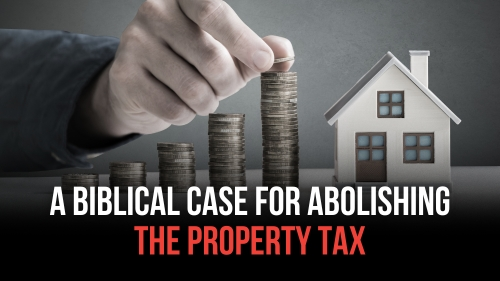
Florida state lawmakers are advancing a measure that would eliminate property taxes altogether, a move that would make it the first state in the nation to do so.
Florida’s proposal has the ability to reshape the financial lives of millions of families, and for Christians who care about stewardship, family stability, and the limits of government, there is a compelling case to pay close attention.
While the debate is being covered largely through an economic lens, there are deeply biblical reasons why believers should welcome, and even celebrate, this kind of reform.
:rotating_light: BREAKING: FLORIDA LEGISLATURE FORMALLY APPROVES ABOLISHING PROPERTY TAXES for most primary homeowners statewide
— Eric Daugherty (@EricLDaugh) June 2, 2026
Both chambers RESOUNDINGLY pass Gov. Ron DeSantis’ proposal, SENDING IT TO VOTERS for approval this November
LET’S GO!!! :sunny::clap::skin-tone-2:
Needs 60% of voters this fall.… pic.twitter.com/mGVGcxjuyp
Here’s a question worth sitting with: if you stop paying property taxes on your home, what happens? The government takes it. That uncomfortable reality means that in a very practical sense, the state holds a permanent lien on every piece of private property in America. Thus, homeowners are, in effect, perpetual renters paying an annual fee to the government for the privilege of living in a home they ostensibly own.
Scripture takes a high view of private property, we see this explicitly in the commandment “You shall not steal” (Exodus 20:15) which presupposes that individuals have a God-given right to own things.
The prophet Micah’s famous vision of peace; every man sitting “under his vine and under his fig tree” (Micah 4:4), is another picture of genuine, secure ownership. So what does this mean for us as believers? That a tax which can result in the forfeiture of your home undermines that security in a fundamental way.
As followers of Christ Jesus, we’re called to be faithful stewards of what God has placed in our hands. For most families, a home is the single largest asset they will ever own, and often the foundation from which they raise children, build community, and extend hospitality. So when it comes to property taxes, we see how they place a recurring burden on that foundation, one that doesn’t go away even after a mortgage is paid off.
Let’s broaden the conversation to those who are elderly and on fixed incomes, this burden can be particularly crushing. Many have spent decades faithfully paying off their homes, only to find themselves land-rich and cash-poor, struggling to meet annual tax bills on a retirement income that was never designed to keep pace with rising assessments. A grandmother who has lived in the same house for 40 years shouldn’t be taxed out of it in her final decades.
Thus, abolishing the property tax would protect the most vulnerable homeowners, many of them widows and the elderly, groups Scripture specifically calls the church and government alike to protect.
One of the great themes running through both Scripture and natural law is that the family, not the government, is the basic building block of a healthy society. So when government policies make it harder for families to build generational stability, to pass something of value on to their children, to remain rooted in a community across decades, those policies work against the grain of how God designed human flourishing to work.
Property taxes are among the most direct obstacles to generational wealth transfer for ordinary families. They add an ongoing cost to simply holding property, discouraging ownership and making it harder to pass a family home or piece of land from one generation to the next.
Proverbs 13:22 tells us that “a good man leaves an inheritance to his children’s children,” so when we see policies that drain family resources year after year, we can begin to see the bigger picture of how this form of legacy-building is made harder for everyone.
Christians rightly acknowledge the biblical call to pay taxes and respect governing authorities (Romans 13:6-7, Matthew 22:21), but submission to taxation doesn’t mean every form of taxation is wise, just, or beyond scrutiny.
The Bible doesn’t grant government an unlimited claim on private citizens’ resources or property, and history is full of examples of tax structures that became instruments of oppression rather than tools for legitimate public order.
Florida’s proposal isn’t without its practical complexities, eliminating property taxes means finding other ways to fund local schools, infrastructure, and public services that currently depend on that revenue. From the level of fraud that has been revealed and exposed over the last two years on a state and federal level, it’s not hard to see how that “issue” in particular, could see a swift remedy.
But the principle at stake is worth defending, a government that cannot perpetually hold your home hostage to an annual payment is a government that respects the sanctity of private ownership in a deeper and more meaningful way.
For believers who understand that the earth is the Lord’s (Psalm 24:1) and that we are stewards, not ultimate owners, there’s something right about families holding their homes with greater security and freedom.
Florida may be onto something, and Christians should be willing to say so.
Thank you for your support.
If you appreciate the work we do to spread the good news of Jesus Christ, please consider giving a gift to help us continue this work. Maranatha!
Click an icon below to share this post.



All articles, including blogs and guest articles, published on Revival Nation News are owned by Revival Nation and Revival Nation News. The use of any content created and published by Revival Nation News may be quoted but attribution is required.
Portions of Revival Nation News articles may be used for reprint and republish purposes, but Revival Nation News MUST BE CREDITED.
All reprinted or republished articles must:
(1) Identify the author of the article.
(2) Contain the Revival Nation News byline at the beginning of the article and a hyperlink “Revival Nation News” to the respective article on the Revival Nation News website.
(3) Contain, at maximum, three paragraphs and then link back to the original article.

You might also like



Explore Categories