Texas High Court Rejects Legal Challenge to Heartbeat Act

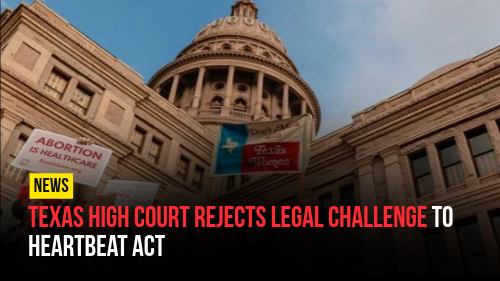
The Texas Supreme Court unanimously dismissed a long-running legal challenge to the state’s Heartbeat Protection Act, leaving the controversial abortion law in force.
In an opinion issued Friday, the court addressed more than a dozen lawsuits filed against Texas Right to Life, the organization’s president, John Seago, and other defendants. The cases were consolidated into a single multidistrict proceeding after the law took effect in September 2021.
The Heartbeat Protection Act prohibits most abortions once embryonic cardiac activity can be detected, typically around six weeks into pregnancy. Rather than authorizing state officials to enforce the restriction, the law permits private citizens to bring civil lawsuits against individuals who perform or assist with an abortion prohibited under the statute.
Doctors, medical groups, and abortion-rights organizations sued Texas Right to Life and Seago after they said they intended to pursue legal action against those violating the law. The plaintiffs sought a declaration under the Uniform Declaratory Judgments Act that portions of the measure were unconstitutional.
The defendants argued that the plaintiffs lacked standing because Texas abortion providers had complied with the law since it took effect. A lower court rejected the defendants’ request for dismissal and ruled in favor of the plaintiffs, temporarily blocking enforcement.
The Texas Supreme Court reversed that decision, concluding that the dispute did not present a controversy the courts could properly decide.
“There is no justiciable controversy before us, and we must therefore dismiss the case,” the justices wrote.
Texas Right to Life celebrated the ruling, calling it a victory for the law and for the organization’s ability to advocate for its enforcement. The group said private citizens remain authorized to sue abortion providers and others accused of violating the statute.
The legal landscape surrounding abortion in Texas has changed substantially since the Heartbeat Protection Act was adopted. In June 2022, the U.S. Supreme Court ruled in Dobbs v. Jackson Women’s Health Organization that the Constitution does not confer a right to abortion.
That decision allowed a separate Texas law to take effect, imposing a near-total abortion ban enforced through criminal sanctions and civil penalties. Unlike the Heartbeat Protection Act, the later restriction gives enforcement authority to state officials, including the Texas Attorney General.
Thank you for your support.
If you appreciate the work we do to spread the good news of Jesus Christ, please consider giving a gift to help us continue this work. Maranatha!
Click an icon below to share this post.
All articles, including blogs and guest articles, published on Revival Nation News are owned by Revival Nation and Revival Nation News. The use of any content created and published by Revival Nation News may be quoted but attribution is required.
Portions of Revival Nation News articles may be used for reprint and republish purposes, but Revival Nation News MUST BE CREDITED.
All reprinted or republished articles must:
(1) Identify the author of the article.
(2) Contain the Revival Nation News byline at the beginning of the article and a hyperlink “Revival Nation News” to the respective article on the Revival Nation News website.
(3) Contain, at maximum, three paragraphs and then link back to the original article.