Trump to EU: Scrap Censorship Laws or Lose Trade Deal and NATO


President Donald Trump is threatening the annihilation of a freshly-signed U.S.-EU trade deal, along with the renegotiation of America’s membership in NATO, if the EU refuses to retreat from its restrictive online censorship policies.
This is classic Trump: America First, resisting globalist incursion, and not permitting foreign bureaucrats to dictate the terms of U.S. prosperity and ingenuity.
The EU’s tech regulations, in particular the Digital Services Act (DSA) and Digital Markets Act (DMA), have long been a thorn in the side of American tech giants Meta, Google, and Apple. The EU’s regulations, which they claim are about fairness and safety, impose heavy-handed content moderation, competition, and data privacy regulations: regulations that disproportionately target U.S. companies.
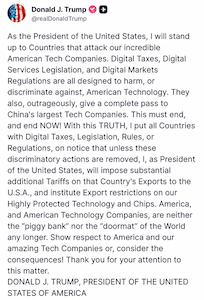
President Trump, as well as key allies like Vice President JD Vance and House Judiciary Chairman Jim Jordan, have called these laws what they are: discriminatory trade barriers intended to kneecap American innovation while giving a free pass to competitors, including China’s tech giants.
As Trump posted on Truth Social, “Digital Taxes, Digital Services Legislation, and Digital Markets Regulations are all designed to hurt, or discriminate against, American Technology.”
The EU pushing for the imposition of these regulations, despite a July 2025 trade agreement that encompassed $750 billion in U.S. energy purchases and $600 billion in investment, is a slap in the face to American interests. That deal, billed by Trump as “the biggest ever,” was supposed to launch a new era of cooperation, with the U.S. imposing a 15% tariff on most EU goods and the EU opening to American exports. But Brussels’ refusal to reconsider its tech regulations has reignited tensions, showing that the EU’s commitment to fair trade at best is weak. Now, Trump is reportedly ready to tear up the agreement and let the EU reap the consequences of its own hubris.
And then, there’s NATO. Trump has been rightfully chastising European allies for years for failing to pay their defense spending commitments, leaving the U.S. to foot the bill for the continent’s security. Similar sentiments have been echoed by Vice President Vance, who has suggested that America’s NATO membership could be called into question if the EU continues to undermine U.S. tech companies. This is more than a trade problem; it’s a sovereignty problem.
Why are American taxpayers paying for the defense of Europe while the EU wages economic war on our most innovative industries? Trump’s insistence on pairing trade with security delivers a clear message that if Europe wants America’s protection, it needs to stop using our tech sector as a punching bag.
Left-wing pundits and Europeans alike will undoubtedly cry foul, accusing Trump of either bullying or destabilizing the transatlantic partnership.
French MEP Stéphanie Yon-Courtin called any DMA concessions an “unacceptable capitulation,” and former EU commissioner Thierry Breton stated that yielding to Trump’s demands would be an affront to Europe’s sovereignty.
But let’s be realistic, the EU’s tech rules aren’t driven by consumer protection or favoring competition, they’re driven by control and jealousy. Europe, which is lagging in the global tech race, is trying to regulate to hobble American companies while failing to produce its own tech giants. Even the Draghi report, a recent analysis of European competitiveness, acknowledged that EU overregulation is stifling innovation.
The Draghi report finds that the European Union is not competitive, lacks technological leadership, and is behind in productivity, jobs, and growth after years of government intervention, stimulus plans, ECB easing, negative rates, and central planning.
— Daniel Lacalle (@dlacalle_IA) September 9, 2024
So, what does he… pic.twitter.com/eabE35y0hY
Trump’s approach is a masterclass in leverage. By putting the trade deal in jeopardy, he’s forcing the EU to confront the economic costs of its own policies.
The 15% tariffs already in place are a significant hit to European exporters: 70% of EU goods now cost more in the U.S. market. If Trump fails to make a deal, those tariffs can increase to the 30% he has previously threatened, devastating industries like European automakers, which are already reeling from a 27.5% tariff on cars. Add the potential loss of $750 billion worth of energy contracts and $600 billion worth of investment, and the economy of the EU, already on weak footing, could spiral out of control.
And as for NATO, Trump’s critics will claim he’s courting geopolitical instability, but people aren’t being fooled.
The U.S. has carried the majority share of NATO’s burden for far too long, and Trump’s demand for more balanced burden-sharing is long overdue. If the EU wants to keep America’s security umbrella, it needs to show some reciprocity. Repealing the DSA and DMA would be a great place to start, as a signal that Europe values its partnership with the U.S. over bureaucratic power plays.
For too long have globalist powers like the EU taken advantage of America’s benevolence, foisting one-sided regulations on us while benefiting from our economic and military strength. Trump’s message is simple: no more free rides.
If the EU wants to play hardball, it will have to be prepared to lose; not just trade concessions, but perhaps the security guarantees it’s taken for granted.
In the end, Trump is gambling for America’s rightful status as the world’s economic and military power. As such, the EU can either get on board or get out of the way. The choice is theirs, but they should not underestimate Donald J. Trump.
Thank you for your support.
If you appreciate the work we do to spread the good news of Jesus Christ, please consider giving a gift to help us continue this work. Maranatha!
Click an icon below to share this post.


All articles, including blogs and guest articles, published on Revival Nation News are owned by Revival Nation and Revival Nation News. The use of any content created and published by Revival Nation News may be quoted but attribution is required.
Portions of Revival Nation News articles may be used for reprint and republish purposes, but Revival Nation News MUST BE CREDITED.
All reprinted or republished articles must:
(1) Identify the author of the article.
(2) Contain the Revival Nation News byline at the beginning of the article and a hyperlink “Revival Nation News” to the respective article on the Revival Nation News website.
(3) Contain, at maximum, three paragraphs and then link back to the original article.

You might also like


Explore Categories