Pentecost: The Day the Church Was Born

What if one of the most important days in the history of the Church had been marked on God’s calendar centuries before it happened?
Long before the disciples gathered in Jerusalem and the Holy Spirit descended upon them, God had already established an annual feast known as Pentecost. It was a celebration of harvest, thanksgiving, and God’s provision. Yet, on one particular Pentecost, something extraordinary happened. The promise Jesus had made to His disciples became reality, and the Church stepped into a new chapter of its history.
But what did this ancient harvest festival have to do with the birth of the Church?
An Appointment on God’s Calendar
In Leviticus 23, God instructed Israel to observe a feast called the Feast of Weeks. It was celebrated seven weeks after the offering of the firstfruits of the harvest. The Israelites were to count seven complete weeks, followed by the fiftieth day. This is why the celebration eventually became known as Pentecost, from a Greek word meaning “fiftieth.”
Unlike Passover, which was closely connected to Israel’s deliverance from Egypt, the Feast of Weeks was primarily a celebration of God’s provision. It marked the wheat harvest and reminded the people that the land, its produce, and every good gift came from the Lord.
Leviticus 23:17 instructed the Israelites to bring an offering of two loaves of bread made with leaven as a firstfruits offering to the Lord. It was a joyful celebration of the harvest and an expression of gratitude to the God who provided for His people.
But centuries later, this very feast would become the setting for an event that would change the world.
Fifty Days After Firstfruits
The timing of Pentecost is particularly interesting when we consider the events surrounding Jesus’ resurrection.
After His resurrection, Jesus appeared to His disciples and continued teaching them about the kingdom of God. Before ascending into heaven, He gave them an important instruction: they were not to leave Jerusalem but to wait for the promised Holy Spirit.
Jesus told them in Acts 1:8, “But you will receive power when the Holy Spirit has come upon you, and you will be my witnesses in Jerusalem and in all Judea and Samaria, and to the end of the earth.”
The disciples had witnessed the risen Christ, but they were not yet ready to carry out the mission He had given them. They needed the power Jesus had promised.
And so they waited.
A Day That Changed Everything
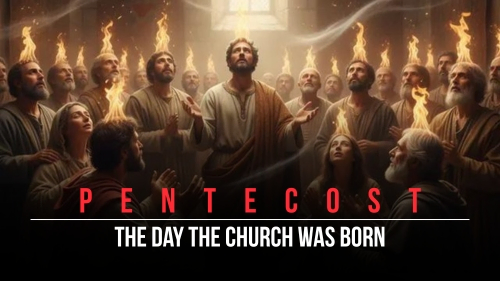
When the day of Pentecost arrived, the disciples were gathered together in one place. Suddenly, a sound like a mighty rushing wind filled the house where they were sitting. Something remarkable followed: divided tongues as of fire appeared and rested on each of them, and they were filled with the Holy Spirit.
Acts 2:4 tells us that they began speaking in other languages as the Spirit enabled them.
Jerusalem was filled with Jewish people from many different nations who had gathered for the feast. When they heard the disciples speaking, they were astonished. Each person heard them declaring the mighty works of God in their own language.
Some were amazed. Others mocked. But Peter, who had once denied Jesus out of fear, stood up and boldly proclaimed the gospel.
He explained that what they were witnessing was the fulfillment of God’s promise through the prophet Joel: God would pour out His Spirit upon His people (Acts 2:16–18; Joel 2:28–29).
Peter then directed their attention to Jesus Christ. He proclaimed His death, resurrection, and exaltation, declaring that the very Jesus they had crucified was both Lord and Christ.
The response was extraordinary. Acts 2:41 tells us that about three thousand people received Peter’s message and were baptized that day.
The Church had been born.
From Harvest to a Greater Harvest
There is a beautiful connection between the original purpose of Pentecost and what happened in Jerusalem.
The Feast of Weeks was a celebration of the harvest. It reminded Israel that God was the giver of life and the provider of their daily bread. On the day of Pentecost in Acts 2, another kind of harvest began to unfold: people from many nations were being gathered into the people of God through the preaching of the gospel.
This does not mean that the agricultural feast was simply a prediction of Acts 2. Rather, the timing and events of Pentecost reveal a remarkable connection between God’s appointed feast and the unfolding mission of the Church.
The risen Christ had promised the Holy Spirit, and now that promise had come to pass. The disciples were no longer simply a group of followers who had witnessed Jesus’ ministry. They were empowered witnesses, commissioned to proclaim His gospel to the nations.
The Promise Was for More Than One Day
Pentecost was not merely a dramatic event in the history of the early Church. It marked the beginning of a new era in which the Holy Spirit would empower God’s people to bear witness to Jesus Christ.
The Spirit’s work was not limited to the apostles or to the first generation of believers. Peter made this clear when he declared that the promise was for his hearers, their children, and all who were far off, everyone whom the Lord calls to Himself (Acts 2:39).
The Church would grow, the gospel would spread beyond Jerusalem, and people from every nation would come to know Christ.
The same God who established the Feast of Weeks, raised Jesus from the dead, and poured out His Spirit at Pentecost was carrying out His redemptive plan.
From the Lamb to the Church
In our journey through the biblical feasts, we have seen how Passover points us to Jesus, the Lamb of God. Unleavened Bread reminds us of His sinlessness and calls us to live in holiness. Firstfruits points us to His resurrection and the promise of our own resurrection.
Now, Pentecost brings us to the coming of the Holy Spirit and the beginning of the Church’s mission.
The disciples were waiting for a promise. God fulfilled it. And the message they began proclaiming in Jerusalem continues to reach people across the world today.
The harvest that began at Pentecost was never meant to remain in Jerusalem. Jesus had promised that His witnesses would carry the gospel to the ends of the earth.
And that mission continues.
This article is part of our series, Jesus in the Feasts, exploring the seven biblical feasts of Leviticus 23 and how each one connects with God’s redemptive plan through Christ.
Next in the series: The Feast of Trumpets: Is It Pointing to the Return of the King?
Previous: Unleavened Bread: Why Did God Tell Israel to Remove All the Leaven?
Thank you for your support.
If you appreciate the work we do to spread the good news of Jesus Christ, please consider giving a gift to help us continue this work. Maranatha!
Click an icon below to share this post.
All articles, including blogs and guest articles, published on Revival Nation News are owned by Revival Nation and Revival Nation News. The use of any content created and published by Revival Nation News may be quoted but attribution is required.
Portions of Revival Nation News articles may be used for reprint and republish purposes, but Revival Nation News MUST BE CREDITED.
All reprinted or republished articles must:
(1) Identify the author of the article.
(2) Contain the Revival Nation News byline at the beginning of the article and a hyperlink “Revival Nation News” to the respective article on the Revival Nation News website.
(3) Contain, at maximum, three paragraphs and then link back to the original article.