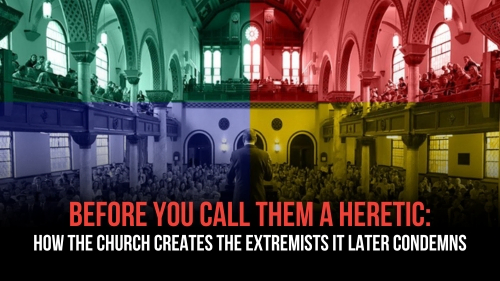
Before You Call Them a Heretic: How the Church Creates the Extremists It Later Condemns

The Church is engaged in a food fight of epic proportions. Accusations, insinuations, and denunciations are being hurled across social media with increasing force. Some of this correction is justified, necessary, and long overdue.
Yet as the intensity rises, we must ask an uncomfortable question: Can a rebuke be biblically accurate and still become spiritually destructive because of the spirit, method, or motive behind it? The Church needs correction, perhaps more than ever, but those who correct are still accountable to Scripture too. If we are going to defend the truth, we have a responsibility to do it God’s way, because the way we confront error can either restore the wandering or drive them farther into error.
(Note: In this blog, we’re dealing with error on secondary, non-salvific issues.)
Imagine that a minister teaches something troubling (that shouldn’t be too hard). A short clip begins circulating online. Within hours, he is called a wolf, a false prophet, and a heretic. Anyone who maintains a relationship with him is accused of compromise. No one asks whether the statement was taken out of context, whether he misspoke, whether the doctrine is central to the gospel, or whether anyone has attempted to correct him personally… he just gets cut off. Months later, his teaching grows more extreme.
The critics point to his development and declare, “See, we were right about him.”
Perhaps they were. Yet another possibility deserves serious consideration: Sometimes the Church creates the extremists it later condemns by driving people beyond the reach of loving correction.
Every teacher remains responsible for what he believes, teaches, and does. Yet the Church must also answer for the way it handles error.
Family is a good example of this. Scripture gives parents real authority, then immediately places a fence around how that authority may be exercised. Ephesians 6 commands children to obey their parents, but the very next instruction turns to fathers: “Provoke not your children to wrath: but bring them up in the nurture and admonition of the Lord.” Colossians follows the same pattern. Children are told to obey, while fathers are warned, “Provoke not your children to anger, lest they be discouraged.” The Bible holds the child accountable for obedience and the parent accountable for the spirit, method, and effect of correction.
A parent may be completely right about the child’s disobedience and still sin in the way correction is delivered. Screaming, humiliation, relentless fault-finding, public shaming, unreasonable demands, and words intended to crush rather than train can provoke anger and break a child’s spirit. Biblical authority carries responsibility. Deuteronomy 6 presents parental instruction as something patiently and consistently woven into everyday life. Hebrews 12 says godly discipline is given for the recipient’s profit and should eventually produce “the peaceable fruit of righteousness.” The fruit of correction matters.
Paul applied this family model directly to spiritual leadership. He said that although the apostles carried authority, they were gentle like a nursing mother who cherishes her children. He also said they exhorted, comforted, and charged believers as a father does his children. Apostolic correction contained firmness and tenderness.
That gives us a powerful principle for the Church:
The authority to correct someone never includes permission to crush them.
A pastor, teacher, or mature believer may have biblical grounds to rebuke error, just as a parent may have grounds to discipline a child. Yet God still holds the corrector accountable for how that authority is used. A rebuke can address a genuine offense while provoking unnecessary wrath, producing discouragement, stoking division, and driving the person farther from the truth. The question is larger than, “Was the correction accurate?” We must also ask, “Was it delivered in a way that reflects the heart and purpose of God?” “Was it done the Bible way?”
A parent can be right about the offense and wrong in the correction. So can a preacher. Biblical authority gives us the responsibility to correct, never the right to abuse.
What happens when we “provoke” our children to wrath? What happens when the substance of the correction is right but the method of application is wrong?
Secondary error can develop into deadly heresy when a person is pushed beyond the reach of loving correction. Error grows extreme when fellowship, accountability, and honest challenge disappear. When correction becomes abandonment, theological error can become theological extremism.
Studies on exclusion and radicalization have found that ostracized people can become more attracted to extreme groups, especially when those groups offer a new identity, a sense of belonging, and protection from a perceived hostile outside group. Remove every reasonable voice from someone’s life, and the only people left may be those who celebrate their worst ideas. This could be one of the fastest ways to radicalize someone and push them further into error.
A Dangerous Doctrine Is Not Automatically Heresy
I have spoken before about the need to distinguish core doctrine from secondary issues, to teach truth instead of chasing every counterfeit, and to pursue restoration rather than building ministries around public exposure.
The modern Church often confuses three categories:
- Disagreement.
- Error.
- Heresy.
A disagreement occurs when sincere Christians reach different conclusions on an issue where faithful believers have historically differed.
An error occurs when someone reaches an incorrect conclusion from Scripture.
A dangerous doctrine is an error that can injure people, distort Christian practice, bind consciences, produce unhealthy fruit, or create a pathway toward more serious deception.
Heresy strikes at the foundational truths that define the Christian faith and the gospel of salvation.
Christians have used the word “heresy” in different ways throughout history, but responsible theologians have generally recognized that every error does not carry the same weight. Historically, the charge of heresy has been reserved for teachings that deny or destroy central Christian convictions. These include the full deity and humanity of Jesus Christ, His atoning death, His bodily resurrection, and salvation through Him.
Albert Mohler describes this process as theological triage. First-order doctrines are essential to Christian identity and the gospel. Second-order doctrines significantly affect church life and organization, yet Christians can disagree on them while recognizing one another as genuine believers. Third-order doctrines allow disagreement even within close fellowship.
This distinction matters because a teaching can be dangerous without placing its teacher outside the Christian faith. This is one of the most difficult points to read, but it’s true.
- A teaching that makes every prophetic impression binding can open the door to manipulation.
- A teaching that turns one interpretation of biblical prophecy into a test of salvation can divide believers.
- A teaching that applies biblical submission in a way that protects controlling leaders can endanger vulnerable people.
These teachings deserve serious biblical correction. Yet the word heresy should still have a threshold. Using the Church’s strongest label for every mistake is itself theological malpractice.
Doctors do not treat a sprained ankle as if it were a gunshot wound. Both require care, but confusing them could kill the patient. Some errors require instruction. Some require a warning. Some require public correction. Some require separation. Wisdom recognizes the difference through the Word of God.
When a person holds a questionable doctrine, relationships provide opportunities for correction. Trusted friends can ask difficult questions. Pastors can open the Scriptures. Fellow ministers can challenge exaggerated claims. Mature believers can separate the legitimate concern behind the teaching from the conclusions that went too far. The jump to “mark and avoid” removes those opportunities.
When the Church casts people out over secondary issues, it can remove the very relationships that might have rescued them from error. This does not mean that we don’t separate and warn. It simply means we do it biblically.
The isolated teacher often finds a new community made entirely of people who agree with him. At that point, changing his mind feels like betraying the only people who stood with him.
Exile can turn a questionable doctrine into an unquestionable obsession. The original error may have been correctable, but rejection hardened it. The person who once needed a conversation now believes he is a persecuted reformer. Every criticism confirms his narrative. Every lost relationship proves that the established Church fears his revelation.
This is why, if you are being attacked or find yourself on the receiving end of public criticism, resist the urge to retreat into a circle of people who only agree with you. Do not dismiss every challenge as persecution. Accountability is a gift, and hard questions can keep a dangerous idea from growing into a destructive one. Some people may be using your name for clicks and views, but seek out mature, reasonable, biblically grounded voices who see things differently. Find people who have nothing to gain from flattering or humiliating you, who love you enough to tell you the truth, and who are willing to remain close enough to help you walk through it.
Wise Christians will keep relational bridges open as long as faithfulness allows.
Do We Trust the Truth We Have Taught?
Some mean-spirited criticism may reveal something uncomfortable about the critic: he does not trust the quality of his own teaching to protect the people God has placed under his influence. (Again, some criticism and public rebuke are justified, but much of what we see online is not.)
Paul described the purpose of apostles, prophets, evangelists, pastors, and teachers in Ephesians 4. Their ministry should equip Christians. Mature believers learn to recognize error because they have been grounded in truth.
Hebrews 5:14 describes mature believers as those whose spiritual senses have been trained to discern good and evil. The Bereans were commended because they searched the Scriptures to test what even the apostle Paul preached.
The goal of Christian leadership is to produce disciples with biblical discernment.
If people can recognize error only after their pastor supplies a weekly list of villains, they have learned dependence rather than discernment, and that is just as cultish as the false teacher they are calling out.
Blacklists can control a congregation for a season. Biblical literacy protects believers for life.
I have taught extensively on how believers can recognize spiritual abuse and doctrinal error. If a leader’s words are elevated to the level of Scripture, or treated as carrying greater authority than Scripture, the church has entered cultlike territory. No Christian is required to obey a command that is immoral, illegal, unethical, or contrary to the Word of God. God gives leaders to His people and often speaks through them, but every leader remains under the authority of Scripture. Believers should never violate a biblically informed conscience simply because someone carries a title. When abuse occurs, it should be reported immediately to the proper authorities. Teaching these basic biblical safeguards can protect people from entire categories of false teachers and abusive leaders without requiring pastors to spoon-feed their congregations a constantly updated list of names.
A mature Christian should be able to hear a questionable statement, open the Bible, examine the context, compare Scripture with Scripture, and identify the problem. A shepherd may sometimes need to point directly at a wolf, but the flock should also be trained to recognize a wolf’s voice.
Constant name-dropping can create intellectually helpless Christians. They learn whom their leader dislikes, but they never learn why the doctrine is wrong.
Teach the truth so clearly that error sounds foreign when your people hear it.
Teach Scripture so thoroughly that believers do not need to borrow your discernment.
Teach the character of Christ so deeply that manipulation, pride, greed, and spiritual abuse become recognizable before a public scandal erupts.
The Biblical Path From Error to Separation
Scripture provides a process that protects truth, people, reputations, and the possibility of restoration.
1. Hear Before You Sentence
Before labeling a person, determine what he actually said.
Listen to the full teaching. Read the complete statement. Examine the context. Distinguish between a poorly worded sentence and a settled theological conviction. Ask whether the person was teaching, speculating, answering a question, or attempting to describe something he had not fully studied. Look to see if they have changed their view since then.
Paul told Timothy not to receive an accusation against an elder without two or three witnesses. When sin was established, Paul also permitted public rebuke. The passage requires both accountability and evidence.
The doctrine can be tested immediately by Scripture. A final judgment concerning the person requires evidence, context, correction, and an opportunity to respond.
Someone may be ignorant, confused, careless, immature, or stubborn. Those conditions require different responses.
2. Teach the Truth Clearly
The first responsibility of a shepherd is to feed the flock.
When a false or dangerous idea begins spreading, open the Bible and show what Scripture says. Explain the relevant passages. Define the important terms. Give people the context. Show them how to reach the biblical conclusion.
There may be no need to mention anyone’s name initially. Correct the idea before creating a controversy around the individual. By calling out their name too early, not only could you be in error, but you could simply fortify their base and increase their popularity.
This approach reveals confidence in the Word.
A leader who has taught the truth faithfully should trust that the Holy Spirit can use the Word to awaken discernment in his people.
3. Take the Person Close Enough to Correct
Acts 18 gives us one of Scripture’s clearest examples.
Apollos was eloquent, mighty in the Scriptures, and fervent in spirit. Yet his understanding was incomplete. Aquila and Priscilla heard him teaching and “took him unto them.” They explained the way of God to him more accurately.
They brought him closer.
They did not begin with a public campaign. They created an opportunity for him to learn. Afterward, the brethren commended Apollos, and he became a great help to the believers. Loving correction preserved a gifted minister and strengthened the Church.
Imagine what the Church would have lost if Aquila and Priscilla had confused incomplete understanding with hardened rebellion or heresy.
4. Answer Public Error Publicly
Private correction is valuable, but Matthew 18 should not become a gag order that prevents necessary public teaching.
Paul corrected Peter publicly in Galatians 2 because Peter’s public conduct had influenced Barnabas and others. The scope of the correction matched the scope of the damage.
Public teaching can require a public answer.
When naming someone becomes necessary, state the name, accurately explain what the person teaches, and open the Word of God. Show where the teaching departs from Scripture. Give enough context for people to judge fairly.
Leave character assassination out of it.
Do not invent motives. Do not diagnose a person’s heart from a video clip. Do not mock their appearance, background, education, family, or personality. Do not exaggerate the claim to make your rebuttal easier.
Address the doctrine.
Paul named Hymenaeus and Philetus, but he also identified their precise error: they taught that the resurrection had already occurred, and their teaching was overthrowing the faith of some. His warning included evidence, content, and consequences. Plus, Paul had a personal relationship with this church.
Some will accuse a ministry of being cultlike because its leader’s words are treated as though they carry the authority of Paul (that IS cultish, by the way). Yet when someone questions the spirit or method of their correction, they immediately appeal to Paul, publicly naming Hymenaeus and Philetus. Without realizing it, they may assume the very position of authority they just condemned in someone else by comparing themselves with Paul. The irony is hard to miss. As wonderful as they may be, they aren’t Paul, either.
John named Diotrephes and described his observable conduct. Diotrephes loved preeminence, spoke maliciously, refused the brethren, and cast people out of the church. John addressed specific actions rather than vague insinuations. Again, John has a personal relationship with this church.
Naming is a scalpel. It should never become a content strategy.
5. Admonish Before Rejecting
Titus 3:10 says, “A man that is an heretick after the first and second admonition reject.”
There is also an important language issue. The Greek word translated heretick is hairetikos. In this context, it carries the sense of someone who is factious or schismatic. Many modern translations render it as a divisive person. Paul is addressing someone who has become stubbornly committed to creating factions. Oddly enough, many of the heresy hunters out there may fall into this category. A person can use the language of heresy to create the very factions Titus warns against.
Paul’s process includes warning, another warning, and then rejection.
Correction gives the person an opportunity to explain, reconsider, repent, and change. If he receives correction, the process has succeeded. If he repeatedly rejects the truth and continues dividing the Church, stronger action becomes necessary.
6. Mark and Avoid When the Biblical Threshold Has Been Met
Romans 16:17 says to mark those who cause divisions and offences contrary to the doctrine the believers had learned.
The verse does authorize separation. It also identifies whom the Church should mark: those who create division and deceive people contrary to apostolic teaching.
Some false teachers must be named. Some ministries must be avoided. Some doctrines are spiritually lethal. Some people will reject repeated correction and use every remaining relationship to spread deception.
At that point, separation protects the flock.
Yet even strong discipline carries a redemptive purpose.
Second Thessalonians 3 instructs believers to note a disobedient person and withdraw fellowship, yet it adds, “count him not as an enemy, but admonish him as a brother.”
Galatians 6 commands spiritual believers to restore the fallen in a spirit of meekness. Second Corinthians 2 tells the church to forgive, comfort, and reaffirm love toward the disciplined person after the punishment had accomplished its purpose.
Biblical discipline establishes a boundary while keeping the door of repentance visible.
Marking someone is a sober act of protection. It should never become a public celebration of another person’s destruction.
The Accuser Is Also Under Judgment
Christians often speak as though the person being accused is the only one standing before God. The accuser is also under judgment.
Proverbs 6 lists both a false witness and one who sows discord among brethren among the things God hates.
Under Israel’s civil law, a malicious false witness could receive the penalty he intended to bring upon the innocent person. The Church does not administer Israel’s civil penalties, but the passage reveals how seriously God views false accusation. He commanded judges to make diligent inquiry before accepting a charge.
An innocent reputation is not acceptable collateral damage in a war for truth.
The same Bible that condemns false doctrine condemns slander, false witness, malicious speech, partiality, pride, gossip, and unnecessary division.
You can identify a doctrinal error accurately and still sin through the way you handle it. You can quote a correct verse and apply it unjustly.
You can defend truth while misrepresenting the person you are attacking.
You can call someone divisive while building your platform by dividing the Body of Christ.
God does not excuse sin because it was committed under the banner of discernment.
Romans 16 may apply to the teacher spreading false doctrine. It may also apply to an accuser who misrepresents a brother, inflames a mob, and fractures fellowship over a secondary matter.
That possibility should produce the fear of the Lord in anyone who builds a ministry around public criticism.
Serious Objections Deserve Serious Answers
“False teachers must be exposed.”
Yes. Jesus warned about wolves. Paul named dangerous teachers. Peter and Jude wrote forcefully against destructive heresies.
Faithful shepherds protect sheep.
Exposure must be accurate, biblical, proportionate, and accountable. Truth never requires slander. A strong case becomes weaker when critics exaggerate, speculate about motives, or edit statements dishonestly. Then they become as guilty as the one they are accusing.
“Public error deserves public correction.”
Often it does.
Public correction can plainly identify the false claim, demonstrate its error from Scripture, and protect the people who heard it. Public correction does not require public humiliation.
The content of a teaching may need an immediate answer while relational and ecclesiastical correction continues.
I’ve personally sat with many ministers privately to bring what I felt was needed correction. I will continue to do so. At times I will share my disagreement publicly, but most of the time it’s dealt with relationally. This is happening with frequency throughout the spirit-filled community, but those who are working to bring this kind of correction will never post it publicly. They don’t need to be known or recognized; they just want to see the Body of Christ edified. I know many of them, and I admire them tremendously.
“I cannot personally contact every public teacher I critique.”
You can evaluate a public teaching without having a private relationship with its teacher.
You should still distinguish between reviewing a doctrine and issuing a final spiritual verdict over a person. An online commentator may refute a sermon. Formal discipline belongs to actual churches, elders, credentialing bodies, and leaders with genuine responsibility and authority.
“Calls for unity can be used to protect abuse.”
Unity never requires silence about abuse, coercion, fraud, violence, or criminal activity.
Protect vulnerable people. Remove immediate access to potential victims. Involve lawful authorities where crimes may have occurred. Preserve evidence. Do not force an alleged victim into a private confrontation with an alleged abuser.
Biblical correction should never become a tool for suppressing legitimate reports or protecting powerful leaders. If you know of any real abuses happening in any context, contact the authorities immediately.
“What happens when someone refuses every attempt at correction?”
Scripture provides the answer.
After patient instruction, clear warnings, verified evidence, and persistent refusal, mark and avoid may become necessary. The hope of restoration does not require endless access to the flock.
Love can establish a firm boundary.
“Does maintaining a relationship communicate endorsement?”
Clear boundaries can prevent confusion, but we don’t want to play the game of guilt by association. I myself am interested in interviewing and talking to people I disagree with and who I believe hold dangerous views. I want to hear it from them myself and see if any progress can be made to correct the error. I’m not concerned about my people being deceived by the error in question. Why? Because I’ve taught them to be Bereans.
A friend can even publicly disagree with a doctrine while privately remaining available to the person. Continued relationship can become the bridge God uses to bring someone back. Wisdom determines the level of access, fellowship, platform, and public association appropriate to each situation.
Unity Does Not Require Uniformity
In another context, I have written that unity does not require uniformity. Christ has never advanced His Kingdom by producing identical servants. He joins people with different gifts, temperaments, assignments, and theological voices through their common allegiance to Him.
John Wesley asked whether believers who could not think alike might still love alike. He argued that smaller differences did not have to prevent union in affection and good works. Christians can demonstrate love across secondary differences.
Even the Westminster Confession acknowledges that councils can err and that many have erred. Christian leaders, denominations, movements, and discernment ministries remain fallible. Scripture alone carries final authority.
Humility strengthens doctrinal courage because it keeps Scripture above our tribe, our platform, and our reputation.
We should hold essential truth with conviction. We should correct dangerous teaching with clarity. We should expose destructive heresy when evidence demands it. We should also refuse to turn every disagreement into an excommunication.
The Church needs correction that is courageous enough to confront error and spiritual enough to desire restoration.
Teach the truth until believers can recognize error for themselves.
Approach people closely enough to correct them.
Answer public error with Scripture rather than insults.
Name names when protection requires it but remain scriptural instead of speculative.
Admonish before rejecting.
Separate when the biblical threshold has been met.
Keep repentance and restoration in view.
Sometimes the Church creates the extremists it later condemns by driving them beyond the reach of loving correction.
Biblical correction speaks plainly, proves its case, protects the flock, honors due process, and keeps the door of restoration visible. The goal is a pure Church, mature believers, protected sheep, corrected teachers, and, whenever possible, a restored brother.
For more, check out Can you be RIGHT about the Heretic and Still Wrong Before God?
Thank you for your support.
If you appreciate the work we do to spread the good news of Jesus Christ, please consider giving a gift to help us continue this work. Maranatha!
Click an icon below to share this post.
All articles, including blogs and guest articles, published on Revival Nation News are owned by Revival Nation and Revival Nation News. The use of any content created and published by Revival Nation News may be quoted but attribution is required.
Portions of Revival Nation News articles may be used for reprint and republish purposes, but Revival Nation News MUST BE CREDITED.
All reprinted or republished articles must:
(1) Identify the author of the article.
(2) Contain the Revival Nation News byline at the beginning of the article and a hyperlink “Revival Nation News” to the respective article on the Revival Nation News website.
(3) Contain, at maximum, three paragraphs and then link back to the original article.