Erika Kirk to NYT: “God Helped Me Forgive My Husband’s Killer”

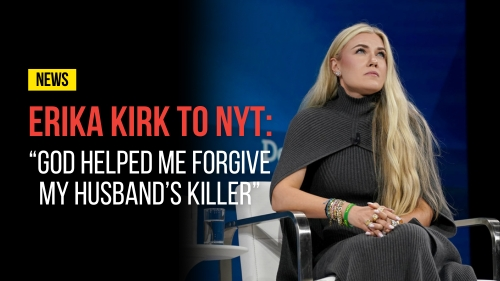
In a city that thrives on sharp edges and unyielding ambition, the stage at the New York Times DealBook Summit on Wednesday became an unlikely pulpit for a message of profound grace. Erika Kirk, the 37-year-old widow of conservative activist Charlie Kirk and newly appointed CEO of Turning Point USA, sat across from host Andrew Ross Sorkin, her voice steady yet filled with the ache of grief.
Just three months after her husband’s assassination on the campus of Utah Valley University, Kirk opened up about the divine intervention she credits for enabling her to forgive his accused killer, a decision that has impacted America’s political and spiritual landscape.
Erika Kirk chillingly reveals how Christ led her to forgive her husband’s assassin. pic.twitter.com/CQfN4OvCqs
— Encounter News (@EncounterNewsX) December 5, 2025
Charlie Kirk, the 31-year-old firebrand founder of the influential youth organization Turning Point USA, was assassinated on September 10, 2025, during a heated debate on his “American Comeback” tour. The suspect, 22-year-old Tyler Robinson, allegedly motivated by what he described in a text to his partner as frustration with Kirk’s “hatred,” now faces charges that could lead to the death penalty. Yet in the midst of national outrage, Erika Kirk has emerged as a beacon of an ancient Christian ethic: forgiveness.
The moment that captivated the summit audience came when Sorkin gently probed Kirk about her impromptu eulogy at her husband’s packed memorial service in Glendale, Arizona. There, before a crowd that included President Donald Trump, Elon Musk and thousands of mourners, Kirk declared, “My husband wanted to save young men, just like the one who took his life. That man, that young man, I forgive him.” It was a declaration she later revealed was not scripted, but a “game-time decision” born of her prayerful surrender.
“I wasn’t up there for anyone else but for the Lord and my husband,” Kirk told Sorkin. “Those were the only two people in my quote-unquote audience.” She elaborated: “God helped me forgive because holding onto that rage would have bound me to evil. It’s not a weakness; it’s the opposite. Forgiveness frees you from the poison, lets your heart breathe again.”
Kirk’s testimony echoed the core of Christian doctrine, where forgiveness isn’t optional but transformative, a divine command that unlocks personal healing and societal reconciliation. As she put it, “I don’t expect everyone to understand… I’m still enraged by what happened. But forgiveness isn’t excusing the act; it’s choosing not to let it define you.”
The Biblical Imperative: Power in Letting Go
At its heart, Kirk’s story illuminates the profound power and function of forgiveness, a theme woven throughout Scripture as both a radical act of obedience and a pathway to liberation.
The Christian worldview of forgiveness isn’t a human invention but a reflection of God’s character, modeled most vividly by Jesus Christ on the cross. As the Gospel of Luke records, amid the agony of nails and mockery, Jesus prayed, “Father, forgive them, for they know not what they do” (Luke 23:34). There was no passivity in this moment, but rather, an active release of judgment into God’s hands, demonstrating that true power lies in vulnerability surrendered to divine justice.
Biblically, forgiveness functions on multiple levels: personal, relational, and cosmic.
On a personal plane, it severs the chains of bitterness that Scripture warns can “defile many” (Hebrews 12:15). Kirk described this vividly: “It frees you to think clearly, to have a moment where your heart is free and you’re not bound to evil or thinking emotionally.”
Psychologists might call this emotional unburdening, but for the believer, we know it’s spiritual warfare. This is the epitome of aligning one’s soul with the call seen in Ephesians 4:31-32 to “let all bitterness and wrath and anger… be put away from you… forgiving one another, as God in Christ forgave you.”
Relationally, forgiveness breaks cycles of vengeance that the Bible equates with self-destruction. Jesus’ parable of the unforgiving servant in Matthew 18:21-35 drives this home: a man forgiven an astronomical debt by his king refuses to pardon a minor one owed to him, only to face the king’s wrath. The lesson? We are all debtors to an infinite mercy; withholding forgiveness hoards grace meant to flow freely. Kirk embodied this at the memorial, extending pardon not to absolve Robinson, but to honor her husband’s mission of redeeming lost young men.
Cosmically, forgiveness participates in God’s redemptive plan, mirroring the Lord’s Prayer: “Forgive us our debts, as we also have forgiven our debtors” (Matthew 6:12).
Forgiveness is a function of the Kingdom, where justice isn’t retributive but restorative. Kirk has publicly opposed the death penalty for her husband’s accused killer, saying, “I do not want this man’s blood on my ledger when I stand before the Lord.” Kirk’s stance aligns with this ethic, viewing capital punishment not as a necessity for personal closure but as a choice by a governing institution.
A Call Beyond the Political Divide
Kirk’s interview transcended her personal loss, weaving forgiveness into broader pleas for unity.
She urged conservatives and liberals alike to “go get Subway” together, imagining figures like Rep. Nancy Mace and Rep. Alexandria Ocasio-Cortez sharing a meal to humanize their divides. “America has a soul problem,” she insisted, rejecting gun control as the sole fix for violence and instead pointing to mental health crises ravaging youth, exacerbated by political toxicity.
As Turning Point USA surges with over 54,000 new student inquiries post-assassination, Kirk steps into her late husband’s shoes as a steward of hope. Her faith-fueled forgiveness challenges a culture addicted to outrage, reminding us that in the Bible’s economy, the greatest power isn’t in striking back, it’s in laying down the right to do so.
In a summit billed for business titans, Erika Kirk delivered something rarer: a sermon on the soul. And in doing so, she invited a nation to glimpse the freedom that comes when God steps in to heal what hatred has torn.
Thank you for your support.
If you appreciate the work we do to spread the good news of Jesus Christ, please consider giving a gift to help us continue this work. Maranatha!
Click an icon below to share this post.



All articles, including blogs and guest articles, published on Revival Nation News are owned by Revival Nation and Revival Nation News. The use of any content created and published by Revival Nation News may be quoted but attribution is required.
Portions of Revival Nation News articles may be used for reprint and republish purposes, but Revival Nation News MUST BE CREDITED.
All reprinted or republished articles must:
(1) Identify the author of the article.
(2) Contain the Revival Nation News byline at the beginning of the article and a hyperlink “Revival Nation News” to the respective article on the Revival Nation News website.
(3) Contain, at maximum, three paragraphs and then link back to the original article.

You might also like



Explore Categories