How Should Christians Think about Iran?

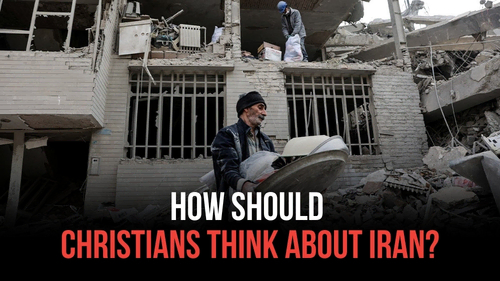
President Trump didn’t enter into this conflict with Iran for the world’s applause — and it’s a good thing, because there isn’t any. The international media, followed by a surprising parade of global leaders, have spent the last several weeks shaming the administration’s decision to neutralize the nuclear threat that a regime of Islamist madmen poses to the planet. Regardless of what public opinion has to say, a lot of Christians are probably trying to understand if his decision was the right one.
Putting aside the rabid anti-Trump crowd (who could run on a platform of ice cream for everyone, Senator John Fetterman, D-Pa., half-joked, and “suddenly, Democrats would hate it”), even The New York Times concedes that there are “compelling reasons for action.” Number one, “Iran poses a threat to the global order,” not just with its missile program and state-sponsored terrorism, but its “deep strategic ties to Moscow and Beijing.” Number two, Bret Stephens acknowledges, the regime “poses a threat to regional stability” through Hamas and Hezbollah, especially. And, he concludes, “it’s a mortal threat to the life and safety of its own people, many thousands of whom it slaughtered last month.” Stephens paused before adding, “There was a time not long ago when Americans, both left and right, cared enough about human rights to believe it could, in some circumstances, justify military intervention.”
But there are other reasons believers should be invested in this mission, Family Research Council President Tony Perkins insists, beyond even the United States’ own interests. “I know a lot of Americans are very short-term in their thinking. They’re looking at the gas prices. They’re looking at the costs associated with [the war].” What they aren’t considering, he argued, “is the long term,” especially as it relates to freedom — “not only for us, but freedom for others who are yearning for what we have here in the United States.” Obviously, he agreed, “There is pressure to reach a [ceasefire] deal. … But what happens if the regime stays in place? Christians remain at risk, and Israel is even more vulnerable.”
Talking with Calvary Chapel Chino Hills Senior Pastor Jack Hibbs, Perkins asked his California friend if his views about the operation have changed over the past six weeks. “No, not at all,” Hibbs answered firmly. And that’s because, “it’s biblically rooted — not politically rooted,” he explained. And what I mean by that is this. … The Iranian people are [increasingly converting to Christianity], and/or they’re atheistic toward Islam. They don’t want Islam. They didn’t want it in 1979, and they don’t want it in 2026. And so that said, my mind has not changed at all.”
Someone, Hibbs underscores, whether it’s the U.S. or Israel, needs to “finish the job of this horrific regime that just wholesale slaughters their own people. But in America,” he points out, “we have a very, very impatient view.” And while he understands those concerns, our nation needs to realize “that the Iranian people are a beautiful and powerful people, and they want freedom. And how important is it to us, the gatekeepers of freedom? How important is it to us that we can export freedom to them by getting this regime off their back?”
But getting the regime off their backs is no small thing, most experts would contend. The U.S. and Israel can set back Iran’s military capabilities years or decades — and they have — but the reality is, it’s very difficult to bomb the Islamic fundamentalism out of Iran. These are madmen, NRO’s Andrew McCarthy underscores, the kind that use child soldiers in war, publicly hang teenagers for wanting free speech, and, as recently as Tuesday, called for citizens to form “human chains” around key power plants and infrastructure to deter Trump.
“Iran’s government is a millenarian jihadist regime that is committed to the destruction of Israel and the West for reasons easily grasped, unless one consciously avoids reality,” McCarthy stressed, “by scrutiny of fundamentalist Islamic doctrine. The regime in Tehran has been killing Americans, making war on the Jewish state, and confidently calling for death to both America and Israel since its 1979 inception. This vision of governance has never been in Iran’s general financial interest, its specific trade interests, or its interest in survival. That hasn’t mattered,” he stresses. “The war will not end unless and until the regime is utterly defeated.”
Senator Lindsey Graham (R-S.C.) echoed this concern on “Washington Watch,” pointing out that even the regime’s “backbenchers,” who’ve been called into leadership after most heads of state have been killed, are hard-core jihadists. “Being part of the regime takes you out of the reasonable camp,” he warned. “[Unless] you think it’s reasonable to want to make the entire world bend to your knee as a religion. They’re religious Nazis. … If you think it’s reasonable to kill all the Jews, I don’t. That’s what they want to do. They’ve been saying this for 47 years. They’ve been acting on their beliefs.” He paused before adding, “They’ve killed like 45,000 of their own people. So never lose sight of who we’re dealing with here. And I don’t think President Trump has.”
The Iranian people want freedom. Tens of thousands of them sacrificed their lives to join demonstrations for it just this year. “There’s an awakening, a revival in Iran. Many people [are] coming to Christ. The regime, though, is desperate,” Perkins pointed out. And at least in the meantime, “Christians are not going to be better off there. Israel is not going to be safer as long as they’re at the helm, even though their weapons capability, their military capability, has been degraded significantly there. It’s just as long as they’re in power, they’re going to be a threat.”
And frankly, Hibbs chimed in, “The Muslim world views Iran as winning. … Why? Because every day they wake up and fight the United States of America, and they’re standing at the end of the day. And to them, that’s victory. … Even if one man is standing every day, they celebrate that they’re winning. And it’s hard for the West to fathom that.” But, he insisted, “We need to get back as a country to understanding our enemy.”
Regardless of what happens next, Iran will be dealing with the catastrophic consequences of Operation Epic Fury for quite some time. Perkins agreed but noted that there’s still work to be done. “I’m not concerned about Israel. God is going to take care of Israel,” he insisted, pointing to Scripture. “But America is at risk if we take the wrong steps and we abandon [them].”
As for where we are in the Bible’s timeline of end days, Hibbs’s answer was interesting. “Ezekiel tells us that Israel will be dwelling in peace at the time of its sudden invasion. [And] Israel right now is not at peace.” In the meantime, Hibbs said, “I would keep my eyes prophetically on Isaiah chapter 17, verses one and two. That is God’s word regarding the absolute destruction of Damascus. It will never again be inhabited, the Bible says. And then the second thing that might very well cue up a time of peace with Iran [is when] many Christians come to faith,” he explained. “I hope and pray that there’s just a tremendous harvest of souls among the Iranian people. That’s what we’re working on. That’s what we’re praying for.”
And maybe that period is short-lived, Hibbs conceded. “But we do know prophetically from Ezekiel chapter 38 that Iran, [or] Persia, will join in … with other nations and invade Israel in a sudden [attack] that catches Israel off guard. Could God be setting up the chess pieces for the events of the last day?” he wondered. “I think we’re getting [a] sufficient warning by God that we need to get right with Him.”
Hibbs went on to explain, “We know that Israel will stand alone in the last days. All nations will be against her. … That includes America. And we also know this — that God will fulfill his prophetic plan for Israel no matter what any podcaster has to say. God is going to return. Christ is going to return in the second coming. Not to Southern California, not to Palestine, but the Bible says to Israel and to the city of Jerusalem, and the Bible says that Jesus will set up his throne in Zion.”
He paused. “So again, I do not know what’s going to happen to this great country of ours. In all of Bible prophecy, America wasn’t written into it. There’s no sign of it yet. We were the greatest nation, the most powerful nation, the most affluent nation, and the most biblically-based nation. And so, I believe because America is absent from Bible prophecy, could it be that America is this covenantal, remarkable moment where God is basically saying to you and [me] right now, ‘Will my pulpits preach repentance and the gospel, and will the nation turn back to me? If they do, I’ll heal their land.’”
For now, Perkins reiterated, “I do believe we’re at that point where we need to be prayerful. We need to repent,” he urged. “Return to the Lord.”
Reprint from The Washington Stand by Suzanne Bowdey – editorial director and senior writer at The Washington Stand.
MORE FROM SUZANNE BOWDEY
For more news with Christian insight from Suzanne Bowdey, follow and subscribe to The Washington Stand.
CLICK HERE for more articles by Suzanne Bowdey.
Follow and connect with Suzanne Bowdey, The Washington Stand, and the Family Research Council
Support the work of Suzanne Bowdey, The Washington Stand and the Family Research Council by using the icons below to follow them on social media and subscribe to their newsletters.
Thank you for your support.
If you appreciate the work we do to spread the good news of Jesus Christ, please consider giving a gift to help us continue this work. Maranatha!
Click an icon below to share this post.


All articles, including blogs and guest articles, published on Revival Nation News are owned by Revival Nation and Revival Nation News. The use of any content created and published by Revival Nation News may be quoted but attribution is required.
Portions of Revival Nation News articles may be used for reprint and republish purposes, but Revival Nation News MUST BE CREDITED.
All reprinted or republished articles must:
(1) Identify the author of the article.
(2) Contain the Revival Nation News byline at the beginning of the article and a hyperlink “Revival Nation News” to the respective article on the Revival Nation News website.
(3) Contain, at maximum, three paragraphs and then link back to the original article.

You might also like



Explore Categories