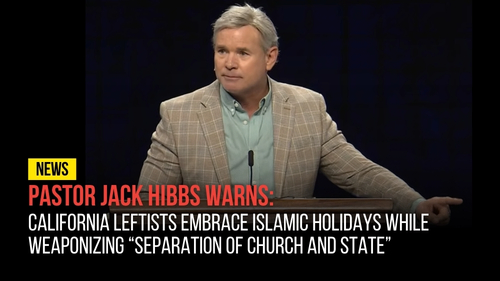
Pastor Jack Hibbs Warns: California Leftists Embrace Islamic Holidays While Weaponizing “Separation of Church and State”

California lawmakers are advancing Assembly Bill 2017 (AB 2017), introduced by Assemblymember Matt Haney (D-San Francisco) in February 2026 and co-sponsored by the Council on American-Islamic Relations (CAIR-CA). The bill would add Eid al-Fitr (marking the end of Ramadan) and Eid al-Adha (commemorating Abraham’s willingness to sacrifice his son, observed with animal sacrifice) to the state’s list of recognized holidays.
If passed, it would allow public schools and community colleges to close on these days, designate them as excused absences for students without academic penalty, and permit state employees to use existing paid leave (vacation, compensatory time, or personal holiday credit) to observe them. The bill explicitly states that Eid wouldn’t become a judicial holiday, meaning courts would remain open.
"Separation of Church and State" when it's convenient. Now Sacramento wants Californians to embrace Islamic holidays.
— Jack Hibbs (@RealJackHibbs) April 15, 2026
OPPOSE AB 2017! pic.twitter.com/spG4pLtr73
Some have framed the bill as promoting “inclusion” for California’s estimated one million Muslims, treating these observances like Christmas or Hanukkah, but in reality, it’s a rejection of American values and foundation.
Selective Application of “Separation of Church and State”
Pastor Jack Hibbs highlighted the issue in a recent post, calling out those who selectively use the “‘Separation of Church and State” but only “when it’s convenient” whilst also urging Americans to “OPPOSE AB 2017!”
His critique points to a longstanding pattern around the phrase “separation of church and state” which was derived from Thomas Jefferson’s 1802 letter referencing the First Amendment’s Establishment Clause that was originally intended to prevent government establishment of a national church or interference in religious exercise, not to purge all religious expression from public life.
In practice, many on the political left invoke this principle aggressively against Christianity.
Examples include efforts to remove nativity scenes from public property, ban voluntary school prayer, challenge “under God” in the Pledge of Allegiance, or restrict Christian symbols and speech in government settings. Yet the same voices often support accommodations, funding, or official recognition for other faiths, particularly Islam.
AB 2017 fits this selective pattern: it embeds Islamic religious observances into the state’s public calendar and education system while longstanding Christian influences on American civic life face scrutiny or marginalization.
One cannot categorize this as neutral pluralism as it reflects a double standard where “separation” serves as a tool to sideline the historic Judeo-Christian foundation of the West while advancing competing ideologies.
Fundamental Incompatibility Between Islam and Christianity (and American Values)
Christianity and Islam aren’t interchangeable Abrahamic faiths with minor differences as they diverge on core doctrines in ways that produce profoundly different worldviews, ethics, and approaches to society and governance.
Christianity centers on the Trinity: one God in three persons (Father, Son, and Holy Spirit), as well as the incarnation, crucifixion, and resurrection of Jesus Christ as the divine Son of God who atones for humanity’s sin through grace and faith. Salvation is a gift received by individuals, not earned through ritual or law. The New Testament emphasizes love for neighbor (even enemies), forgiveness, and the separation of spiritual and temporal authority (“Render to Caesar the things that are Caesar’s, and to God the things that are God’s.” Mark 12:17).
While Christians have sometimes failed to live this out, scriptures and historical development in the West helped foster concepts of individual conscience, limited government, equality before the law, and the inherent dignity of every person made in God’s image.
Islam, by contrast, teaches strict monotheism centered on Allah, with Muhammad as the final prophet. It explicitly rejects the divinity of Jesus (calling him a mere prophet, not the Son of God) and denies the crucifixion and resurrection.
Meanwhile, the Quran and Hadith present salvation through submission to Allah, adherence to the Five Pillars (including the Shahada declaration of faith, prayer, fasting, charity, and pilgrimage), and following Sharia, a comprehensive legal and moral code derived from the Quran, Muhammad’s example (Sunnah), and scholarly consensus.
Sharia doesn’t just govern personal piety but politics, family law, criminal justice, finance, and warfare. Apostasy, blasphemy, and certain moral infractions carry severe earthly penalties.
These differences also extend to society.
Christianity, at its theological core, supports the idea that the church and state have distinct roles, enabling the religious liberty that defines America. The U.S. Constitution’s First Amendment protects free exercise of religion while prohibiting the establishment of a state religion. America’s founding values of individual rights, consent of the governed, equality under law, and freedom of speech and conscience all grew from this soil!
Meanwhile, Islam’s orthodox sources present a different vision. The Quran commands spreading Islam through various means, including jihad. Muhammad served as both prophet and political/military leader, establishing a model where religion and state are fused under Sharia.
In practice, this has historically produced societies where non-Muslims face legal disabilities, blasphemy laws suppress criticism, and conversion out of Islam is punishable by death in many interpretations. While individual Muslims vary widely in practice, the religion’s foundational texts and the track record of Muslim-majority nations (where religious minorities often face persecution, and apostates risk violence) reveal systemic tensions with pluralistic liberal democracies and our republic.
Polls and global data consistently show higher support in Muslim communities for Sharia-based governance, hudud punishments (amputation, stoning), and restrictions on speech critical of Islam. In the U.S., this manifests in demands for accommodations that go beyond private observance such as prayer rooms in schools, halal mandates, or, as with AB 2017, official state endorsement of Islamic holy days while resistance to similar Christian expressions is labeled “theocracy.”
America, with its laws, rights, and culture were all profoundly shaped by biblical ethics: the rule of law over rulers, protection of the weak, and the sanctity of individual conscience. Importing and elevating a faith whose orthodox doctrines reject these distinctions risks eroding the very framework that allows diverse religious practice to coexist without coercion.
The Broader Pattern in Sacramento
California’s push for AB 2017 continues a trend where the state has restricted Christian viewpoints in public education, mandated curricula that undermines traditional family values rooted in Christianity, and shown reluctance to address honor-based violence, female genital mutilation, or grooming concerns linked to certain Islamic communities. Meanwhile, it fast-tracks recognition of Islamic observances. Similar moves have occurred elsewhere, such as in Washington state.
This isn’t harmless multiculturalism (it is never “harmless”), this is the normalization of a faith whose supremacist elements which views non-Muslims as inferior and aiming for eventual dominance, clash with America’s experiment in ordered liberty.
Pastor Hibbs and others are urging Christians in California to stand in opposition to AB 2017 to defend the foundational incompatibility: a nation built on Christian-influenced principles of freedom and liberty cannot indefinitely accommodate a system that subordinates all to Sharia [Islamic] law without consequences for those freedoms.
Californians and Americans should insist on consistent principles.
Religious liberty means the right to private worship and conscience not government promotion of any faith’s calendar or values at public expense. True inclusion doesn’t require the state to “embrace” holidays that celebrate an ideology at odds with the nation’s heritage. What is required is the preservation of America’s framework which is proven to protect all without preferential treatment that tilts the scales toward incompatibility.
Thank you for your support.
If you appreciate the work we do to spread the good news of Jesus Christ, please consider giving a gift to help us continue this work. Maranatha!
Click an icon below to share this post.



All articles, including blogs and guest articles, published on Revival Nation News are owned by Revival Nation and Revival Nation News. The use of any content created and published by Revival Nation News may be quoted but attribution is required.
Portions of Revival Nation News articles may be used for reprint and republish purposes, but Revival Nation News MUST BE CREDITED.
All reprinted or republished articles must:
(1) Identify the author of the article.
(2) Contain the Revival Nation News byline at the beginning of the article and a hyperlink “Revival Nation News” to the respective article on the Revival Nation News website.
(3) Contain, at maximum, three paragraphs and then link back to the original article.

You might also like


Explore Categories