Can AI Become an Idol? What Christians Need to Know About Artificial Intelligence

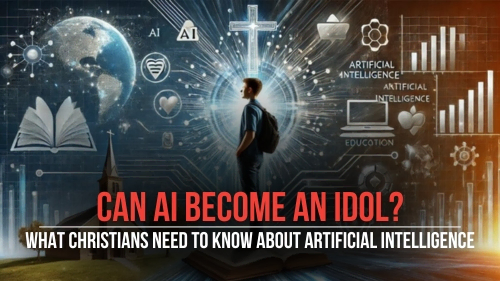
You can ask AI to write your prayer. You can ask it to explain a Bible verse.
You can ask it what a difficult passage means, help you prepare a Bible study, give you advice about a relationship, or even tell you what you should do when you don’t know which decision to make.
And it will answer. Quickly. Patiently. At any hour of the day. But there is a question Christians need to ask, not simply about what artificial intelligence can do, but about what we are allowing it to become in our lives:
Can AI become an idol?
At first, the question may sound strange. An idol, after all, is something we might imagine sitting on an ancient altar, a carved image made of wood or stone. But Scripture’s warning about idolatry goes much deeper than statues. An idol is anything we give the place, trust, devotion, or dependence that belongs to God.
And that means idolatry can exist in the modern world just as easily as it did in the ancient one. It can hide behind money, success, relationships, politics, entertainment, comfort, and now, potentially, technology.
AI Is Already Changing the Way Christians Live
Artificial intelligence is no longer a futuristic idea reserved for science-fiction movies. People are using AI to write, research, translate, create images, organize information, study, communicate, and answer questions. Christians are using it too.
In July 2026, Barna reported that practicing Christians in the United States were using AI at significant rates, with 44% saying they used AI “very often” or “often” in their personal lives.
Christian ministries are also exploring constructive uses of the technology. One ministry working with persecuted Christians has launched an AI tool designed to provide biblical and apologetic answers to people who may have limited access to Christian resources. It can help translate information. It can help organize research. It can make certain tasks faster. It may even help make biblical resources accessible to people who otherwise could not easily obtain them.
So the Christian response does not have to be, “AI is evil.” That is too simplistic, and the more important question is:
Who is the master, and who is the servant?
A Tool Is Not the problem, and the Bible does not condemn technology. Human beings have always created tools. We build, invent, cultivate, organize, communicate, and use the resources available to us. The issue is not whether we use a tool. The issue is whether the tool begins to rule us.
A knife can prepare dinner or perform surgery. The same object can also be used to harm someone. Technology works in much the same way.
AI can help a Bible translator, and it can also encourage someone to stop reading the Bible for themselves. It can help a pastor organize research, and can also tempt a Christian to replace prayerful study with instant answers. It can help someone find information and can also become the first place they turn for wisdom.
That distinction matters.
Recent Christian discussions about AI have raised precisely this concern. Christian mathematician and apologist John Lennox has warned that technology designed to serve humanity can become “a very dangerous master.” He has specifically expressed concern that dependence on AI could contribute to declining reading habits and, consequently, declining engagement with Scripture.
The problem, then, is not necessarily the existence of AI. It is dependence.
What Exactly Is an Idol?
To understand how AI could become an idol, we first need to understand what the Bible means by idolatry. God’s command in Exodus is unmistakable:
“You shall have no other gods before me.” — Exodus 20:3
An idol is ultimately a rival to God. It takes something created and gives it a place that belongs to the Creator. That is why idolatry can be much more subtle than bowing before a statue.
Jesus said, “No one can serve two masters” (Matthew 6:24).
Paul warned believers to “flee from idolatry” (1 Corinthians 10:14).
And Jeremiah contrasted two very different kinds of trust:
“Blessed is the man who trusts in the LORD, whose trust is the LORD.” — Jeremiah 17:7
The biblical issue is therefore not simply: “What do you use?”
It is:
What do you trust? What do you run to first? What do you believe will give you security? Where do you look for wisdom? What controls your attention? What do you believe you cannot live without?
Those questions expose idols much more effectively than looking for statues.
When AI Starts Taking God’s Place
Imagine someone facing a difficult decision and instead of praying, they immediately open an AI chatbot. They explain the situation and the machine gives them a thoughtful answer. They follow it, and the next time something happens, they do the same thing. Eventually, AI becomes their first source of counsel, then their most trusted source, then perhaps their primary source.
Nothing dramatic happened; there was no altar, no statue, no declaration that AI is God, but something changed. The person gradually moved from: “Let me use this tool.” to: “Let me ask this tool.” to: “I need this tool to tell me what to do.”
That is where Christians need to pay attention because a useful tool can quietly become an authority. And an authority can quietly become an idol.
AI Can Give Answers, But It Cannot Be God
This is especially important when AI enters our spiritual lives. For example, a chatbot can explain the doctrine of justification, it can summarize Romans, it can list Bible verses about anxiety, it can generate a prayer and it can compare theological positions.
But it cannot regenerate a human heart, it cannot forgive sins it cannot reconcile a sinner to God, it cannot sanctify you it cannot love you, it cannot pray for you in the way Scripture describes the Spirit interceding for believers and it certainly cannot take the place of Jesus Christ.
Christianity is not ultimately about having access to the right information it is about knowing God through Jesus Christ. Jesus did not say, “Come to a system that can answer all your questions.”
He said: “Come to me, all who labor and are heavy laden, and I will give you rest.” — Matthew 11:28
That distinction is crucial, AI can provide information but only Christ provides salvation.
What Happens When We Stop Reading the Bible?
Perhaps one of the greatest dangers is not that Christians will suddenly worship machines. It is that we will slowly stop thinking, reading, praying, studying, and wrestling with God’s Word because a machine can do those things more quickly.
Why spend thirty minutes reading Romans when AI can summarize it in thirty seconds? Why study a difficult passage when a chatbot can explain it instantly? God’s Word is not merely information to be consumed. It is truth to be believed, treasured, meditated upon, obeyed, and lived.
Psalm 1 describes the blessed person as one whose “delight is in the law of the LORD” and who meditates on it “day and night.”
Notice the language. Delight, Meditation, Time, Relationship. The Christian life cannot be reduced to just receiving instant answers.
Recent discussions among Christian apologists have raised exactly this concern. John Lennox and Wes Huff have warned that AI-generated summaries can become a substitute for actually reading and meditating on Scripture, describing this as a danger of spiritual starvation.
The Bible was not given to us merely so we could know what it says. It was given so that we might know the God who speaks.
What If AI Gives You a Biblical-Sounding Answer?
This is where things become even more complicated. AI does not necessarily produce obviously false information. Sometimes the answer may sound deeply Christian. It may quote Scripture and it may mention Jesus. It may use words such as grace, salvation, faith, forgiveness, and love.
But sounding Christian is not the same as being biblically faithful.
A recent study of AI responses to doctrinal questions found concerns about “doctrinal flattening”, the tendency of AI systems to oversimplify complex theological positions or present differences between Christian traditions in misleading ways.
That should make Christians cautious because the smoothness, confidence, or the number of Bible verses in an answer does not prove its truth. The Christian’s standard is Scripture.
AI Should Never Become Your Shepherd
There is another danger worth considering: emotional dependence. AI can be remarkably conversational, it can respond immediately and does not become tired of your questions.
For someone who is lonely, anxious, grieving, or confused, that can feel comforting. But Christians need to remember the difference between simulated companionship and Christian fellowship.
Hebrews 10:24–25 calls believers to encourage one another and not neglect gathering together. We need brothers and sisters who can pray with us, correct us, encourage us, challenge us, and sometimes simply sit beside us.
So, Should Christians Stop Using AI?
Not necessarily. Christians can use technology wisely without allowing technology to become their master. AI may help with research, translation, organizing information, assisting with administrative work, or locating resources they did not know existed.
But we should be careful when AI begins moving into areas that require spiritual authority, wisdom, discernment, pastoral care, or personal obedience to God.
Before asking AI a spiritual question, perhaps ask yourself: Have I prayed about this? Have I searched Scripture? Have I spoken with a mature Christian? Am I using AI as a tool, or am I looking to it as an authority?
Those questions can help keep technology in its proper place.
A Simple Test for the Christian
Here is perhaps the simplest way to think about it.
Imagine taking AI away for a month.
Would your relationship with God become weaker? Would you struggle to study the Bible? Would you feel unable to make decisions? Would you feel as though you had lost your counselor, companion, or source of wisdom?
If the answer is yes, that deserves prayerful examination. Because the question is no longer simply whether AI is useful. The question is whether we have begun to depend on it in a way that belongs to God.
Psalm 20:7 says: “Some trust in chariots and some in horses, but we trust in the name of the LORD our God.”
The Greatest Danger May Not Be AI Becoming God
Perhaps the greatest danger is not that machines will become gods. It is that humans will treat them as though they are.
AI can appear incredibly knowledgeable because it can access and process enormous amounts of information. But knowledge is not wisdom, information is not truth, intelligence is not divinity, and human invention is not the Creator.
The Bible gives us a radically different picture of human beings.
We are made in the image of God (Genesis 1:27).
Our worth does not come from our productivity but from our Lord.
Keep the Tool in Its Place
Artificial intelligence will continue to develop. It will become faster, more conversational, and more beneficial.
Christians do not need to fear every new technology. But neither should we blindly embrace everything technology offers. We need wisdom, discernment, Scripture, and above all, we need to remember who God is.
AI can be a tool, but it must never become our master.
Because there is only one Lord. There is only one Savior. There is only one source of ultimate truth. And there is only one who deserves our worship.
Jesus Christ.
As technology becomes increasingly capable of answering our questions, may Christians become increasingly committed to knowing the One who is the answer to our deepest need.
Because the most important question in the age of artificial intelligence is not: “What can AI do for me?” It is: “Who am I trusting?”
And the Christian answer should remain the same yesterday, today, and forever: “We trust in the name of the LORD our God.”
Thank you for your support.
If you appreciate the work we do to spread the good news of Jesus Christ, please consider giving a gift to help us continue this work. Maranatha!
Click an icon below to share this post.
All articles, including blogs and guest articles, published on Revival Nation News are owned by Revival Nation and Revival Nation News. The use of any content created and published by Revival Nation News may be quoted but attribution is required.
Portions of Revival Nation News articles may be used for reprint and republish purposes, but Revival Nation News MUST BE CREDITED.
All reprinted or republished articles must:
(1) Identify the author of the article.
(2) Contain the Revival Nation News byline at the beginning of the article and a hyperlink “Revival Nation News” to the respective article on the Revival Nation News website.
(3) Contain, at maximum, three paragraphs and then link back to the original article.

You might also like




Explore Categories