5 Supreme Court Cases That Could Change America

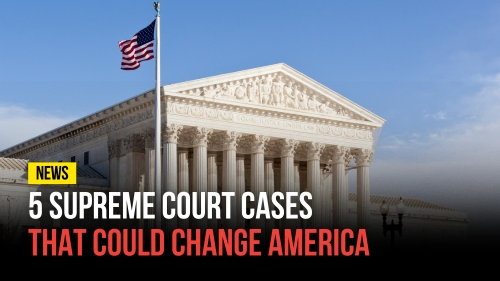
It’s June and U.S. Supreme Court justices still have some of the most consequential cases in recent memory left to decide. From the meaning of American citizenship to the integrity of elections, to men participating in women’s sports to immigration policy to gun rights, the rulings expected before the end of June will reverberate across the country for generations.
As such, we have outlined the five cases every American should be watching:
1. Birthright Citizenship: Trump v. Barbara
This case tests whether the 14th Amendment’s Citizenship Clause, which states, “All persons born or naturalized in the United States and subject to the jurisdiction thereof” automatically confers citizenship on children of illegal entrants or temporary visa holders.
President Trump’s executive order seeks to restore the original public meaning: jurisdiction requires full allegiance and legal obligation, excluding those here unlawfully or transiently (as with diplomats or invaders under traditional understanding).
The 1898 Wong Kim Ark ruling involved legal residents; it didn’t settle the issue for mass illegal immigration unknown at the time of the Amendment’s ratification. Important to note is how modern policy creates powerful incentives for illegal crossings and “birth tourism,” both of which undermine sovereignty and the rule of law.
A ruling upholding Trump’s order would reclaim congressional intent and democratic control over citizenship, rather than leaving it as an unchecked magnet.
2. Mail-In Ballots and Election Day: Watson v. Republican National Committee
At stake is whether states can extend Election Day by judicial or legislative grace periods for mail-in ballots received after the statutory deadline (the first Tuesday after the first Monday in November). Federal law and historical practice treat that date as the clear, uniform cutoff. Mississippi’s five-day window risk diluting Election Day integrity, inviting chain-of-custody issues, late surges, and eroded public confidence.
Conservatives argue that secure, same-day voting with absentee exceptions for cause preserves trust. Striking these extensions would reinforce a single, verifiable Election Day, reduce opportunities for manipulation, and force states to prepare ballots properly in advance of midterms. Uniform rules protect the franchise for all lawful voters equally.
3. Protecting Women’s Sports: Little v. Hecox and West Virginia v. B.P.J.
Twenty-seven states have protected female athletics by maintaining sex-based categories rooted in biology. The Supreme Court will decide whether the 14th Amendment’s Equal Protection Clause forbids states from barring biological males from girls’ and women’s teams, despite well-documented advantages in strength, speed, and physiology that persist post-puberty.
Lower courts blocked Idaho and West Virginia laws; the Supreme Court now has an opportunity to affirm that states may recognize biological reality without violating the Constitution. This isn’t discrimination against individuals identifying as “trans” but safeguarding fair competition, safety, scholarships, and Title IX’s promise for millions of female athletes. A strong ruling would validate the widespread state consensus and prevent activist reinterpretations of “sex.”
4. Ending Perpetual “Temporary” Status: Mullin v. Doe and Trump v. Miot
These consolidated cases address the president’s authority to terminate Temporary Protected Status (TPS) designations for countries like Syria and Haiti when conditions no longer warrant them. Enacted in 1990 for genuine short-term crises, TPS has in practice become semi-permanent residency for hundreds of thousands, even after years or decades.
The core question is executive discretion under the statute: Can designations be ended, or has “temporary” become a judicially entrenched entitlement?
Conservatives support restoring the program’s original narrow purpose: protection during acute emergencies, followed by repatriation, rather than open-ended amnesties by inertia. Upholding termination authority would allow the elected president to enforce immigration law, prioritize American workers and resources, and encourage resolution in home countries.
5. Second Amendment Cases: Wolford v. Lopez and United States v. Hemani
Wolford challenges Hawaii’s default prohibition on carrying firearms onto private property open to the public (absent explicit permission), effectively expanding “sensitive places” to cover much of daily life. This tests Bruen’s history-and-tradition standard: Founding-era carry rights were not so easily nullified by broad state presumptions against armed self-defense.
Hemani examines federal bans on gun ownership by users of controlled substances, often applied categorically even to marijuana in legal states.
Both cases offer the Court a chance to reinforce that the Second Amendment isn’t merely a second-class right subject to interest-balancing or expansive carve-outs. A pro-2A outcome would limit judicial and legislative creativity that burdens law-abiding citizens while criminals ignore restrictions.
These rulings also test core conservative principles: original public meaning over evolving policy, border sovereignty and citizenship control, election security through clear rules, biological fairness for women and girls, accountable executive enforcement of immigration statutes, and an armed citizenry as a bulwark of liberty.
A term yielding decisions in these directions would rebalance federalism, restore textual limits on government, and deliver lasting wins for constitutional order heading into the midterms and beyond. June could mark a pivotal return to first principles.
Thank you for your support.
If you appreciate the work we do to spread the good news of Jesus Christ, please consider giving a gift to help us continue this work. Maranatha!
Click an icon below to share this post.



All articles, including blogs and guest articles, published on Revival Nation News are owned by Revival Nation and Revival Nation News. The use of any content created and published by Revival Nation News may be quoted but attribution is required.
Portions of Revival Nation News articles may be used for reprint and republish purposes, but Revival Nation News MUST BE CREDITED.
All reprinted or republished articles must:
(1) Identify the author of the article.
(2) Contain the Revival Nation News byline at the beginning of the article and a hyperlink “Revival Nation News” to the respective article on the Revival Nation News website.
(3) Contain, at maximum, three paragraphs and then link back to the original article.

You might also like


Explore Categories