Pentagon Trims Faith Codes to 31, And the Constitution Permits It

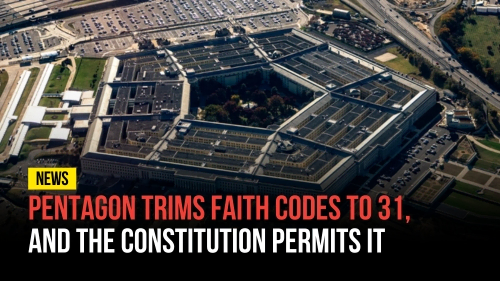
It’s official, the Department of War has reduced its official list of recognized religious affiliation codes, cutting the roster from more than 200 designations down to just 31. Among the belief systems removed are Wicca, Druidry, Asatru, Paganism, Shamanism, Rosicrucianism, Humanism, and various New Age traditions.
The revision, enacted through a May 20, 2026 memorandum signed by Undersecretary of Defense Anthony Tata, represents the most significant restructuring of military faith codes in nearly a decade.
Whilst critics have been quick to cry constitutional foul, a careful reading of the First Amendment, the Supreme Court’s own jurisprudence, and the unique legal context of military administration tells a different story, one that suggests the Department of War’s action falls well within the bounds of constitutional authority.
The stated purpose of the reform is administrative streamlining. Defense Secretary Pete Hegseth announced the initiative back in a December 2025 video message and elaborated on the plan in March 2026, explaining that the old system had become unwieldy and unworkable. “The previous system had ballooned to well over 200 faith codes,” Hegseth said. “It was impractical and unusable, and many codes were never used at all.”
That claim is backed by the data. According to the Department’s own analysis, approximately 82 percent of religiously affiliated service members identify under just six of the available faith categories. The remaining 200-plus codes were largely dormant, a bureaucratic overgrowth that provided little practical benefit to chaplains trying to deliver targeted spiritual support.
The revised list retains 31 broadly defined categories, including Christianity’s major denominations (Baptist, Catholic, Lutheran, Methodist, and others), Judaism, Islam, Buddhism, Hinduism, Sikhism, and a general Agnostic category, among others. The goal, per the May 20 memo, is to “streamline the DoW collection of religious preferences for service members to enhance the delivery of targeted religious support from the Chaplaincy.”
Here’s where clarity is essential, because much of the outrage directed at this decision fundamentally misunderstands what the First Amendment requires of the government.
The First Amendment contains two religion clauses: The Establishment Clause, which prohibits Congress, and by extension the executive branch, from making any law “respecting an establishment of religion.” And secondly, the Free Exercise Clause prohibits the government from interfering with the practice of religion.
What neither clause does is require the government to formally catalogue, codify, and administratively recognize every conceivable belief system in the world. Recognition in a bureaucratic database isn’t the same thing as protecting religious practice.
A Wiccan service member whose faith code no longer appears on a drop-down menu retains every legal right to practice his or her beliefs, seek accommodation, and request chaplaincy services. The military chaplaincy has always operated on the principle of “perform or provide,” meaning a chaplain of one faith tradition is expected to facilitate access to spiritual care for service members of any tradition, even when a chaplain of that specific tradition is unavailable.
The constitutional standard that matters here was articulated repeatedly by the Supreme Court: the Establishment Clause “prohibits the government from establishing an official religion” and prohibits “government actions that unduly favor one religion over another.” Removing Wicca, for example, from an administrative list doesn’t establish Christianity as a state religion, it doesn’t ban Wiccan practice nor does it punish Wiccan belief. What it does do is reorganize an internal bookkeeping system.
Critics also tend to overlook a foundational principle of American constitutional law: the military occupies a distinct legal space.
The Supreme Court has long recognized that courts owe substantial deference to the professional judgments of military leadership on matters of internal administration. In Goldman v. Weinberger (1986), the Court held that “the military is, by necessity, a specialized society separate from civilian life” and that military authorities are entitled to considerable latitude in regulating conduct that would be protected in the civilian world.
Administrative decisions about the categorization and tracking of service member demographics, including religious preference codes, are precisely the kind of internal operational judgments that courts have historically left to military commanders. The Pentagon isn’t a church, a courthouse, or a seminary. It’s an administrative institution with legitimate interests in efficiency and practicality.
A distinction that critics have largely ignored is the difference between removing a code from an administrative database and actually infringing upon religious liberty. The aren’t the same things.
The precedent cuts both ways. In 2017, during the first Trump administration, the Armed Forces Chaplains Board expanded the recognized faith list to better capture demographic data, reflecting an administrative preference for granularity. The May 2026 memo reflects an administrative preference for consolidation. Both actions are the kind of routine internal policy adjustments that executive departments make as circumstances, data needs, and leadership priorities change.
The Establishment Clause doesn’t freeze government administrative structures in place nor does it entitle any particular religious group to continued recognition in a departmental database. The government is permitted to organize its own internal record keeping in whatever manner best serves its operational mission, so long as it doesn’t actively penalize belief, compel religious observance, or officially endorse a single faith as the national religion. None of those things have happened here.
The Department of War’s action doesn’t appear to violate the First Amendment as the Supreme Court has interpreted it. The government isn’t required to maintain an exhaustive taxonomy of every belief system as a condition of respecting religious freedom.
For all of the hullabaloo surrounding this move, it ultimately serves as a refresh of internal systems and not the denial of any service members deeply held beliefs.
The Department of War’s memo takes effect within 60 days of its May 20, 2026 issuance. Legal challenges from civil liberties organizations are expected.
Thank you for your support.
If you appreciate the work we do to spread the good news of Jesus Christ, please consider giving a gift to help us continue this work. Maranatha!
Click an icon below to share this post.
All articles, including blogs and guest articles, published on Revival Nation News are owned by Revival Nation and Revival Nation News. The use of any content created and published by Revival Nation News may be quoted but attribution is required.
Portions of Revival Nation News articles may be used for reprint and republish purposes, but Revival Nation News MUST BE CREDITED.
All reprinted or republished articles must:
(1) Identify the author of the article.
(2) Contain the Revival Nation News byline at the beginning of the article and a hyperlink “Revival Nation News” to the respective article on the Revival Nation News website.
(3) Contain, at maximum, three paragraphs and then link back to the original article.