
Children Aren’t “Sex Workers”: How a UN Body Betrayed Its Own Mandate


In February 2026, the UN Committee on the Elimination of Discrimination Against Women — the body known as CEDAW — published what should have been a routine review of women’s rights conditions in the Kingdom of the Netherlands.
What it published instead was a document that human rights advocates, child protection experts, and even a fellow UN official have all condemned as a fundamental betrayal of the children it was created to protect.
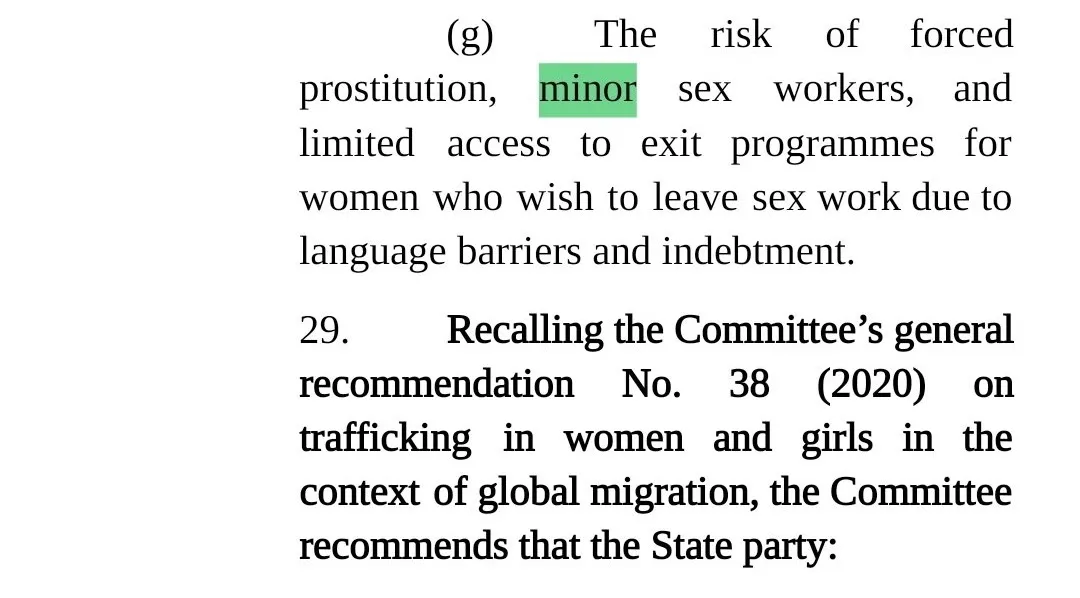
Buried in the report’s recommendations was a phrase that shocked advocates: “minor sex workers.”
Those three words aren’t a technicality as some will inevitably try to spin them as. They aren’t a translation artifact or a drafting oversight.
So what are they? They represent the adoption, in official UN language, of the horrific fiction that a child can be a worker in the sex trade and that what is done to a trafficked girl is a form of employment!
It is not. It is a crime.
And the institution charged with defending women and girls from exactly this kind of exploitation was the one that gave it a name that makes exploiting little girls sound like a job. In no world can this be normalized.
What CEDAW Is — and What It Is Supposed to Do
To understand the magnitude of this failure, we must first understand what CEDAW is and what it exists to accomplish.
The CEDAW Committee is the body of independent experts (at least, they’re supposed to be) that monitors implementation of the Convention on the Elimination of All Forms of Discrimination Against Women, often described as the “International Bill of Women’s Rights.” (There’s a lot I could say about their anti-women’s rights work, but that is for another day.)
The CEDAW Convention itself is unambiguous about where it stands on prostitution and trafficking. Article 6 of CEDAW explicitly requires that states take all appropriate measures to suppress the trafficking of women and the exploitation of prostitution of women. The 23 experts on “women’s rights” from around the world in the committee seem to have forgotten this, however.
CEDAW’s own General Recommendation No. 38, adopted in 2020, goes further, recognizing trafficking and the exploitation of prostitution as “indivisible” phenomena, both described as severe forms of gender inequality and a threat to international peace and security.
In other words, CEDAW’s founding mandate is to protect women and girls from sexual exploitation not to rebrand that exploitation as labor, and certainly not to apply labor terminology to children being trafficked!
The Netherlands Report and Its Catastrophic Language
In late February 2026, the CEDAW Committee published an “advance unedited version” of its Concluding observations on the seventh periodic report of the Kingdom of the Netherlands.
The report was, in theory, an examination of whether the Netherlands was fulfilling its obligations under the Convention to prevent and combat trafficking and the exploitation of prostitution.
What it delivered was something else entirely.
The CEDAW Committee recommended that the Netherlands further decriminalize pimping and brothel-keeping, lift restrictions on the sex trade, and permit “home-based sex work.” The report also characterizes prostitution as a form of labor and refers to sex trafficked girls as “minor sex workers.”
These observations and recommendations stand in complete violation of provisions in CEDAW itself:
- The Protocol to Prevent, Suppress and Punish Trafficking in Persons Especially Women and Children,
- The Convention on the Rights of the Child, and
- The 1949 Convention for the Suppression of the Traffic in Persons and of the Exploitation of the Prostitution of Others.
Each one of these treaties recognizes that persons under the age of 18 exploited in the sex trade are, by definition, sex trafficked children and not “minor sex workers!”
The same 1949 Convention, a foundational pillar of international anti-trafficking law, states plainly that prostitution is incompatible with human dignity and there is no version of international law under which a child being sexually exploited is a “worker.” There never has been. CEDAW’s own foundational documents say so. And yet the Committee wrote it anyway.
The Netherlands Connection: Following the Lead of an Interested Party
One of the most troubling dimensions of this scandal is how the language “minor sex workers” appears to have entered the CEDAW report in the first place, and the answer points directly to the Kingdom of the Netherlands itself.
The Kingdom of the Netherlands has a centuries-old history of promoting the system of prostitution in its country and territories, former colonies, and globally.
In 2000, the Dutch government formally legalized the sex trade and lifted the ban on brothel owning.
Today, the vast majority of women in prostitution in the Dutch sex trade are migrant women from Eastern Europe and the Global South who are brutally abused at the hands of sex buyers, traffickers, and other third-party exploiters.
This context matters enormously.
CEDAW’s role is to hold member states accountable by the evaluation of whether a government is meeting its obligations under international law to protect women and girls. It’s not to adopt the framing and terminology of the government under review, particularly when that government has an obvious and longstanding institutional interest in normalizing its own sex trade.
When a UN treaty body uncritically borrows the language of the state it is meant to scrutinize, something has gone deeply wrong.
The independence that gives CEDAW its authority and legitimacy was abandoned the moment the Committee echoed the Dutch government’s preferred vocabulary and applied it to children.
What good is an international human rights body that doesn’t protect the most vulnerable but instead allows a powerful, pro-prostitution state to set the linguistic terms of the debate?
Children Cannot Consent. They Cannot Be “Workers.” Full Stop.
This point cannot be stated often enough or with sufficient force: there is no such thing as a child “sex worker.” The concept is a legal and moral impossibility.
Every framework of international child protection law rests on the recognition that children cannot give meaningful consent to sexual activity with adults.
The UN Convention on the Rights of the Child, the most ratified convention of the United Nations, establishes the obligation to protect children from all forms of sexual exploitation and sexual abuse.
The Optional Protocol to the Convention on the Rights of the Child on the Sale of Children, Child Prostitution and Child Pornography explicitly prohibits the use of children in prostitution and demands criminalization, not classification as employment.
A “worker” is someone who enters into a voluntary labor arrangement. Children cannot do this.
A girl being sold to adult men for sex isn’t choosing an occupation, she is being violated. She is a victim/survivor of trafficking, abuse, and exploitation. The perpetrators are criminals. The buyers are criminals. The traffickers are criminals. There is no room for the rebranding of these transactions.
The term “minor sex worker” doesn’t describe a reality but it manufactures a false one.
It implies agency where there is none, consent where consent is legally and developmentally impossible, and normalcy where there is only harm.
When a body as prominent and globally influential as CEDAW uses this language in an official document, it doesn’t merely describe but it legitimizes. All whilst sending a signal to governments, courts, law enforcement agencies, and the general public that what is happening to these children has some analogue to ordinary employment, that the proper response might be regulation rather than rescue and prosecution.
That signal is catastrophic.
The Broader Ideological Capture Behind the Language
No international law gives a definition of the term “sex work.”
In past decades, the term has crept into cultural and institutional parlance, representing efforts by the multi-billion-dollar commercial sex industry and its supporters to rebrand prostitution as labor and to push for its legalization and decriminalization.
This ideological project has now reached into the language of CEDAW’s official reports, and it has reached there, in this case, through the submission of a state with a direct financial and political interest in the normalization of prostitution.
The Netherlands’ centuries-long role in promoting the global sex trade isn’t a neutral policy position. It is a stance with victims, and those victims are disproportionately migrant women and trafficked girls who have no voice in the committee rooms where their exploitation gets renamed.
The role of UN human rights treaty bodies, like the CEDAW Committee, is to ensure that the Netherlands and other governments fulfill their obligations to enact laws to prevent and end these unspeakable violations against women and girls, including offering comprehensive services to sex trade survivors and holding purchasers of sexual acts accountable for the harm they inflict.
That is the mandate.
Recommending the further decriminalization of pimping and brothel-keeping, and calling trafficked children “workers,” is in no way the fulfillment of that mandate. It is its negation and it is sickening.
The Special Rapporteur’s Consistent and Principled Opposition
The scandal of CEDAW’s Netherlands report doesn’t stand in isolation.
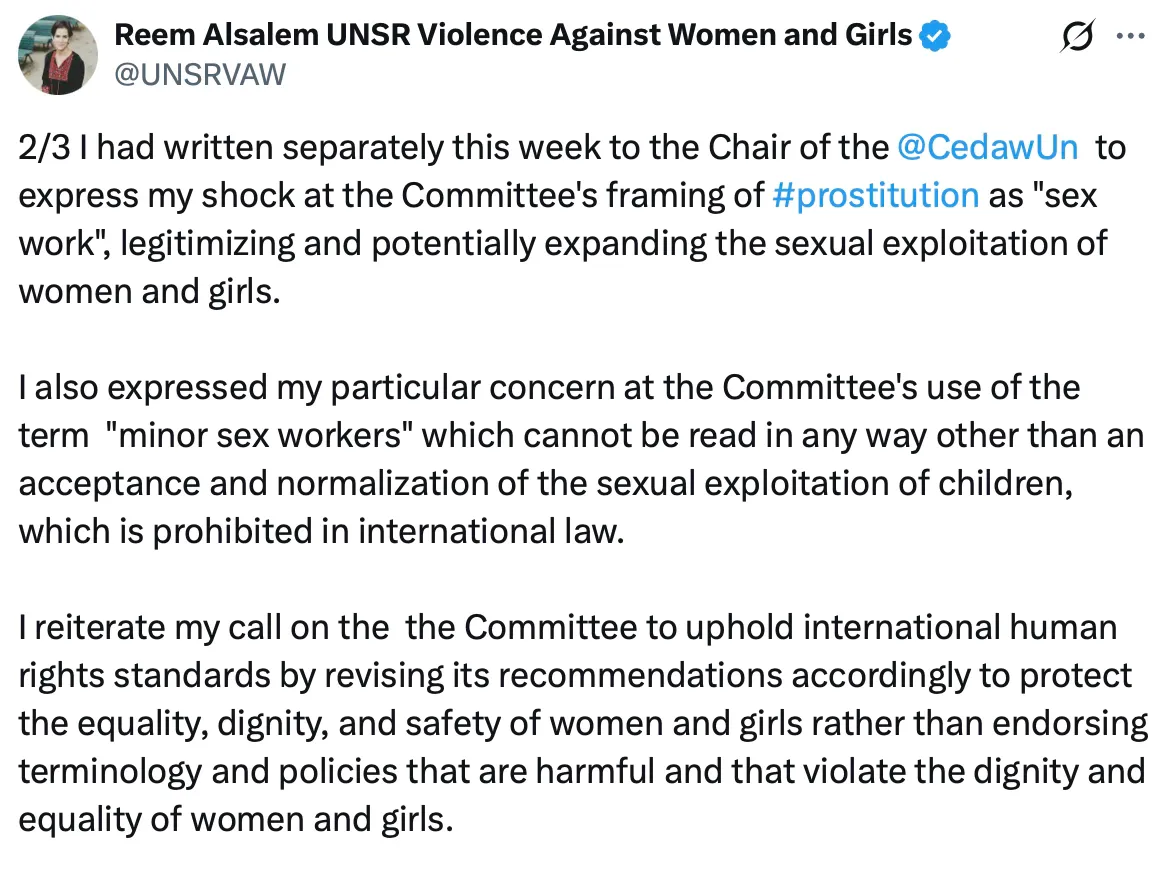
Against the backdrop of a broader and well-documented debate within the UN system itself has been Reem Alsalem, the UN Special Rapporteur on Violence Against Women and Girls.
In her landmark 2024 report to the UN Human Rights Council, “Prostitution and Violence Against Women and Girls,” Alsalem connected prostitution with the abuse of male power and sexual demand.
She declined to use the term “sex work,” noting that it wrongly depicts prostitution as an activity as worthy and dignified as any other work and fails to account for the human rights violations inherent in prostitution.
The Special Rapporteur’s approach is embedded in the Universal Declaration of Human Rights, which proclaims that all human beings are born equal in dignity and rights.
Meanwhile, the 1949 UN anti-trafficking convention states clearly that prostitution is incompatible with the dignity and worth of the human person and endangers the welfare of the individual, the family, and the community.
Alsalem’s 2024 report drew on expertise from 300 organizations and specialists across 150 countries, and its findings were unambiguous: frameworks that legalize or decriminalize prostitution lead to higher rates of sex trafficking, violence, abuse, and rape.
The report also calls for the abolition of prostitution, supporting what is known as the equality model, an approach that decriminalizes prostituted people, recognizing them as victims of systemic exploitation, while criminalizing the buyers, pimps, and other third parties who profit from exploitation.
When Alsalem has addressed the specific use of the term “sex work” in international bodies, she hasn’t equivocated.
In an open letter to the Parliamentary Assembly of the Council of Europe in September 2024, she wrote that the term “sex work” is neither recognized nor defined in international law OHCHR, and she raised serious concerns that its adoption would constitute a dangerous regression for the rights of women.
That same critique applies with full force to CEDAW’s use of “minor sex workers” to describe trafficked children.
The incoherence within the UN system is now impossible to ignore.
One body’s official language describes trafficked children as “workers.” Another body’s appointed independent expert on violence against women has published a comprehensive, evidence-based report saying that prostitution is inherently violence and incompatible with human dignity. These are not reconcilable positions.
The International Response: Outrage Across 40 Countries
Thankfully, the world has taken notice.
By March 4, 2026, more than 1,300 women’s and human rights advocates, including sex trade survivors, from over 40 countries had signed an open letter expressing outrage over the CEDAW Committee’s recommendations to the Netherlands.
The signatories called on the CEDAW Committee to immediately modify the report by removing all references to “sex work,” “minor sex workers,” “forced prostitution,” and any and all recommendations that encourage the Netherlands to legally protect perpetrators, sex buyers, brothel owners, traffickers, and other exploiters at the expense of women’s and girls’ lives.
The breadth of the condemnation, spanning survivors, advocates, and rights organizations across six continents, reflects just how serious this failure is understood to be by the people closest to the harm.
Understand this, these aren’t abstract legal arguments but are people who have lived the reality that the CEDAW Committee just euphemized, and they’re telling that committee that its language protects abusers and endangers children.
A Crisis of Institutional Legitimacy
What CEDAW did in its February 2026 Netherlands report was by no means a minor editorial misstep, this was an institutional failure of the first order. This failure has consequences in the real world, because language shapes law, and law shapes who is prosecuted, who is protected, and who is abandoned.
Without taking action to amend the report, the Committee can no longer profess to uphold international and human rights principles or claim any legitimacy in its mandate to safeguard the fundamental human rights of women and girls to equality and a life free from violence.
That is the only honest assessment.
A body that calls trafficked girls “workers” isn’t protecting them, it’s providing ideological cover for those who exploit them!
The children caught in the Dutch sex trade, and in every sex trade where this language will be cited as precedent, deserve a CEDAW that remembers what it was created to do.
The committee should amend this report, but will they? That is yet to be seen.
What needs to happen is the removal of every euphemism that reframes a child’s abuse as employment. One more step would then be necessary: a recommitment to the principle that is not up for debate in any legal, ethical, or human framework: a child cannot consent, cannot be a prostitute, and cannot be a “sex worker.”
A child can only ever be a victim and the institutions meant to protect them should say so.
*My hope is that with this article, we can bring awareness to the issue of sex-trafficking and the necessity of helping those who are still trapped within the trade, as well as the survivors who have been rescued from it. Additionally, we can hold accountable those within positions of influence who are falling dangerously short of their mandates.
SUPPORT MATTEA’S WORK
- Tune into The Mattea Merta Podcast
- Follow her on Twitter and Instagram
- Fund the mission through CashApp or PayPal: @matteamerta
CLICK HERE for more posts by Mattea Merta.
Thank you for your support.
If you appreciate the work we do to spread the good news of Jesus Christ, please consider giving a gift to help us continue this work. Maranatha!
Click an icon below to share this post.
All articles, including blogs and guest articles, published on Revival Nation News are owned by Revival Nation and Revival Nation News. The use of any content created and published by Revival Nation News may be quoted but attribution is required.
Portions of Revival Nation News articles may be used for reprint and republish purposes, but Revival Nation News MUST BE CREDITED.
All reprinted or republished articles must:
(1) Identify the author of the article.
(2) Contain the Revival Nation News byline at the beginning of the article and a hyperlink “Revival Nation News” to the respective article on the Revival Nation News website.
(3) Contain, at maximum, three paragraphs and then link back to the original article.