
Dead Sea Quake Tied to Jesus’ Death?

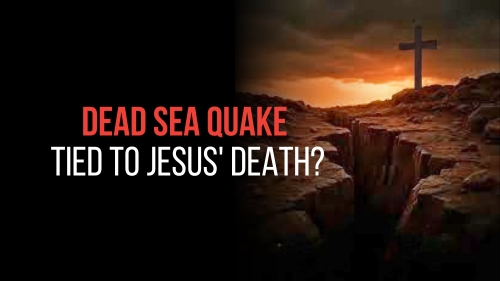
A 2012 geological study has resurfaced online, sparking fresh discussion about whether incredible evidence from the Dead Sea region supports the biblical account of an earthquake at the time of Jesus’s crucifixion.
In the Gospel of Matthew (chapter 27), the text describes how, right after Jesus’s death on the cross, “the earth shook” along with other dramatic signs like rocks splitting and tombs opening. This inspired a team of geologists including Jefferson B. Williams, Markus J. Schwab, and A. Brauer to publish research in the International Geology Review analyzing sediment cores taken from near Ein Gedi on the Dead Sea’s western shore. This location is roughly 25 miles (about 40 km) from Jerusalem, the traditional site of the crucifixion.
The researchers identified clear signs of seismic activity preserved in the lake’s layered sediments, known as varves. These are annual deposits which are typically a darker, coarser layer from winter runoff and a lighter, finer one from summer settling. By counting and examining these varves, scientists are able to reconstruct a year-by-year timeline of the lake’s history, including disruptions caused by earthquakes.
The cores showed evidence of two notable events in the relevant timeframe:
- A major earthquake around 31 BC, which left widespread deformation in the sediments.
- A more localized seismic disturbance dated between 26 and 36 AD (with the study’s abstract suggesting a tentative center around 31 AD ±5 years).
This narrower window overlaps precisely with the governorship of Pontius Pilate (26–36 AD), the Roman prefect under whom, according to the Gospels and historical sources like Tacitus, Jesus was tried and executed. Many biblical scholars place the crucifixion around 30–33 AD, fitting comfortably within the seismic range.
The Dead Sea Transform fault system makes the region highly earthquake-prone with the Arabian Plate and Sinai subplate slide past each other, creating a mix of strike-slip motion, extension, and compression that has triggered quakes for millennia.
The Dead Sea occupies a deep pull-apart basin, the lowest land point on Earth, and historical records (including from Josephus) document frequent seismic activity there.
In the deformed layers, the team observed bent, broken, or liquefied sediments, all classic signs of strong ground shaking. They ruled out several other documented quakes in nearby years (e.g., 19 AD, 37 AD, 47 AD, 48 AD) as not matching the specific deformation patterns or intensity seen in the Ein Gedi cores.
The scientists remained measured in their conclusions, outlining several interpretations:
- The disturbance could directly correspond to the earthquake mentioned in Matthew, providing physical corroboration for the biblical narrative.
- It might reflect a separate but contemporaneous quake that influenced or was incorporated into the Gospel account.
- It could represent a smaller, local event strong enough to disrupt lake-bottom sediments but not powerful or widespread enough to appear in surviving non-biblical historical records—meaning the Matthew reference might draw on real geology but frame it theologically or allegorically.
Skeptics have pointed out the 10-year dating uncertainty, arguing how it falls short of definitive proof, or question whether sediment deformation can be tied so precisely to a specific event in Jerusalem. Others wrongly assert that ancient earthquakes can’t be dated accurately at all, yet paleoseismology routinely uses varve counting, radiocarbon dating, disturbed sediment analysis, and cross-correlations with tree rings or historical accounts to pinpoint events thousands of years old.
The authors os the study have encouraged caution as the evidence shows an earthquake happened in the Pilate era, but linking it causally to the crucifixion moment remains one plausible scenario among others. Independent re-examinations of the same cores have supported the overall timeline, which has added credibility to the findings.
Ultimately, this research highlights the intriguing intersection of geology and ancient texts. It reminds us that the Earth’s own record echoes stories preserved in scripture.
Thank you for your support.
If you appreciate the work we do to spread the good news of Jesus Christ, please consider giving a gift to help us continue this work. Maranatha!
Click an icon below to share this post.
All articles, including blogs and guest articles, published on Revival Nation News are owned by Revival Nation and Revival Nation News. The use of any content created and published by Revival Nation News may be quoted but attribution is required.
Portions of Revival Nation News articles may be used for reprint and republish purposes, but Revival Nation News MUST BE CREDITED.
All reprinted or republished articles must:
(1) Identify the author of the article.
(2) Contain the Revival Nation News byline at the beginning of the article and a hyperlink “Revival Nation News” to the respective article on the Revival Nation News website.
(3) Contain, at maximum, three paragraphs and then link back to the original article.

You might also like


Explore Categories