Poland’s President Vetoes EU’s Censorship Bill

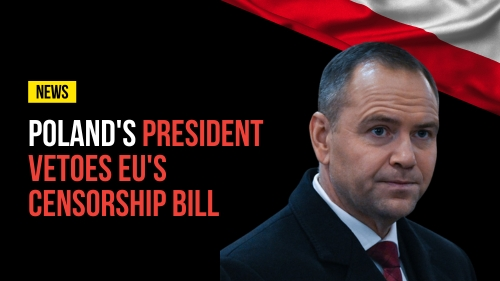
Poland’s President Karol Nawrocki has vetoed legislation that would have imposed the European Union’s censorship masterpiece called the Digital Services Act (DSA) within the country.
The DSA is an Orwellian tool for online censorship being pushed by Brussels which seeks to force major social media platforms, such as X, Facebook, and Instagram, to aggressively moderate and remove content deemed “illegal” or “harmful” under broad EU guidelines.
Poland's President Karol Nawrocki vetoes the implementation of the EU's Digital Services Act which aims to censor Europeans online:
— Daily Romania (@daily_romania) January 12, 2026
"A situation in which a government official decides what is permitted on the Internet is reminiscent of the Ministry of Truth in Orwell’s 1984." pic.twitter.com/jWFdnORK1T
This bill not only attacks free speech, but it empowers unelected regulators and governments to dictate what citizens can say online whilst carrying with it the potential of silencing dissenting opinions, and legitimate political discourse under the guise of combating disinformation, hate speech, or child safety risks.
President Nawrocki, aligning with principles echoed by U.S. President Donald Trump and his administration which has condemned the DSA for censorship which targets right-wing perspectives, described the proposed implementation as creating a dangerous system of “administrative censorship.” The Trump administration has gone so far as to impose measures against the DSA’s key architects as they view it as an attack on free speech.
:rotating_light: Freedom of speech is under attack in Poland.
— :flag-pl: Paweł Jabłoński (@paweljablonski_) January 11, 2025
Government fears impending electoral defeat. Their reaction? Censorship.
:x: Withdrawal of broadcasting license for main conservative TV station.
:x: Plans to restrict access to X, Facebook – banning platforms they cannot control.… pic.twitter.com/poK6rqdJE9
Nawrocki warned that the DSA risks establishing a state-controlled “Ministry of Truth,” where bureaucrats could decide what Poles are permitted to express or think. While acknowledging legitimate concerns about online threats, particularly to children, the president emphasized that true protection must not come at the expense of fundamental freedoms. His veto ensures that ordinary Poles won’t have to battle government officials to defend their right to free expression.
By vetoing the bill, Poland stands with allies who reject heavy-handed EU mandates that could stifle innovation and empower Big Tech critics while punishing platform operators for failing to censor enough, and undermining sovereignty.
Opponents of the veto, including Digital Affairs Minister Krzysztof Gawkowski, claim it undermines online safety and exposes users to risks. Yet such arguments ring hollow as the DSA’s vague definitions of “harmful content” have long raised fears of partisan enforcement, where conservative viewpoints on issues like immigration, gender ideology, or election integrity could be disproportionately targeted as “disinformation” or “hate.” Relying on ordinary courts rather than administrative fiat still opens the door to widespread content removal without robust due process.
Poland’s action highlights the importance of resisting supranational overreach. As one of the few EU member states without full national enforcement mechanisms for the DSA following the veto, the country has preserved space for open debate in an era when globalist institutions increasingly seek to control information flows.
Thankfully, the Polish Parliament lacks the supermajority to override the veto easily, and any new bill would require substantial revisions, which would give Poles time to push back against further encroachments.
Thank you for your support.
If you appreciate the work we do to spread the good news of Jesus Christ, please consider giving a gift to help us continue this work. Maranatha!
Click an icon below to share this post.



All articles, including blogs and guest articles, published on Revival Nation News are owned by Revival Nation and Revival Nation News. The use of any content created and published by Revival Nation News may be quoted but attribution is required.
Portions of Revival Nation News articles may be used for reprint and republish purposes, but Revival Nation News MUST BE CREDITED.
All reprinted or republished articles must:
(1) Identify the author of the article.
(2) Contain the Revival Nation News byline at the beginning of the article and a hyperlink “Revival Nation News” to the respective article on the Revival Nation News website.
(3) Contain, at maximum, three paragraphs and then link back to the original article.

You might also like

Explore Categories