Iran Deal: Caution, Optimism, And How Israel Is In the Crosshairs

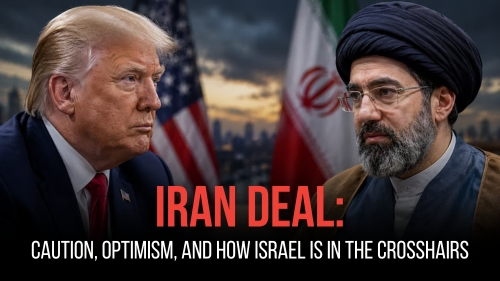
The United States and Iran are about to sign a Memorandum of Understanding (MOU) that its architects are calling historic, but throughout the MOU, there’s a serious case for cautious pause.
President Trump, speaking at the G7 in Evian-les-Bains, France on June 17, called it a deal that “will be very strong,” while warning that failure to comply would mean a return to bombing. A senior US administration official called it a potential “home run deal.”
But a home run for whom? And at what cost?
This isn’t the place for blind enthusiasm or reflexive dismissal. Some of what’s in the MOU is genuinely better than what came before, whilst other portions of what we know about it raises serious alarm. And this one question looms above all others: What does this mean for Israel?
*NOTE: A Memorandum of Understanding (MOU) isn’t a Treaty and there are negotiations yet to take place. Therefore, this isn’t a done deal but a deal in the making.
What the MOU Gets Right (Cautious Green Lights)
✅ Sanctions relief is conditional and performance-based (not front-loaded). This is a meaningful structural improvement over Obama’s 2015 JCPOA. Under Obama’s deal, Iran received massive economic relief upfront, before sustained compliance was demonstrated. This MOU ties sanctions relief to Iran holding up their end of the agreement. That sequencing matters enormously as rewards should follow behavior and not precede it.
✅ No sunset clauses. Obama’s JCPOA was riddled with expiration dates, provisions that would sunset after 8, 10, or 15 years, essentially putting Iran’s nuclear ambitions on a timer rather than ending them. This MOU contains no such language. All commitments are framed as permanent, contingent on continued Iranian good behavior. That’s a significant and welcome departure from the framework that preceded it.
✅ No US taxpayer funding for the proposed reconstruction plan. The $300 billion economic development and reconstruction plan referenced in the MOU is to be privately financed. The US government isn’t writing a check to Tehran. Sanctions relief, the unlocking of Iran’s ability to trade and access frozen assets, is the mechanism, not direct American funding. Control over the pace and scope of that relief remains in Washington’s hands.
✅ Iran agrees to neutralize its enriched uranium stockpile. For the first time, Iran has formally committed to down-blending its existing enriched uranium under IAEA supervision. This is more concrete than previous agreements, which allowed Iran to retain and expand its stockpile. The destruction of existing enriched material, if verified, would meaningfully set back any near-term weapons development timeline. (This also falls under the “concern” category)
Where the MOU Raises Serious Concerns
❌ Iran’s promise not to develop nuclear weapons is only as good as Iran’s word, and that word isn’t worth much. Iran has spent decades deceiving the international community about the nature and scope of its nuclear program. The Mossad’s 2018 extraction of Iran’s nuclear archive revealed systematic, deliberate deception spanning years.
An agreement that rests primarily on Iran’s reaffirmation of non-proliferation without an airtight verification mechanism built into the MOU itself is asking the world to trust a regime that has earned precisely the opposite. The mechanism for ensuring compliance must be iron-clad, and as of now, we don’t know what it looks like.
❌ IAEA inspections aren’t a sufficient safeguard. Iran has beaten them before. The return of IAEA inspectors is better than no inspections, but the IAEA has a documented history of being outmaneuvered by Iran. Inspectors were denied access to key sites for months at a time under the previous deal. The US, not just an international body, must have independent, continuous monitoring capacity. “Trust, but verify” was Ronald Reagan’s standard. This situation demands something closer to “don’t trust, verify constantly.”
❌ The framework for long-term enrichment limits is dangerously vague, and the existing stockpile should leave Iran entirely. The MOU calls for enriched uranium to be down-blended on Iranian soil under IAEA supervision. That isn’t destruction, it’s a process change, conducted inside Iran, supervised by an agency Iran has deceived before. The enriched material should be physically removed from Iran and destroyed outside its borders.
Furthermore, Iran’s enrichment capacity going forward should be severely limited to genuine civilian energy needs, with no pathway, whether technical or legal, to weapons-grade levels. Trump’s reported openness to a 15-year enrichment halt is also concerning given his earlier position that Iran cannot enrich at all. That is a significant walk-back that deserves scrutiny.
❌ The Strait of Hormuz opening lasts only 60 days.
The MOU requires Iran to guarantee toll-free passage through the Strait for 60 days. After that? The framework reverts to whatever is negotiated in the final deal. Iran controls one of the most strategically critical chokepoints in the world, nearly one-fifth of global oil and natural gas passes through it. Giving Iran a 60-day goodwill window while the long-term status remains unresolved hands Tehran ongoing leverage over global energy markets. They have used that leverage before. They will use it again.
❌ Sanctions relief based on “good behavior” requires clearly defined mechanisms, which the MOU doesn’t specify. History is instructive here. After the Obama-era JCPOA was implemented, Iran gained access to approximately $150 billion in previously frozen assets. Much of that money flowed directly into Iran’s support of Hezbollah, Hamas, the Houthis, and other proxy networks throughout the Middle East. The MOU promises that sanctions relief will be earned, not given, but without clearly defined, publicly stated mechanisms for measuring compliance, “good behavior” is a subjective standard that can be gamed. What are the tripwires? Who adjudicates violations? The answers to those questions are the deal.
❌ Iran’s missile program, the most likely delivery mechanism for a nuclear weapon, is entirely absent from the MOU. You can down-blend all the enriched uranium you want. If Iran retains an advanced ballistic missile program capable of carrying a nuclear warhead, the threat isn’t neutralized, it’s deferred. A nuclear deal that doesn’t address Iran’s missiles is like confiscating someone’s bullets while leaving the gun. This omission is not a footnote. It is a fundamental gap.
❌ The MOU claims to end the fighting “including in Lebanon,” but says nothing about Iran’s sponsorship of terrorism or its proxy networks. The White House has stated that the MOU “ends the fighting, including in Lebanon.” But ending active hostilities is not the same as dismantling the infrastructure that makes those hostilities possible. Iran’s Revolutionary Guard Corps, Hezbollah, Hamas, the Houthis, Iraqi militias, these aren’t independent actors. They are instruments of Iranian foreign policy, funded, trained, and directed by Tehran. None of them are addressed in the MOU’s 14 points. A ceasefire that leaves the proxy architecture intact is not peace, it is a pause.
The Israel Problem: The Elephant in Every Room
This is where the conversation becomes most urgent, and most troubling.
Israel isn’t a party to this agreement. Israel didn’t sign it, was not consulted in its final form, and has already rejected it. And yet Israel is the nation most directly affected by its terms.
It was Israel, with American alignment and support, that launched the strikes against Iran’s nuclear and military sites that brought Tehran to the negotiating table in the first place. Israel led the charge. Israel absorbed the retaliatory strikes. Israel fought on its northern border against Hezbollah throughout the conflict, and now Israel watches from the outside as the United States negotiates the terms of Iran’s future with the regime that has called for Israel’s annihilation as a matter of state policy.
The MOU’s inclusion of Lebanon in its ceasefire language is significant, it acknowledges that Hezbollah’s attacks on Israel’s northern border are part of the conflict being resolved. That is not nothing, but it is far from enough. Hezbollah is still active, it is still armed and it is still ideologically committed to Israel’s destruction. The MOU doesn’t require Hezbollah to disarm, it doesn’t require Iran to cease its financial support of the group, nor does it create a buffer or a guarantee for Israel’s northern security.
Vice President Vance has suggested there is an expectation that “everyone” will abide by the deal, implying that Iran’s proxies are somehow bound by an agreement they didn’t sign and whose terms do not mention them. That is a hope, not a mechanism.
There is one element genuinely favorable to Israel: the US has stated it will maintain its current regional force posture, the same presence it held prior to the war. That matters. American boots, ships, and aircraft in the region are a deterrent, and their continued presence is a signal to Tehran that Washington has not simply walked away.
But here is the core danger: the future reduction of US troop levels is explicitly tied to verification of Iranian compliance with the new agreement. As Iran demonstrates compliance, however that is measured, sanctions are relieved, frozen assets are unfrozen, and American forces begin drawing down. That sequencing creates a compounding risk for Israel.
Every dollar that flows back into Iran’s economy under sanctions relief is a dollar that can be redirected to Hezbollah, to missile development, to rebuilding the military infrastructure that Israel spent enormous blood and treasure degrading. And as US forces draw down, the deterrent umbrella over Israel shrinks.
Iran has broken agreements before. Iran has used economic windfalls to fund terrorism before. Iran has rebuilt military capacity after setbacks before. And now Iran faces Israel across a conflict that has hardened hatred on both sides. Israel struck Iranian soil. Iranian leaders have made clear that is not forgotten. The vendetta is real, and it is not going away because a memorandum was signed.
The question Israel, and every American ally in the region, must be asking is this: When the 60-day clock runs out, when the final deal is struck, when US forces begin their phased withdrawal and Iranian assets are unfrozen, what stands between Israel and an Iran that is reconstituting, re-funded, and more motivated than ever?
The MOU doesn’t answer that question, and until it does, cautious optimism about what was agreed must sit alongside serious alarm about what was left out.
The formal signing ceremony is scheduled for June 19, 2026, at the Bürgenstock Resort, Switzerland. The 60-day final negotiation window begins upon signing.
Thank you for your support.
If you appreciate the work we do to spread the good news of Jesus Christ, please consider giving a gift to help us continue this work. Maranatha!
Click an icon below to share this post.
All articles, including blogs and guest articles, published on Revival Nation News are owned by Revival Nation and Revival Nation News. The use of any content created and published by Revival Nation News may be quoted but attribution is required.
Portions of Revival Nation News articles may be used for reprint and republish purposes, but Revival Nation News MUST BE CREDITED.
All reprinted or republished articles must:
(1) Identify the author of the article.
(2) Contain the Revival Nation News byline at the beginning of the article and a hyperlink “Revival Nation News” to the respective article on the Revival Nation News website.
(3) Contain, at maximum, three paragraphs and then link back to the original article.