Pastors Must Engage Culture: Why Silence Is Not an Option for the Church

A church in Washington State isn’t new to speaking directly into a cultural moment, and they know full well that when they do, they’re inviting opposition (and they love it).
Pastor Russell Johnson of Pursuit Church in Snohomish, WA argues that retreat from cultural conversation isn’t an option for those who follow Scripture, and he’s 100% correct.
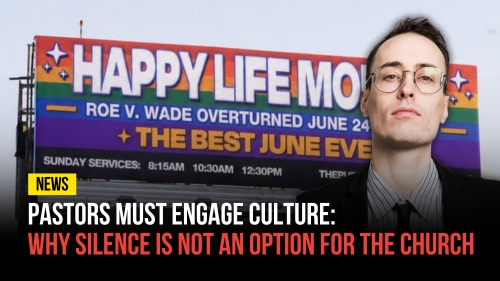
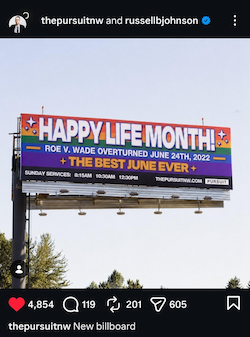
Pursuit Church has made a practice of producing thought-provoking billboards; thematic, lighthearted messages that carry deeper significance. And this June, they didn’t disappoint. They created a billboard coinciding with “Pride Month” which is also the anniversary of Roe v. Wade being overturned. It reads: “Happy Life Month! Roe v. Wade overturned June 24th, 2022. THE BEST JUNE EVER”
Some of the responses from those driving by has been, at times, positive and at others, venomous. One email criticized the church for “promoting the rights of women being taken away” and declared: “I hope your kids turn out gay. You are all nazi fake Christians.”
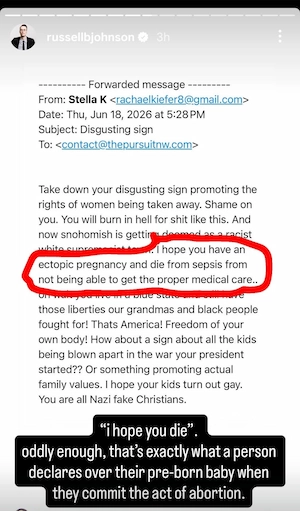
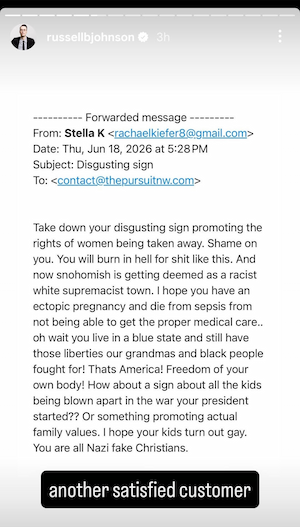
Another, from someone claiming to have appreciated the church’s previous lighthearted messaging, expressed dismay: “We had always assumed a church with a sense of humour would align with our community’s more progressive values, and the values of Christ himself: acceptance, compassion, empathy… How rich does your pasture have to be to afford some class?”
Both reflected a common criticism: that pastors/churches should just stay out of the culture wars.
But Johnson’s responses cut to the heart of a fundamental question about the Church’s purpose. Drawing from Judges 6, he points to Gideon’s instruction: tear down your father’s altar to Baal, then build a proper altar to the Lord.
“That is still the primary pattern of apostolic ministry today,” Johnson argues. “It’s binding and loosing. It’s tearing down and building up. It’s rooting out and planting.”
He also challenged the passive sentiment in American churches which see their role as only to proclaim what they’re for and never what they’re against. Such a church “would be a foreign concept to the Church Fathers and apostolic authors,” he contends.
To those who dismiss this as modern “culture war” engagement, Johnson offers a comprehensive historical corrective. The early Church, from the Didache (AD 100) through the Apostolic Constitutions (AD 380), spoke directly into the moral crises of their age.
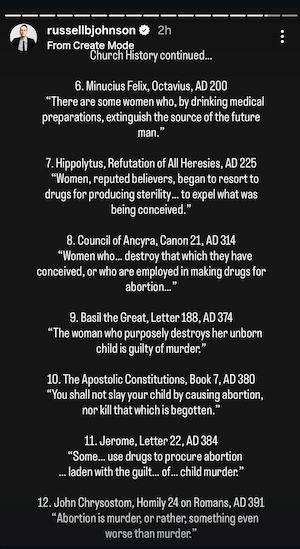
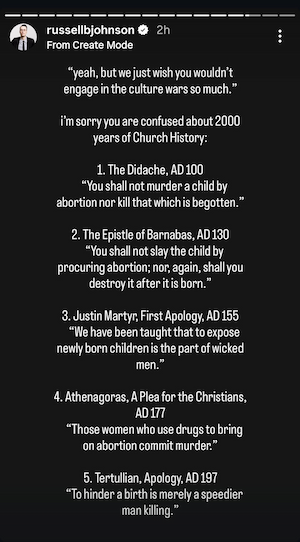
The Didache (AD 100): “You shall not murder a child by abortion”
The Epistle of Barnabas (AD 130): “You shall not slay the child by procuring abortion; nor…shall you destroy it after it is born” Justin Martyr (AD 155): “To expose newly born children is the part of wicked men”
Tertullian (AD 197): “To hinder a birth is merely a speedier man killing”
Basil the Great (AD 374): “The woman who purposely destroys her unborn child is guilty of murder”
John Chrysostom (AD 391): “Abortion is murder, or rather, something even worse than murder”
On cultural idolatry more broadly: Johnson mapped the pattern seen all across Scripture: Baal demanded child sacrifice. Asherah poles promised sexual autonomy. Artemis embodied sexuality and commerce. The golden calf represented strength and consumer prosperity.
In each case, the apostolic response wasn’t silence or cultural accommodation. It was prophetic confrontation of the idols standing in opposition to God’s kingdom, coupled with the declaration and construction of true worship.
One response to Johnson’s billboard particularly reveals what’s at stake. A commenter who posted a review of the church stated they previously “looked forward to seeing what seasonal bit this creative group would come up with” revealed the core tension in their follow-up: “We were fine with the messaging of this church until they dared to touch our idol.”
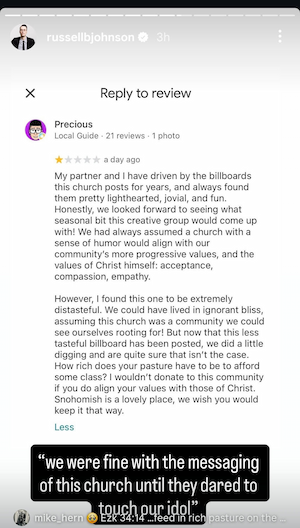
Johnson’s response was surgical: “We were fine with the messaging of this church until they dared to touch our idol.”
This captures the most essential element of this subject. The request that churches remain culturally engaged but politically neutral isn’t actually neutral because it is a request to be engaged only where it doesn’t challenge contemporary idolatries. It’s asking the Church to speak prophetically everywhere except where it matters most to the culture at large.
None of this suggests that prophetic engagement requires hostility or that churches should become primarily known for what they oppose. A church can be known for what it’s for; the Gospel, redemption, grace, community, mercy, all the while confronting the idols that stand in opposition to those very things.
The early Church wasn’t known primarily for what it opposed. It was known for radical love, costly sacrifice, and the bold proclamation of the Gospel. Yet those early believers also spoke directly into the moral crises of their moment. It wasn’t either or, it was both.
Throughout Scripture and Church history, prophetic engagement has always been costly. The early Christians faced ridicule, ostracism, and worse for their refusal to accommodate their faith to cultural idolatries. In place of comfort they maintained integrity.
The request of society in the Western world of churches is to remain silent of issues within the culture. This is, in essence, a request for comfort for the society, but it is also a call to decay for the believer! A society that asks, or tells, believers to maintain cultural belonging at the expense of moral clarity, is a society destined for failure.
Pastor Johnson suggests that silence and passivity have never been the apostolic option. The Church in every generation faces a choice: speak into the moral crises of the age, knowing it will invite opposition, or retreat into a private, domesticated faith that offends no one, changes nothing and weakens the church from within.
The question before the Church isn’t whether to engage culture, it’s how. Will we do so with the prophetic clarity of the early Church, confronting the idols of our age while proclaiming the Gospel? Or will we accept a diminished role, speaking only where it’s convenient and affirming only where we’re already welcomed?
The billboard in Snohomish suggests at least one pastor on the West coast believes the Church’s calling requires more than Sundays in the pews and the rest of the week being silent.
The Church’s prophetic witness has never been about winning cultural approva, but bearing witness to a Kingdom that stands in opposition to every false god the world erects. It’s far past time we remembered that.
Thank you for your support.
If you appreciate the work we do to spread the good news of Jesus Christ, please consider giving a gift to help us continue this work. Maranatha!
Click an icon below to share this post.



All articles, including blogs and guest articles, published on Revival Nation News are owned by Revival Nation and Revival Nation News. The use of any content created and published by Revival Nation News may be quoted but attribution is required.
Portions of Revival Nation News articles may be used for reprint and republish purposes, but Revival Nation News MUST BE CREDITED.
All reprinted or republished articles must:
(1) Identify the author of the article.
(2) Contain the Revival Nation News byline at the beginning of the article and a hyperlink “Revival Nation News” to the respective article on the Revival Nation News website.
(3) Contain, at maximum, three paragraphs and then link back to the original article.

You might also like



Explore Categories