
Sorry, Steven: Christians Aren’t Losing Sleep Over Your Alien Movie

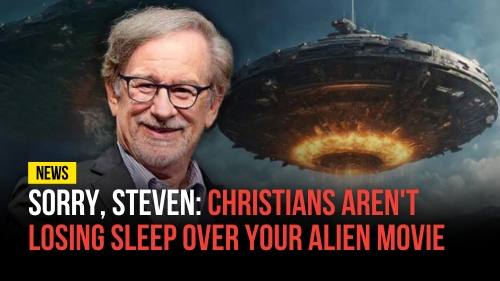
Steven Spielberg is 79 years old, one of the most celebrated filmmakers in human history, and apparently believes that his new film has the ability to shake the faith of Christians.
Disclosure Day, which opens in theaters June 12, is already being framed not merely as a summer blockbuster but as a spiritual grenade lobbed into the pews of America’s churches, and Spielberg seems genuinely surprised that everyone isn’t cowering.
In a recent interview with CBS News, the director laid out his vision for what the film would do to audiences of faith. “The movie also takes the position of the church,” Spielberg explained. “What does this do to the fundamental beliefs that many of us have? Is God our God only on this planet? Or is God a god for every system where there’s civilization and intelligent life, and even developing life?”
Steven Spielberg says his new alien movie 'Disclosure Day' will make Christians question their faith: "Is God our God only on this planet, or is God a God for every system where there's civilization?"
— Revival Nation News (@EncounterNewsX) June 8, 2026
Hahahaha people who serve the one true God won't be moved by an alien movie… pic.twitter.com/YMx23fVn04
It’s a genuinely interesting question. It’s also, to the amusement of Christians everywhere, not a new one. The assumption that a Spielberg film is what it takes to finally force believers to confront the subject of extraterrestrial life reveals something telling about Hollywood’s relationship with religious Americans.
At SXSW in March, he declared, “I don’t know any more than any of you do, but I have a very strong suspicion that we are not alone here on Earth right now, and I made a movie about that.” His curiosity was rekindled by a 2017 New York Times investigation into the Pentagon’s UFO program, as well as an authenticity that runs back to his childhood in New Jersey, staying up reading his father’s dog-eared copies of Galaxy and Analog science fiction magazines.
He said this will be his first film “that will be considered science fiction that I do not consider to be science fiction,” insisting it is “much more reflective of the world as it is evolving and discoveries that are being made as we speak.”
The film itself follows a cybersecurity whistleblower, played by Josh O’Connor, who possesses long-suppressed government evidence of alien contact, while a corporate executive (Colin Firth) tries to contain the secret and a meteorologist (Emily Blunt) begins experiencing a mysterious spiritual awakening.
Even the film’s screenwriter, David Koepp, has acknowledged that “religion is an important part” of the movie. Raised Catholic but now agnostic, Koepp told MovieMaker Magazine: “My personal belief is the same as my personal belief in God, which is why I think religion is an important part of ‘Disclosure Day.’ I’ve always felt like the only reasonable position is agnostic; is only to admit: ‘Possibly. I don’t know.’”
The primary subject at hand isn’t the film itself, but Hollywood’s promotional machine making the following implicit claim: that faithful Christians haven’t already wrestled with these questions, and that a two-hour film is going to be the thing that breaks them.
The assumption buried inside Spielberg’s framing, that any news of extraterrestrial life would leave Christians stammering at the altar, unable to reconcile Genesis with gray aliens, betrays a profound misunderstanding of what Christian theology actually looks like from the inside.
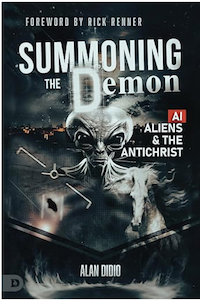
Christianity isn’t a fragile system of beliefs. Theologians have debated the question of extraterrestrial life for centuries. C.S. Lewis wrote an entire science fiction trilogy exploring it. Pastor Alan DiDio wrote an entire book on the topic. The Vatican has a chief astronomer who has publicly said that if aliens exist, he would happily baptize them.
The idea that a Spielberg summer blockbuster is the thing that finally cracks open the question of God’s cosmic jurisdiction is a little like assuming Christians have never once looked up at the night sky and wondered what’s out there. They have. They wondered about it before Hollywood existed.
Christian commentators have also noted, with some amusement, that the film’s trailer features a nun whispering: “Why would He make such a vast universe, yet save it only for us?,” a line that assumes devout viewers have never heard the Psalms. “The heavens declare the glory of God,” Psalm 19 opens. The heavens. Plural. All of them.
This isn’t the first time the entertainment industry has predicted that a piece of media would shatter Christian faith, and it won’t be the last.
The Da Vinci Code was going to upend two millennia of theology. Noah was going to start a revolution. Silence was going to hollow out the church. Each time, the anticipated crisis failed to materialize. Each time, Hollywood seemed genuinely puzzled.
But the confusion only runs in one direction: Hollywood, which skews heavily secular, tends to imagine religious belief as a kind of intellectual house of cards; one surprising revelation away from total collapse. From inside that worldview, the question “Is God our God only on this planet?” sounds shattering. From inside a church, it sounds like a Wednesday evening Bible study discussion topic, circa 1987.
This isn’t to say Disclosure Day won’t be a good film. The questions the film raises about faith, about government secrecy, about what it means to be human in a possibly populated universe are worth asking on screen as much as anywhere else.
But the marketing of those questions as existential grenades aimed at Christianity is both theologically illiterate and commercially transparent. It’s a strategy, not a prophecy. If the film causes someone to think more deeply about their faith, wonderful. Faith that survives scrutiny is stronger for it, but if the assumption is that a cinemaplex in June 2026 is finally going to do what centuries of philosophy, science, and genuine human suffering could not, namely, make Christians question whether God is real, then Hollywood has once again fundamentally misread its audience.
People who have built their lives on an encounter with the living God are not going to have that encounter undone by Emily Blunt having a mysterious awakening.
Steven Spielberg is good at his job, but the church will still be open on Sunday, June 15 the morning after opening weekend and the pews will still be full.
Thank you for your support.
If you appreciate the work we do to spread the good news of Jesus Christ, please consider giving a gift to help us continue this work. Maranatha!
Click an icon below to share this post.


All articles, including blogs and guest articles, published on Revival Nation News are owned by Revival Nation and Revival Nation News. The use of any content created and published by Revival Nation News may be quoted but attribution is required.
Portions of Revival Nation News articles may be used for reprint and republish purposes, but Revival Nation News MUST BE CREDITED.
All reprinted or republished articles must:
(1) Identify the author of the article.
(2) Contain the Revival Nation News byline at the beginning of the article and a hyperlink “Revival Nation News” to the respective article on the Revival Nation News website.
(3) Contain, at maximum, three paragraphs and then link back to the original article.

You might also like



Explore Categories