
Follow the Money: The Hidden Campaign to Reshape Hungary From the Outside In

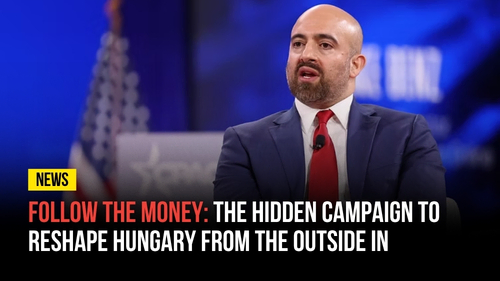
There’s a coordinated effort by European Union institutions and aligned nongovernmental organizations (NGOs) to shape the future of Hungary — and, in turn, the direction of Hungarian policy, on issues ranging from immigration to national sovereignty.
Analyst Mike Benz, who tracks foreign influence operations, outlined a series of interlocking moves by EU bodies that he argues amount to a sustained campaign to pressure Hungary into compliance, and by the outcome of its recent elections, it appears Hungary’s leadership was just replaced with a more pliable government for the EU to control.
Right now, all eyes (and cash) among EU Blobsters are on Hungary's election, which is 2 months away, where untold foreign millions could be pouring in to covertly fund this guy's astroturfed campaign, because the Biden Admin & EU teamed up to force Hungary to repeal its FARA law https://t.co/Jita9mth6Y pic.twitter.com/ZJexgyuifu
— Mike Benz (@MikeBenzCyber) February 17, 2026
A Six-Step Pattern of Pressure
According to Benz, the pressure campaign unfolded in distinct stages:
Financial leverage: The EU Council withheld approximately $40 billion in funds from Hungary, conditioning their release on Hungary ceding control of its court system to NGOs.
2. Legal warfare: The EU Court blocked Hungary from enacting its own equivalent of the United States’ Foreign Agents Registration Act (FARA), a law that would have required NGOs operating in Hungary to disclose whether they were funded by EU institutions.
3. Voting power threats: The EU Council announced plans to centralize decision-making authority over EU accession matters, effectively removing Hungary’s vote in future proceedings should Prime Minister Viktor Orbán remain in power.
4. NGO mobilization: EU-linked political NGOs poured into Hungary to support opposition candidate Péter Magyar’s campaign, with the explicit goal of ousting Orbán, and thereby softening Hungary’s resistance to EU mandates on Ukraine accession, mass immigration, and progressive social policies.
5. Conditional funding: After Magyar’s electoral success, the EU immediately produced a 27-point conditions list before agreeing to release the withheld funds, conditions that included compliance on Ukraine policy, immigration, and LGBTQ+ issues.
6. Centralization anyway: Despite Magyar’s victory appearing to satisfy EU political objectives, an EU Commissioner announced plans to centralize voting power regardless, thus cutting out member states like Hungary from key decisions.
The FARA Question and Foreign Money
Central to the controversy is the question of transparency. Hungary had sought to pass legislation modeled on the United States’ Foreign Agents Registration Act, which would require foreign-funded organizations operating within its borders to publicly register and disclose their backers.
Benz notes that the Biden administration and EU worked in tandem to pressure Hungary to repeal this effort, leaving the door open for what he describes as untold millions in foreign cash to flow into Hungary’s political landscape ahead of the upcoming election, with little accountability.
Critics of Hungary’s government argue that such laws are designed to suppress civil society. Defenders counter that no democratic nation should be barred from knowing who is funding political influence operations within its own borders, a principle the United States itself has long upheld domestically.
Sovereignty, Self-Determination, and the Stakes Ahead
The dispute goes deeper than elections. At its core, the conflict between Hungary and the EU reflects a fundamental disagreement about who holds legitimate authority: democratically elected national governments, or supranational institutions and the civil-society networks aligned with them.
Hungary has repeatedly resisted EU mandates on mass immigration and opposed certain aspects of LGBTQ+ policy advocacy in schools, positions that have put Budapest on a collision course with Brussels.
The current election cycle, Benz suggests, represents one of the most consequential tests yet of whether EU member states retain meaningful self-governance, or whether that governance has quietly shifted to unelected supranational bodies. And now, with the results of Hungary’s elections, it would appear that the latter is true.
A Biblical Worldview on National Sovereignty & Foreign Influence
Scripture speaks with striking relevance to the dynamics unfolding in Hungary.
The Bible consistently affirms that God ordains distinct nations and boundaries as part of His created order. In Acts 17:26, the Apostle Paul declares that God “made from one man every nation of mankind to live on all the face of the earth, having determined allotted periods and the boundaries of their dwelling place.”
National boundaries, in the biblical framework, aren’t accidents of history but are part of God’s sovereign design.
The Book of Deuteronomy (32:8) similarly notes that the Most High “fixed the borders of the peoples.” This isn’t a mandate for nationalism as an idol, but it is a clear affirmation that distinct peoples, with distinct self-governance, reflect God’s intended structure for human civilization, as opposed to the consolidation of power into ever-larger, unaccountable global or regional bodies.
Proverbs 11:14 reminds us that “where there is no guidance, a people falls, but in an abundance of counselors there is safety,” counselors accountable to the people they serve, not foreign institutions with their own agendas. The Old Testament is equally unambiguous about the danger of powerful outside forces reshaping a nation’s laws and culture covertly.
The tactics described in Benz’s account; financial pressure, covert funding, and legal manipulation echo patterns the prophets condemned when Israel was manipulated by surrounding empires.
Romans 13 calls Christians to honor governing authorities but those authorities are the ones God has established through legitimate, accountable governance within nations, not supranational bureaucracies that insulate themselves from democratic accountability.
When foreign powers seek to replace or override a nation’s elected leaders through financial coercion and covert influence, believers have every reason to be concerned.
Christians watching Hungary’s situation aren’t simply observing a geopolitical dispute, they’re witnessing a real-time test of whether the God-ordained concept of national self-determination survives, or whether the tower of Babel is being rebuilt, brick by bureaucratic brick, in Brussels.
The church is called to pray for Hungary’s leaders (1 Timothy 2:1-2), to seek justice for the vulnerable and the governed, and to remain watchful as the powers of this age seek ever-greater centralization of authority, an ambition Scripture consistently warns against.
Thank you for your support.
If you appreciate the work we do to spread the good news of Jesus Christ, please consider giving a gift to help us continue this work. Maranatha!
Click an icon below to share this post.


All articles, including blogs and guest articles, published on Revival Nation News are owned by Revival Nation and Revival Nation News. The use of any content created and published by Revival Nation News may be quoted but attribution is required.
Portions of Revival Nation News articles may be used for reprint and republish purposes, but Revival Nation News MUST BE CREDITED.
All reprinted or republished articles must:
(1) Identify the author of the article.
(2) Contain the Revival Nation News byline at the beginning of the article and a hyperlink “Revival Nation News” to the respective article on the Revival Nation News website.
(3) Contain, at maximum, three paragraphs and then link back to the original article.

You might also like


Explore Categories