
The Push to Normalise Lab-Grown Meat

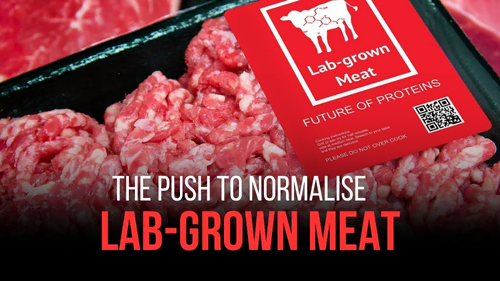
Over the past few years, the public debate around food systems, sustainability, and the climate has shifted drastically. One of many controversial developments in that shift is the push for lab-grown, cell-cultivated, and even 3D-printed meat. Until recently, this was seen as a fringe topic confined to science fiction and Silicon Valley startups. Now, internal documents obtained through a Freedom of Information (FOI) request reveal a quiet but coordinated effort within the UK government to support and normalise synthetic meat, with substantial help from taxpayer-funded stakeholder groups.
The goal is to shape public perception, rewrite regulations, and secure long-term institutional support for a radical transformation of what we eat.
What the FOI Documents Reveal
In May 2025, I submitted a Freedom of Information request to UK Research and Innovation (UKRI), asking for internal communications, stakeholder input, and strategic discussions involving synthetic meat. The response included detailed CSV records of “Call for Evidence” submissions, alongside ministerial briefings and correspondence between senior scientific advisers and policy leads. These files, which I’ve reviewed line by line, expose a layered picture of stakeholder lobbying, policy coordination, and narrative management.
Here are the key revelations:
1. The Role of UKRI and Its Networks UKRI is a major funding body that oversees a wide range of scientific research initiatives in the UK. Through bodies like the Biotechnology and Biological Sciences Research Council (BBSRC) and initiatives like the Networks in Industrial Biotechnology and Bioenergy (NIBBs), UKRI has directly funded many of the groups promoting lab-grown meat. These networks are not neutral scientific collectives. They operate as lobbying vehicles, coordinating responses to government consultations and pushing for favourable policy shifts.
One document notes the strategic objective of NIBBs to “normalise synthetic protein technologies” in both the policy landscape and public consciousness.
2. Framing and Narrative Strategy Multiple stakeholders explicitly recommend framing lab-grown meat as a climate solution, a moral imperative, and a future inevitability. One submission suggested that government communications should emphasise the “unsustainability of traditional animal agriculture” while highlighting synthetic alternatives as cleaner, safer, and more ethical.
It showed a strategic push to reframe the entire food system in moral and environmental terms, which is backed by taxpayer funds and academic influence.
3. Industry-Government Convergence Documents also reveal collaborations between UKRI, SMEs (small and medium-sized enterprises), and private investors. Stakeholders pressed for relaxed regulatory frameworks, accelerated trials, and financial incentives for lab-grown meat producers. One comment notes the need to “involve regulators early, so that safety and approval pathways can be optimised alongside product development.”
In other words, design the science and the rules together.
4. No Public Debate Perhaps most striking is what’s missing: public transparency. These discussions have happened largely out of view, with no public consultation or open parliamentary debate on the societal consequences of removing traditional meat from the food chain. Yet the policy momentum and infrastructure are already being built.
When stakeholder groups openly describe their goal as to “normalise” synthetic food, influence consumer psychology, and rewrite regulatory frameworks, it should raise concern. Especially when those same groups are funded with taxpayer money and are shaping food policy behind closed doors.
Reprint from The State Of It by Lewis Brackpool.
MORE FROM LEWIS BRACKPOOL
Follow Lewis Brackpool to delve into the intersection of Politics, Culture, and Agendas as he explores pressing issues shaping the world today.
CLICK HERE for more thought-provoking discussion.
Follow and connect with Lewis Brackpool
Support Lewis Brackpool using the icons below to follow him on social media, sign up for his newsletter, become a Patreon supporter, or donate directly through PayPal.
Thank you for your support.
If you appreciate the work we do to spread the good news of Jesus Christ, please consider giving a gift to help us continue this work. Maranatha!
Click an icon below to share this post.
All articles, including blogs and guest articles, published on Revival Nation News are owned by Revival Nation and Revival Nation News. The use of any content created and published by Revival Nation News may be quoted but attribution is required.
Portions of Revival Nation News articles may be used for reprint and republish purposes, but Revival Nation News MUST BE CREDITED.
All reprinted or republished articles must:
(1) Identify the author of the article.
(2) Contain the Revival Nation News byline at the beginning of the article and a hyperlink “Revival Nation News” to the respective article on the Revival Nation News website.
(3) Contain, at maximum, three paragraphs and then link back to the original article.

You might also like




Explore Categories