
Three Prophetic Truths Every Christian Needs to Know About Iran

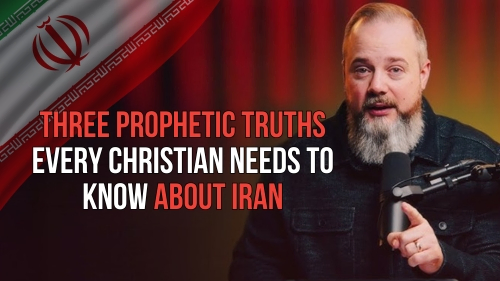
In a recent appearance on Daystar Television, Bishop Alan DiDio offered something rare in contemporary Christian commentary on the Middle East: a biblically grounded, historically layered, and spiritually urgent perspective on Iran.
DiDio invited viewers to see current events through a more textured prophetic lens, one that takes seriously both the ancient past and this present moment.
His message centered on three key insights, each drawing from Scripture and history to reframe how believers think about Iran’s role in God’s redemptive story.
1. Iran’s Ancient Legacy: A Nation God Used to Preserve His People
It may surprise many in the West to learn that Iran, which is ancient Persia, has one of the most remarkable biblical records of any Gentile nation when it comes to protecting the Jewish people. DiDio pointed to this history, noting that Persia was instrumentally used by God to preserve and restore His covenant people at a moment when their survival hung in the balance.
“Iran has historically been used by God to preserve God’s people. Iran has seed in the ground of helping to preserve God’s people and even rebuild the temple.”
The most vivid example is Cyrus the Great, the Persian king whom God calls His “anointed” in Isaiah 45:1, a remarkable designation for a Gentile ruler. It was Cyrus who issued the decree allowing the Jewish exiles to return to Jerusalem and rebuild the temple (Ezra 1:1–4), fulfilling Isaiah’s prophecy by name more than a century before it happened. Persia’s role was not incidental; it was divinely appointed.
“He is my shepherd, and he shall fulfill all my purposes.” Isaiah 44:28
DiDio acknowledged that later regimes have inverted this legacy entirely yet he emphasized that God has not forgotten the seed that was planted: “God has not forgotten that even though regimes in the future have done the exact opposite.”
Nations carry spiritual legacies that far outlast their political leaders and God remembers the choices that informed their history.
2. Queen Esther and the Question of Divine Reciprocity
History, DiDio argued, is a prophetic voice second only to Scripture itself and it is a voice most people are not listening to. “If there’s one thing we learn from history,” he said, “it’s that we don’t learn from history. And history repeats itself because it has to, because no one is listening.”
To illustrate the principle of divine reciprocity, DiDio turned to one of the Bible’s most dramatic stories set entirely on Persian soil: the Book of Esther.
In the courts of the Persian Empire, a Jewish woman named Esther rose to become queen, and through extraordinary courage, as well as extraordinary providence, she dismantled Haman’s genocidal plot against the Jewish people. The Persian Empire became the stage for one of history’s most stunning reversals of fortune. That deliverance is still celebrated annually in the feast of Purim.
Against this backdrop, DiDio posed a question that deserves to linger: “Could it be that 2,500 years later, God is blessing the nation of Iran for the protection that was released during that time?” It is a provocative theological inquiry. It is also a reminder that God’s covenantal memory is deep. Nations that sheltered His people in one era may yet experience His mercy in another, even across millennia.
This doesn’t minimize the present dangers Iran poses, nor does it ignore the suffering of those living under its current regime, but it does invite a more complex, more biblical picture than a simple geopolitical threat assessment. God’s dealings with nations aren’t one-dimensional.
3. The Ram’s Horn: Iran as God’s Alarm Clock for the Church
Perhaps the most distinctive element of DiDio’s message was his explanation of Daniel 8, where Persia appears symbolically as a ram with two horns (Daniel 8:3, 20). Most readers approach this passage as one of Scripture’s geopolitical previews, but as DiDio explains, it’s a divine signal.
“A ram’s horn is representative of an alarm clock. Of an awakening blast.” In Jewish tradition, the shofar, which is the ram’s horn, isn’t just a musical instrument; it’s a call to attention, a summons to repentance, and an announcement of the holy. DiDio drew on this resonance, stating that whenever something significant is happening in Iran, God intends it as a wake-up call for the Church.
“Whenever something is happening in the nation of Iran, it is God’s intention that it wakes up the church.”
This reframes entirely how believers might watch the news and the unfolding events in the region today. Events in Tehran aren’t merely geopolitical developments to be analyzed but are divine signals demanding a response from the Body of Christ.
That response, he argued, shouldn’t be passive speculation about prophetic timelines but active, engaged faith.
Drawing on Paul’s exhortation in 1 Thessalonians 5:6, he urged believers to be sober and vigilant, whilst issuing a two-part charge that captures the tension of faithful Christian living in uncertain times: “Set our eyes on the sky and set our hands to the plough.” Both postures occur at once.
Watch for Christ’s return whilst actively occupying, evangelizing, praying, and building. One without the other is incomplete. Eschatological expectation without present faithfulness becomes escapism; present engagement without eternal orientation loses its ultimate grounding.
Establish A Biblical Lens
Bishop DiDio’s message resists the temptation to reduce Iran to a single prophetic role. Iran isn’t simply the villain in an end-times script but a nation with a layered biblical heritage: a nation used by God to protect His people, a stage for one of Scripture’s greatest reversals, and now, according to DiDio, a prophetic signal pointing the Church toward wakefulness.
As tensions in the Middle East continue to escalate, believers would do well to resist both cynicism and sensationalism, for the biblical picture is richer than either.
God’s sovereignty extends over nations, regimes, and centuries. His redemptive plan, centered on Israel and fulfilled in Christ, is moving forward with or without our attention.
The ram’s horn is sounding, and the question is whether the Church is awake enough to hear it.
HUGE victory for parental rights against Gavin Newsom!
— Billboard Chris :earth_americas: (@BillboardChris) March 3, 2026
The Supreme Court has ruled that parents must be informed of any social transition.
No more name and pronoun changes in secret, which was California’s policy.
Newsom even passed a law banning school districts from… pic.twitter.com/Jq8pw2z9Mz
Child advocate Chris Elston who is widely known as “Billboard Chris” was jubilant over the ruling, hailing it as a “HUGE victory for parental rights against Gavin Newsom!” He highlighted how California’s approach had enabled secret name and pronoun changes, even through laws banning districts from requiring parental notification when a child identifies as transgender. The post declares: “No more name and pronoun changes in secret, which was California’s policy.”
Elston points out that similar secrecy policies persist in places like British Columbia, Canada where teachers’ unions instruct staff not to disclose a student’s trans status to parents without the child’s consent unless there’s a “specific ‘need to know.’” In response, he stated: “There is always a need to know when your own child is having a mental health crisis and a break from reality!”
The broader implications of such policies are how they can enable bad actors, including predators or groomers, by keeping parents in the dark. Thankfully, this ruling restores parental involvement in these critical moments, affirming the fundamental right to direct a child’s education and care.
Supporters, including the Thomas More Society (which represented the plaintiffs: religious parents and teachers claiming violations of parental, religious, and free speech rights), celebrated it as a “historic, groundbreaking victory” that dismantles California’s “secret gender transition regime.”
This decision sends a clear message nationwide: parents have a constitutional role in their children’s lives, especially regarding sensitive issues like gender identity and mental health. It also pushes back against state overreach that treats families as secondary to bureaucratic or ideological agendas.
For families who know that children deserve transparency and support from those who love them most, this is cause for genuine celebration, a step towards safer, more accountable schools and stronger family bonds.
As Billboard Chris and other pro-family Americans have expressed, it’s a win not just for California families, but for parents everywhere fighting to keep their children from being hidden from them during potentially vulnerable times.
Here’s to more victories for parental rights and child protection!
Thank you for your support.
If you appreciate the work we do to spread the good news of Jesus Christ, please consider giving a gift to help us continue this work. Maranatha!
Click an icon below to share this post.




All articles, including blogs and guest articles, published on Revival Nation News are owned by Revival Nation and Revival Nation News. The use of any content created and published by Revival Nation News may be quoted but attribution is required.
Portions of Revival Nation News articles may be used for reprint and republish purposes, but Revival Nation News MUST BE CREDITED.
All reprinted or republished articles must:
(1) Identify the author of the article.
(2) Contain the Revival Nation News byline at the beginning of the article and a hyperlink “Revival Nation News” to the respective article on the Revival Nation News website.
(3) Contain, at maximum, three paragraphs and then link back to the original article.

You might also like




Explore Categories