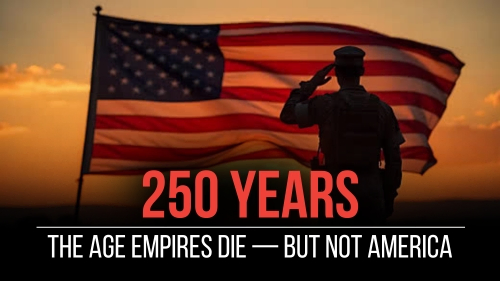
250 Years: The Age Empires Die — But Not America

In 1976, a decorated British general named Sir John Bagot Glubb sat down and did something no historian before him had done; he compared a series of ancient and modern empires and concluded that their average lifespan was ten generations, about 250 years, and that, despite great geographic, technological, religious, and cultural differences, all empires follow a general pattern as they expand, develop, and finally decline and collapse.
Rome. The Ottomans. The Arab Caliphate. The British Empire. All of them rose with fire and faith and fell with comfort and corruption, and all of them did it on roughly the same schedule.
In 2026, the United States of America turns 250 years old, and thus the greatest test of her exceptionalism.
The Clock No One Wants to Read
According to Glubb, each superpower comes onto the stage of history, makes a unique and tremendous impact on the world, and after an average lifespan of 250 years disappears from the world stage, making place for another empire.
Like a living being, the empire goes through different stages or “Ages” of development: the Age of Pioneers, the Age of Conquests, the Age of Commerce, the Age of Affluence, the Age of Intellect, and finally, the Age of Decadence.
This is a tried and true pattern so consistent across three thousand years of human civilization that Glubb called it the fate of empires.
So where does America fall in that sequence? By every honest measure, the answer is the final stage, the Age of Decadence.
The Age of Decadence arrives when civil dissensions arise and political factions fight each other over the leftovers rather than collaborating to repair what is breaking. An atmosphere of pessimism and frivolity arises. People live for themselves and for the moment, thus accelerating the breaking apart of the empire.
Sound familiar?
The characteristics of a falling civilization include frivolity, love of money instead of duty, excessive reverence for celebrities, and the rise of intellect over action.
In ancient Roman this was known as panem et circenses, “bread and circuses.” This was the policy of keeping people comfortable and distracted so that institutions are never held accountable. Thus, as the colosseum roared with cheers, Rome rotted.
Most sobering of all is what Glubb identified as the true cause of collapse: the survival of a nation depends basically on the loyalty and self-sacrifice of its citizens. The impression that the situation can be saved by mental cleverness, without unselfishness or human self-dedication, can only lead to collapse.
Glubb argued that empires don’t fall from external enemies, they fall from internal collapse of character.
The Exceptional Nation and Its Exceptional Foundation
America’s fall isn’t inevitable, but we must ask the question: what made America exceptional in the first place? And the answer is inseparable from its Christian foundation.
While America didn’t have a Christian founding in the sense of creating a theocracy, its founding was deeply shaped by Christian moral truths. There are, after-all, dozens of references to the Bible found throughout the U.S. Constitution.
The Founders, whatever their varying personal theologies, built their framework of liberty on a foundation that assumed a moral universe, one governed by a Creator who endowed men with rights that no government could legitimately take away. That conviction didn’t come from philosophy alone, it came from the Bible.
The vast majority of America’s Founders were God-fearing men, and most were Christians with many of them regularly and openly expressing their personal faith. Men such as Benjamin Rush, Samuel Adams, Patrick Henry, John Jay, John Witherspoon, and John Hancock.
Mountains of evidence exist that prove America was founded upon the biblical principles of the Christian faith, and it was this Christian foundation that quickly fashioned America into a moral, economic, cultural, and military global leader.
American exceptionalism wasn’t about geography, or military might, or economic dominance. Those were just outcomes. The source was something much deeper; a people who believed they were under God, accountable to God, and called by God to build something the world had never seen. The very architecture of American liberty includes the dignity of every person, the limits on government power, the accountability of leaders, the protection of conscience, all of which flow directly from a biblical worldview.
When that worldview erodes, the architecture can no longer stand. Whilst some will label my statement as a mere opinion, the truth is that this is what three thousand years of history are trying to tell us.
What Collapse Actually Looks Like
Many Americans assume collapse means an overnight catastrophe where armies at the gates and the lights go out, but that isn’t how empires usually end. Rome didn’t disappear in a day, it faded across generations, hollowed out from within long before the barbarians ever arrived. The institutions remained standing but they simply stopped meaning anything.
That’s the collapse we should fear not the dramatic fall, but the quiet surrender. The moment when courts lose legitimacy, when elections feel like theater, when churches are empty and families are fractured, and a generation grows up with no story to tell about who they are or why it matters.
We aren’t watching America disappear, we’re watching it drift. We’re comfortable, distracted, and increasingly unable to command the moral clarity that built it.
Watchmen on the Walls
The prophet Ezekiel was given a charge that resonates with our present age: “Son of man, I have made you a watchman for the people of Israel; so hear the word I speak and give them warning from me.” (Ezekiel 33:7)
Christians in America are called to be exactly that, watchmen on the walls of our cities, our neighborhoods, our schools, and our culture. We were never called to be passive observers waiting for someone else to sound the alarm. Nor were we called to be consumers of the same entertainment and distraction that is softening the civilization around us.
Watchmen: people who see clearly, speak honestly, and refuse the comfort of silence.
The church has, at its best moments in history, been the conscience of civilization. It ended the slave trade in Britain. It built the hospitals and universities of the Western world. It gave literacy to the poor and dignity to the forgotten. When it retreated from the public square, something irreplaceable went with it.
The Age of Decadence doesn’t have to be the final chapter but turning the page requires people who are willing to live differently with sacrifice over comfort, service over self, and truth over the applause of culture.
The One Variable History Cannot Account For
Here’s what Glubb’s brilliant, sobering framework ultimately cannot contain: God.
Every empire he studied was subject to the ordinary laws of human nature. They rose on virtue and fell on vice, and nothing interrupted the cycle because nothing could.
America, however, was founded by men who believed, however imperfectly they lived it out, that this nation’s story was not merely a human one. That there was a divine hand in its founding, and that the same hand could intervene in its fate.
The ancient promise of 2 Chronicles 7:14 wasn’t written to an empire but to a people: “If my people, who are called by my name, will humble themselves and pray and seek my face and turn from their wicked ways, then I will hear from heaven, and I will forgive their sin and will heal their land.”
Notice what it doesn’t say. It doesn’t say: “if the right politicians win,” “if the economy recovers,” or “if the culture improves.” The condition is entirely internal: humility, prayer, repentance, and turning. It’s the precise opposite of the decadence Glubb described and it’s a condition that no general, or legislature, or president can manufacture. Only a people can choose it.
History says America’s time is up, that the pattern is clear, the clock has run out, and the symptoms are undeniable but history has never had to reckon with 2 Chronicles 7:14.
The fate of empires may be fixed but America’s fate is not. What it comes down to is if we, the people, are willing to be the variable that changes everything.
SUPPORT MATTEA’S WORK
- Tune into The Mattea Merta Podcast
- Follow her on Twitter and Instagram
- Fund the mission through CashApp or PayPal: @matteamerta
CLICK HERE for more posts by Mattea Merta.
Thank you for your support.
If you appreciate the work we do to spread the good news of Jesus Christ, please consider giving a gift to help us continue this work. Maranatha!
Click an icon below to share this post.



All articles, including blogs and guest articles, published on Revival Nation News are owned by Revival Nation and Revival Nation News. The use of any content created and published by Revival Nation News may be quoted but attribution is required.
Portions of Revival Nation News articles may be used for reprint and republish purposes, but Revival Nation News MUST BE CREDITED.
All reprinted or republished articles must:
(1) Identify the author of the article.
(2) Contain the Revival Nation News byline at the beginning of the article and a hyperlink “Revival Nation News” to the respective article on the Revival Nation News website.
(3) Contain, at maximum, three paragraphs and then link back to the original article.

You might also like


Explore Categories