
3 Reasons Why Mary and Joseph Weren’t Illegal Aliens

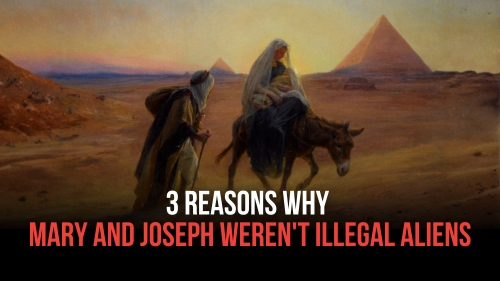
In recent years, political commentators and pastors alike have attempted to draw parallels between the biblical story of Mary and Joseph traveling to Bethlehem and modern-day illegal immigration into the United States. They portray the couple as “migrants” or even “illegal aliens” to argue in favor of more lenient policies toward those who enter countries unlawfully. However, this interpretation completely distorts the historical and biblical context of the Nativity story as described in the Gospel of Luke.
In no way were Mary and Joseph not fleeing persecution at that point, nor were they illegally crossing international borders without authorization. Instead, they were law-abiding subjects of the Roman Empire, fulfilling a legal obligation.
Below, we explore three key reasons why this modern narrative doesn’t hold up, grounding it all in the historical realities of the time.
Reason 1: They Were Complying with a Mandatory Imperial Census Decree
The primary reason for Mary and Joseph’s journey from Nazareth to Bethlehem was a census ordered by Caesar Augustus, the emperor of Rome. According to Luke 2:1-4, “In those days Caesar Augustus issued a decree that a census should be taken of the entire Roman world… And everyone went to their own town to register.” Joseph, being of the lineage of David, traveled to Bethlehem, the city of David, to comply with this requirement. This wasn’t a voluntary migration or an attempt to evade authorities; it was direct obedience to Roman law.
Historically, censuses in the Roman Empire were conducted for taxation and administrative purposes, often requiring people to register in their ancestral or familial hometowns. While there is scholarly debate about the exact timing of this particular census (often linked to the Census of Quirinius around 6 AD, though Jesus’ birth is dated earlier, around 4-6 BC), the point remains that such decrees were standard practice under Roman rule.
Mary and Joseph weren’t breaking laws; they were following them to the letter, much like U.S. citizens today might file taxes or register for the draft. Equating their compliance with the law of the land to illegal border crossings ignores the lawful intent and imperial mandate behind their trip.
Reason 2: Both Nazareth and Bethlehem Were Under the Same Roman Control
Mary and Joseph weren’t crossing from one sovereign nation to another, they were moving within the boundaries of the vast Roman Empire, which spanned from Britain to the Middle East.
Nazareth, located in the region of Galilee, and Bethlehem, in Judea, were both part of this empire during the late first century BC. At the time of Jesus’ birth, the area was under the rule of Herod the Great, a client king appointed by Rome, who governed Judea (including Galilee) on behalf of the emperor.
This meant there were no “international borders” to illegally cross; it was akin to traveling from one U.S. state to another today, such as from New York to Pennsylvania. The Roman Empire’s administrative divisions didn’t require passports or visas for internal movement, especially for something as routine as a census registration. Even after Herod’s death in 4 BC, when Galilee fell under Herod Antipas and Judea became a direct Roman province, the overarching authority remained Roman.
Portraying this as migration across hostile or foreign territories misrepresents the unified imperial control, which facilitated such travels without the need for clandestine entry.
Reason 3: Their Journey Was Not About Seeking Unauthorized Entry or Economic Opportunity
Unlike modern claims of illegal aliens entering countries for asylum or work without proper documentation, Mary and Joseph’s trip had no such motives. They weren’t refugees fleeing immediate danger during the census journey (that came later, with the flight to Egypt to escape Herod’s massacre of infants). Nor were they seeking better economic prospects or evading authorities. Bethlehem was Joseph’s ancestral home, and the travel was a temporary obligation, after which they intended to return to Nazareth.
In contrast, illegal immigration today often involves knowingly violating national laws, such as crossing borders without inspection or overstaying visas. The Roman system, while oppressive, didn’t classify internal census compliance as illicit movement.
By twisting this story, proponents overlook that Mary and Joseph exemplified civic duty within their legal framework, not rebellion against it. This distinction is crucial: supporting immigration reform is one thing, but using a biblical account of lawful obedience to justify law-breaking distorts both history and scripture.
In conclusion, the story of Mary and Joseph’s journey to Bethlehem is one of faithfulness to God and adherence to earthly authorities, not a tale of illegal migration.
By understanding the Roman context, we see just how far removed it is from contemporary debates. This doesn’t diminish the Nativity’s message of hope and humility but reminds us to approach sacred texts with accuracy rather than political agendas.
Thank you for your support.
If you appreciate the work we do to spread the good news of Jesus Christ, please consider giving a gift to help us continue this work. Maranatha!
Click an icon below to share this post.
All articles, including blogs and guest articles, published on Revival Nation News are owned by Revival Nation and Revival Nation News. The use of any content created and published by Revival Nation News may be quoted but attribution is required.
Portions of Revival Nation News articles may be used for reprint and republish purposes, but Revival Nation News MUST BE CREDITED.
All reprinted or republished articles must:
(1) Identify the author of the article.
(2) Contain the Revival Nation News byline at the beginning of the article and a hyperlink “Revival Nation News” to the respective article on the Revival Nation News website.
(3) Contain, at maximum, three paragraphs and then link back to the original article.

You might also like


Explore Categories